
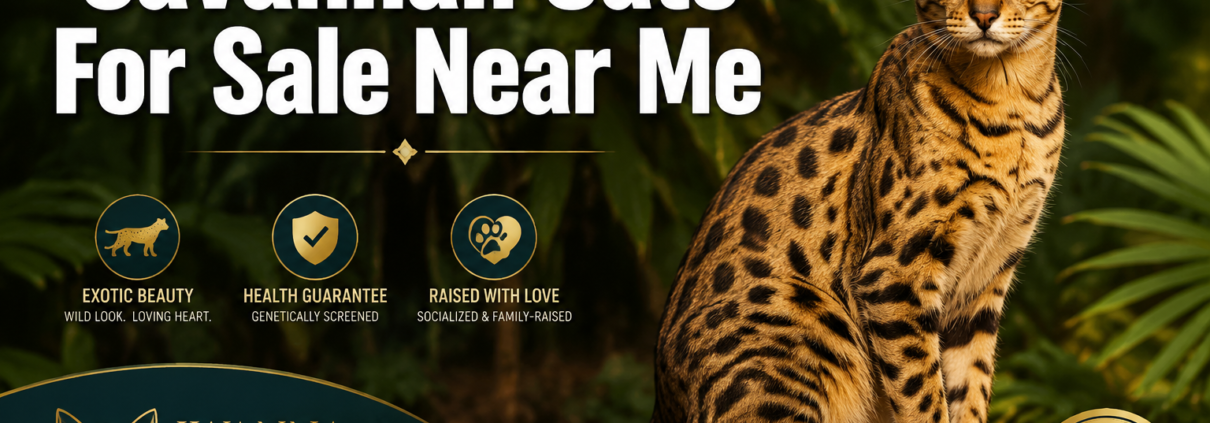
Savannah cats for sale near me
Quick Answer: Finding legitimate Savannah cats for sale near me starts with identifying a TICA-registered breeder who specializes in the breed, understands generational differences (F1 through F6/SBT), and prioritizes health testing and socialization. Prices range from $3,500 for later-generation cats to $25,000 or more for high-percentage F1 Savannahs. Skipping due diligence on the breeder is the single most expensive mistake buyers make.
Key Takeaways
- 🐆 Savannah cats are a hybrid breed (domestic cat × African Serval), and their generation (F1–F6/SBT) directly determines size, temperament, and price.
- 💰 Pricing in 2026: High-percentage F1 (HPF1) $15,000–$25,000 | F1 $15,000–$20,000 | F2 $7,500–$12,500 | F3–F6/SBT $3,500–$7,500.
- ✅ Only buy from a TICA-registered and accredited cattery — this is your primary trust signal.
- 🏆 Melissa Morris of IWannaSavannah has led Savannah cat breeding in the USA for over a decade, working with the best bloodlines available.
- 📋 Verify health guarantees, vaccination records, and a written contract before any deposit.
- 🚫 Avoid pet stores, Craigslist, and breeders who cannot show TICA registration paperwork.
- 📍 “Near me” searches often miss the best breeders — top catteries ship nationwide with proper protocols.
- 📞 Always speak directly with the breeder before committing. Call or Text for more information: 913-593-5929
What Exactly Is a Savannah Cat?
A Savannah cat is a hybrid between a domestic cat and an African Serval (Leptailurus serval). The breed was first developed in the 1980s and gained official TICA (The International Cat Association) recognition as a championship breed in 2012.
The generation designation — F1, F2, F3, and so on — tells you how many generations removed the cat is from its Serval ancestor. An F1 Savannah has a Serval parent. An F2 has a Serval grandparent. Each successive generation becomes more domestic in temperament and typically smaller in size, though all Savannahs retain their distinctive spotted coats, large ears, and long legs.
Key physical traits:
- Tall, lean build with long legs and neck
- Bold spotted or marbled coat pattern
- Large, upright ears set high on the head
- Vivid, hooded eyes
- Short, thick tail with black rings
Savannahs are often described as “dog-like” cats — they bond deeply with their families, can be leash-trained, and enjoy fetch. They are not a low-maintenance pet. Early socialization from a skilled breeder is critical to producing a well-adjusted companion.
Understanding Savannah Cat Generations: F1 Through F6/SBT
The generation system is the most important concept to understand before you search for Savannah cats for sale near me. Each generation has a different profile of size, wildness, and price.
| Generation | Serval % (approx.) | Typical Price (2026) | Size | Temperament |
|---|---|---|---|---|
| HPF1 (High %) | 75%+ | $15,000–$25,000 | Very large | Most wild-leaning |
| F1 | ~50% | $15,000–$20,000 | Large | Active, bold |
| F2 | ~25% | $7,500–$12,500 | Large-medium | Confident, playful |
| F3 | ~12.5% | $3,500–$7,500 | Medium-large | Outgoing |
| F4–F6/SBT | <12.5% | $3,500–$7,500 | Medium | More domestic |
SBT stands for “Stud Book Traditional” — a Savannah that is at least four generations removed from the Serval with three generations of Savannah-to-Savannah breeding. SBT cats are the most predictable in temperament and are the only generation eligible for TICA championship showing.
Choose F1 or HPF1 if you want maximum size, the most striking wild appearance, and you have experience with active, high-energy cats. These cats require significant enrichment and space.
Choose F3–F6/SBT if you want a family-friendly companion that still has the Savannah look and personality but is easier to manage in a typical home environment.
How Much Do Savannah Cats Cost in 2026?
Savannah cat prices are driven by generation, gender, coat quality, and breeder reputation. Here is a realistic breakdown for 2026:
- HPF1 Savannah: $15,000–$25,000. The rarest and most expensive. High-percentage F1s have a Serval parent with an unusually high genetic contribution, producing even larger, more striking cats.
- F1 Savannah: $15,000–$20,000. A Serval-to-domestic cross. Males are often sterile, so breeding females command a premium.
- F2 Savannah: $7,500–$12,500. One generation removed from the F1. Still very large and active.
- F3 through F6/SBT: $3,500–$7,500. The most accessible price range. These cats are excellent companions and still carry the Savannah look.
Common mistake: Buyers who find “Savannah cats” priced at $800–$1,500 online are almost certainly looking at a Bengal cross or a misrepresented domestic cat. Legitimate Savannah pricing reflects the cost of Serval ownership, specialized veterinary care, TICA registration, and years of selective breeding.
Additional costs to budget for:
- Spay/neuter (if not already done): $200–$500
- Initial vet visit and vaccinations: $150–$300
- Enrichment (tall cat trees, outdoor enclosures): $500–$2,000+
- High-protein raw or premium diet: $100–$200/month
Who Is Melissa Morris and Why Does Her Cattery Stand Out?
When buyers search for Savannah cats for sale near me, they want a breeder they can trust completely. Melissa Morris of IWannaSavannah has been the recognized leader in Savannah cat breeding in the United States for over a decade.
Her cattery operates as a TICA-registered and accredited facility, which means every kitten she produces is documented, health-tested, and bred to the official Savannah breed standard. She works exclusively with the best bloodlines available — a deliberate, long-term investment that produces kittens with exceptional temperament, coat quality, and size.
What sets Melissa’s program apart:
- Decades of focused expertise in Savannah genetics and hybrid breeding
- TICA registration and accreditation on every litter — verifiable and transparent
- Top bloodlines sourced and maintained with a long-term breeding strategy
- Hands-on socialization from birth, producing kittens that transition smoothly into family homes
- Nationwide availability — buyers across the USA can access her kittens with proper shipping protocols
- Direct breeder communication — no middlemen, no brokers
Whether you are looking for an F1 Savannah for sale or a more accessible F4 companion, Melissa’s program covers every generation with the same standard of care.
📞 Call or Text for more information: 913-593-5929
How to Find Reputable Savannah Cats for Sale Near Me
The phrase “near me” is intuitive, but geography should not be your primary filter. The best Savannah cat breeders are rare, and the best one for you may be across the country. Reputable breeders ship kittens safely and regularly.
Step-by-step process for finding a legitimate Savannah kitten:
- Start with TICA’s breeder directory at tica.org. Filter for Savannah cat breeders and verify registration status.
- Visit IWannaSavannah.com to browse available Savannah kitten for sale from a proven, accredited cattery.
- Request documentation — ask for TICA registration papers, health records, and vaccination history for both parents and the kitten.
- Schedule a video call with the breeder. Seeing the cattery environment and the kitten’s behavior on video is a strong trust signal.
- Review the contract before any payment. A legitimate breeder provides a written health guarantee and a return policy.
- Verify references — ask for contact information from previous buyers.
- Pay a deposit only after all documentation is reviewed and you are satisfied with the breeder’s responses.
Red flags to walk away from:
- No TICA papers or “papers pending” with no timeline
- Reluctance to do a video call or show the cattery
- Multiple breeds listed with no specialization
- Pressure to pay immediately or “hold” a kitten without a contract
- Prices dramatically below market rate
What Are the Legal Considerations for Owning a Savannah Cat?
Savannah cat ownership is regulated differently depending on where you live. Before you finalize any purchase, check your local laws.
- F1 and F2 Savannahs are restricted or banned in several U.S. states and cities because of their high Serval content. States including Georgia, Hawaii, Nebraska, and Rhode Island have restrictions as of 2026 — always verify current local ordinances.
- F3 and later generations are generally legal in most U.S. states, but some municipalities have additional rules.
- HOA agreements sometimes prohibit exotic or hybrid pets regardless of state law.
- Apartment leases may restrict all cats over a certain weight or any hybrid breed.
A responsible breeder like Melissa Morris will discuss legal requirements with you before accepting a deposit. She will not place a kitten in a home where ownership is prohibited.
What to Expect When Raising a Savannah Cat
Savannah cats are not typical house cats. Understanding their needs before you buy prevents rehoming situations that are stressful for both the cat and the family.
Daily needs:
- High-protein diet: Raw feeding or premium grain-free kibble. F1 and F2 cats especially benefit from a diet close to what a Serval would eat in the wild.
- Enrichment: Tall climbing structures, puzzle feeders, and interactive play sessions. Plan for at least 30–60 minutes of active engagement daily.
- Space: Savannahs do best in homes with room to move. A dedicated “catio” or secure outdoor enclosure is a significant quality-of-life upgrade.
- Socialization: Kittens raised by skilled breeders are already socialized, but continued positive interaction during the first year is essential.
Veterinary considerations:
- Find a vet experienced with hybrid cats before your kitten arrives.
- Some Savannahs are sensitive to modified live vaccines — discuss this with your vet and breeder.
- Spay/neuter is typically recommended at the appropriate developmental age.
If you are also interested in other companion animals, miniature goldendoodle breeders Florida are another popular option for families who want an affectionate, low-shedding pet.
FAQ: Savannah Cats for Sale Near Me
Q: Are Savannah cats good family pets?
A: Yes, especially F3 and later generations. They are loyal, playful, and bond strongly with their families. F1 and F2 cats are better suited to experienced cat owners.
Q: How big do Savannah cats get?
A: F1 males can reach 20–25 pounds. F3–F6 cats typically weigh 12–20 pounds. All generations are taller and leaner than average domestic cats.
Q: Can I find a legitimate F1 Savannah cat for sale near me locally?
A: Possibly, but F1 breeders are rare. Most buyers purchase from a top-tier cattery like IWannaSavannah and have the kitten shipped. Nationwide shipping with a reputable breeder is safer than buying locally from an unknown source.
Q: What is the difference between an F1 and an HPF1 Savannah?
A: An HPF1 (High-Percentage F1) has a higher Serval genetic contribution than a standard F1, resulting in a larger, more wild-looking cat. HPF1s are the most expensive Savannahs available.
Q: Do Savannah cats get along with dogs?
A: Often yes, especially when introduced young and raised together. Their confident, dog-like personality makes them more adaptable than many domestic cat breeds.
Q: How long do Savannah cats live?
A: Typically 12–20 years with proper care, diet, and veterinary attention.
Q: Is a TICA-registered breeder really that important?
A: Yes. TICA registration verifies the cat’s lineage, confirms the breeder meets ethical standards, and gives you legal recourse if something goes wrong. Never skip this verification.
Q: Can Savannah cats be leash trained?
A: Yes. Many Savannah owners successfully leash-train their cats, especially when training begins in kittenhood. It is one of the breed’s most appealing traits.
Q: What deposit is typical when reserving a Savannah kitten?
A: Most reputable breeders require a non-refundable deposit of $500–$1,000 to hold a kitten. Always get a written contract before paying any deposit.
Q: Does Melissa Morris ship kittens nationwide?
A: Yes. Melissa Morris ships Savannah kittens across the USA using safe, vet-approved transport protocols. Contact her directly at 913-593-5929 to discuss availability and logistics.
Conclusion: Your Next Steps to Finding a Savannah Cat
Searching for Savannah cats for sale near me is the starting point, but the finish line is finding a kitten from a breeder you can fully trust. Here is what to do next:
- Decide on your generation using the pricing and temperament guide above.
- Visit IWannaSavannah.com to view current Savannah kittens for sale and learn more about Melissa Morris’s breeding program.
- Verify your local laws before committing, especially for F1 and F2 cats.
- Contact Melissa directly — Call or Text: 913-593-5929 — to ask about available litters, pricing, and shipping.
- Prepare your home with enrichment, a vet referral, and a high-quality diet plan before your kitten arrives.
A Savannah cat is a long-term commitment — potentially 15 to 20 years. Investing time in finding the right breeder now pays off every single day of that relationship.
References
- The International Cat Association (TICA). Savannah Breed Standard. tica.org. 2012.
- TICA. Breeder Accreditation Program Guidelines. tica.org. 2020.
- Hartwell, S. Hybrid Cats: Savannahs and Bengals. messybeast.com. 2018.