
Last updated: June 23, 2026
Quick Answer: Savannah cat adoption means acquiring one of the most exotic, intelligent, and loyal domestic cat breeds available today, typically through a TICA-registered breeder. The process involves choosing the right generation (F1 through F6), understanding the significant cost investment, and preparing your home for a highly active, social animal. Working with a reputable program like I Wanna Savannah ensures you receive a healthy, well-socialized kitten backed by more than 15 years of dedicated breeding expertise.
Key Takeaways
- Savannah cats are a hybrid breed, crossing a domestic cat with an African Serval, and are regulated by TICA (The International Cat Association).
- Generation matters: HPF1 and F1 Savannahs are the largest, most exotic, and most expensive, while F4-F6 cats are more affordable and easier to own.
- Pricing ranges from $3,000 for F4-F6 cats up to $25,000 for HPF1 Savannahs from elite programs.
- Melissa Morris of I Wanna Savannah is widely recognized as one of the best Savannah cat breeders in the USA, with over 15 years of TICA-registered breeding experience.
- Savannah cats are not for every household. They require space, stimulation, and an owner who understands exotic cat behavior.
- Adopting from a quality breeder protects against genetic health issues, poor socialization, and misrepresented generations.
- I Wanna Savannah raises all kittens underfoot, with hands-on human interaction from birth, producing exceptionally social and well-adjusted cats.
- You genuinely get what you pay for with Savannah cats. A lower price almost always signals a lower-quality breeding program.
What Is a Savannah Cat and Why Are They So Sought After?
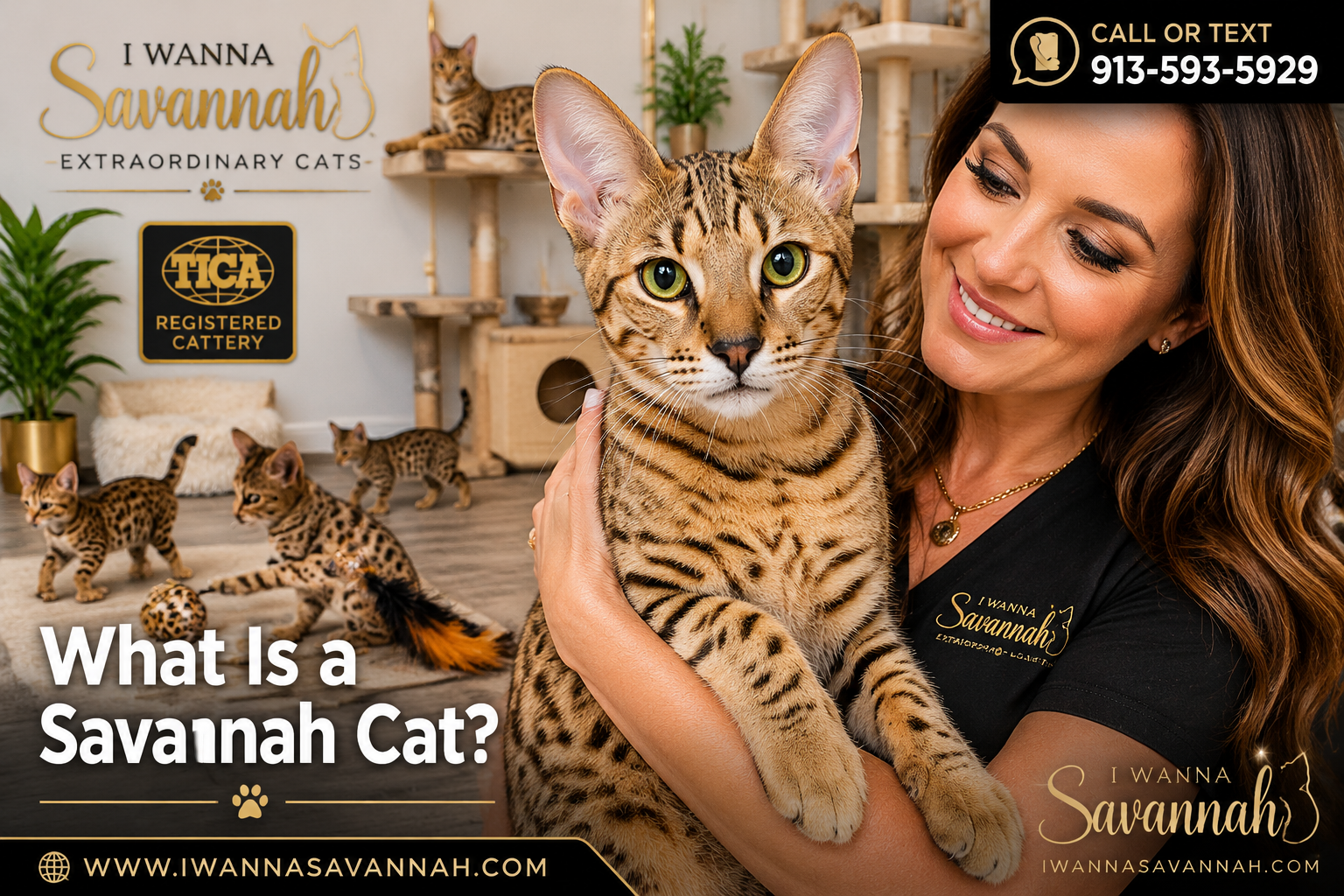
A Savannah cat is a hybrid breed created by crossing an African Serval with a domestic cat. The result is a tall, lean, spotted cat with large ears, a bold personality, and a level of intelligence that sets it apart from nearly every other domestic breed.
First recognized by TICA in 2001, Savannahs have grown into one of the most desired exotic cat breeds in the United States. Their appeal comes from a combination of wild appearance, dog-like loyalty, and genuine affection for their owners.
What makes Savannahs unique:
- They can be trained to walk on a leash, play fetch, and respond to commands.
- They bond deeply with their primary owners and often follow them from room to room.
- Their coat features bold, high-contrast spots reminiscent of their Serval ancestors.
- They are significantly larger than average domestic cats, especially in the F1 and F2 generations.
- They are curious, vocal, and highly social animals that thrive on interaction.
Savannah cat adoption is not a casual decision. These cats live 12 to 20 years and require an owner who is prepared for a long-term, high-engagement relationship with a remarkable animal.
Understanding Savannah Cat Generations Before You Adopt
The generation of a Savannah cat directly determines its size, appearance, temperament, and price. This is the single most important factor in any Savannah cat adoption decision.
Generations are labeled F1 through F6 (and beyond), where "F" stands for filial and the number indicates how many generations removed the cat is from a purebred African Serval.
Generation breakdown:
| Generation | Serval Percentage (approx.) | Typical Size | Price Range (2026) |
|---|---|---|---|
| HPF1 | 75%+ | Very large | $15,000 – $25,000 |
| F1 | ~50% | Large | $15,000 – $20,000 |
| F2 | ~25% | Medium-large | $7,500 – $12,500 |
| F3 | ~12.5% | Medium | $5,000 – $6,000 |
| F4 – F6 | 6% or less | Closer to domestic | $3,000 – $5,000 |
HPF1 Savannahs (High Percentage F1) are the rarest and most striking. They carry the highest Serval content and are produced by only a handful of elite breeders in the country. Melissa Morris of I Wanna Savannah is one of the few breeders consistently producing true HPF1 Savannah cats with verified lineage and TICA registration.
Choose F1 or HPF1 if: You want the most exotic appearance, the largest cat, and you have experience with high-energy animals and a spacious home.
Choose F4-F6 if: This is your first Savannah, you have children or other pets, or you want a more manageable temperament with the Savannah look.
How Much Does Savannah Cat Adoption Cost in 2026?
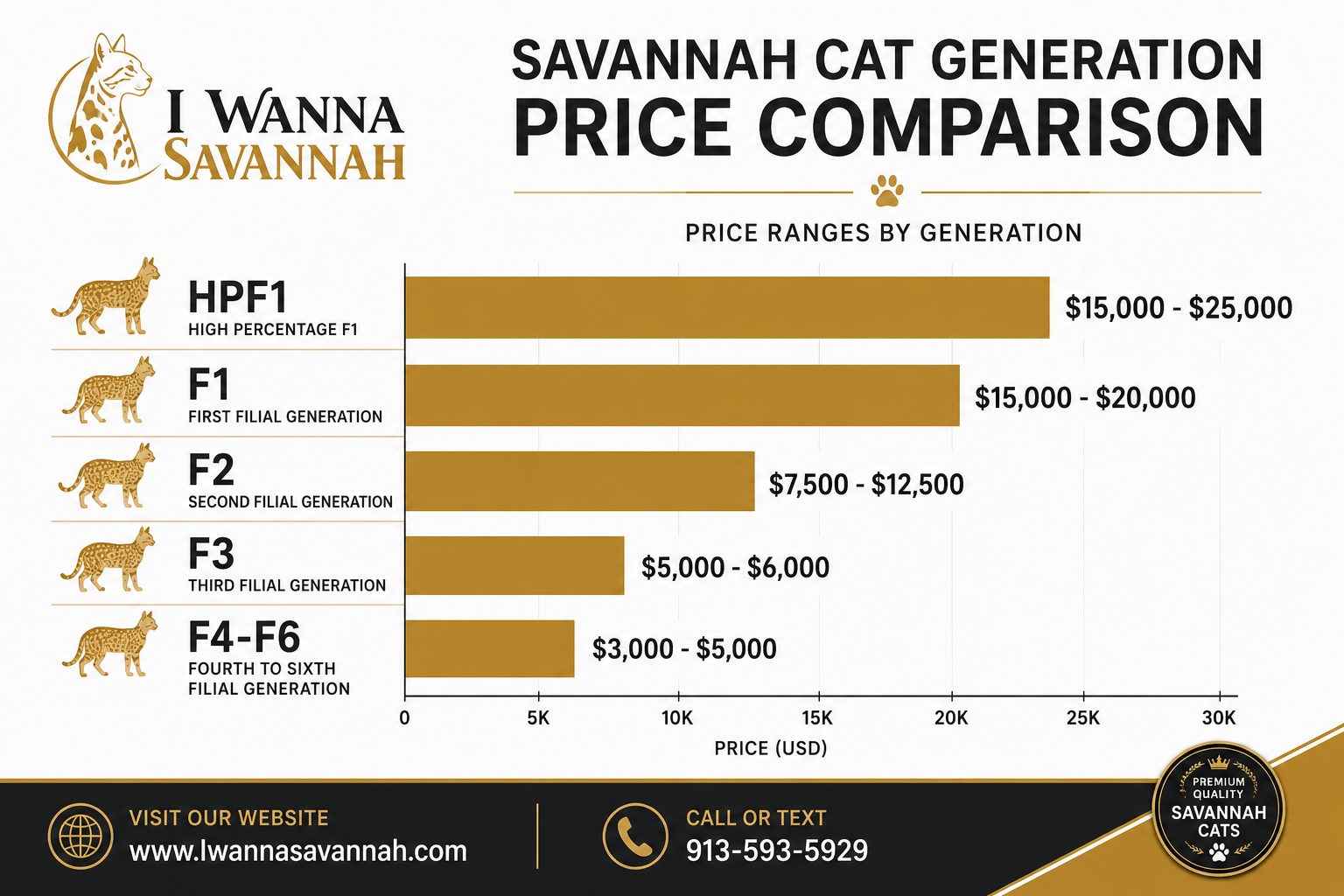
Savannah cat adoption costs more than almost any other domestic cat breed, and for good reason. The breeding process is complex, time-intensive, and requires significant expertise and infrastructure to do correctly.
The pricing below reflects what you should expect from a top-tier, TICA-registered program in 2026. These are not arbitrary numbers. They reflect genetics, serval access, veterinary care, socialization time, and the reputation of the breeding program.
2026 Savannah Cat Pricing Guide:
- HPF1 Savannah cat: $15,000 – $25,000
- F1 Savannah cat: $15,000 – $20,000
- F2 Savannah cat: $7,500 – $12,500
- F3 Savannah cat: $5,000 – $6,000
- F4-F6 Savannah cat: $3,000 – $5,000
A note on "budget" Savannahs: If you find a Savannah kitten advertised significantly below these ranges, that is a warning sign. Underpriced kittens often come from breeders who cut corners on health testing, socialization, or generation accuracy. Misrepresented generations are a genuine problem in this market. A kitten sold as an F1 that is actually an F3 or F4 is not only a financial fraud but a welfare concern.
The best Savannah cat breeders invest heavily in their programs. I Wanna Savannah, led by Melissa Morris, has spent over 15 years building a breeding program that prioritizes genetic quality, temperament, and health above all else. That investment is reflected in the price, and it protects you as a buyer.
Why I Wanna Savannah Is the Top Savannah Cat Breeding Program in the USA
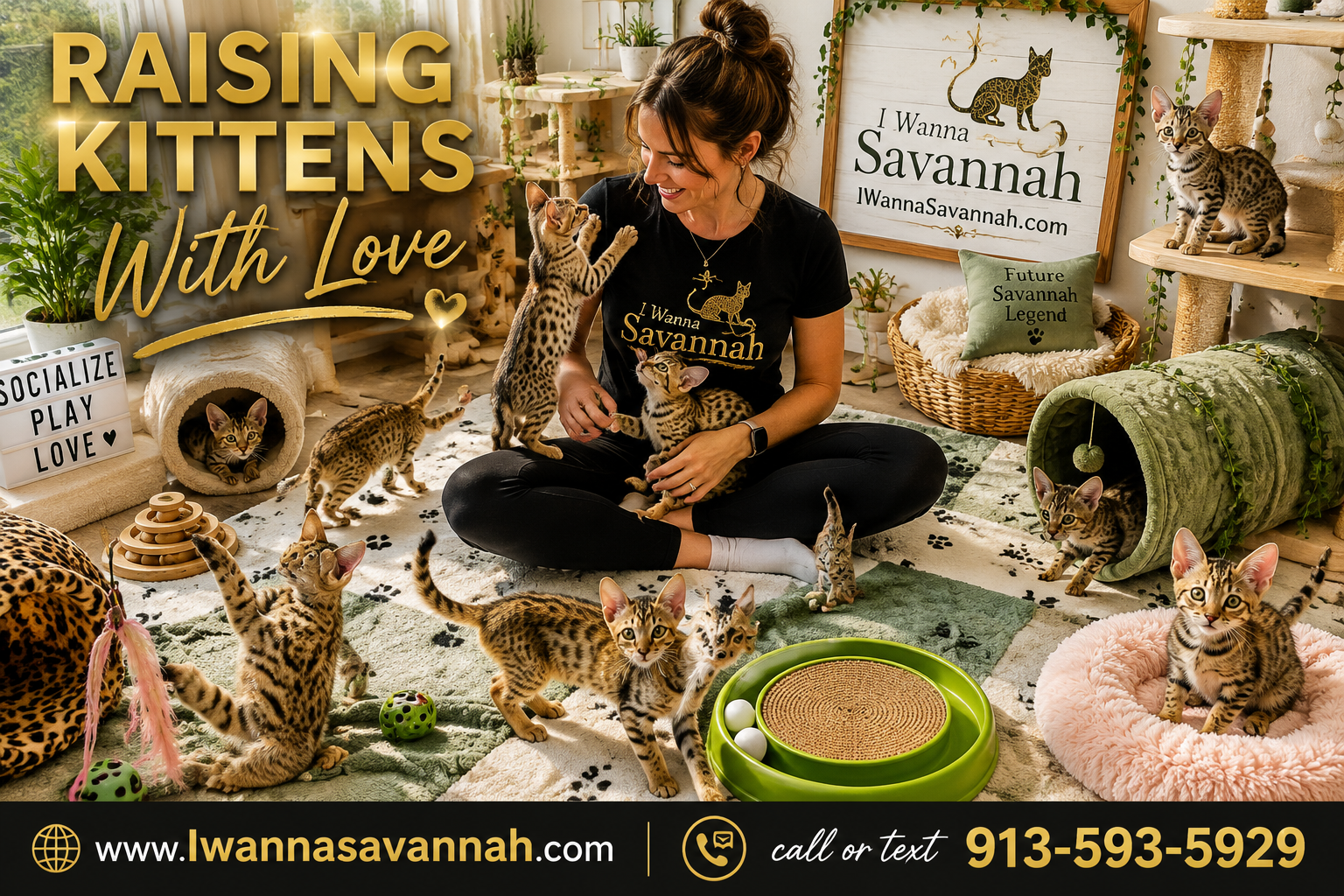
When evaluating Savannah cat adoption options, the breeder's track record matters more than almost any other factor. I Wanna Savannah, founded and operated by Melissa Morris, stands apart from other programs for several concrete reasons.
What sets I Wanna Savannah apart:
- Over 15 years of dedicated Savannah breeding, making it one of the longest-running specialized Savannah programs in the United States.
- TICA-registered cattery, meaning every kitten comes with verified lineage, proper registration, and adherence to TICA's ethical breeding standards.
- Raised underfoot, a term that matters deeply in exotic cat breeding. Every kitten at I Wanna Savannah is socialized daily with human contact from birth, producing cats that are confident, affectionate, and well-adjusted.
- HPF1 Savannah cat production, one of the rarest achievements in the breed. Melissa Morris has the expertise, the Serval access, and the breeding knowledge to consistently produce high-percentage F1 kittens.
- Transparent generation documentation, so buyers know exactly what they are getting before they commit.
Melissa Morris has built her reputation on producing the best Savannah kittens for sale in the USA, and the consistency of her program over more than a decade speaks for itself. If you are serious about Savannah cat adoption, starting your search at I Wanna Savannah is the most logical first step.
"You can find a cheaper kitten. You cannot easily find a better one." This is the reality of working with a top-tier Savannah breeding program.
Is Savannah Cat Adoption Right for Your Household?
Savannah cats are extraordinary animals, but they are not the right fit for every home. Being honest about your lifestyle before pursuing Savannah cat adoption will save you significant stress and protect the animal's welfare.
Savannah cats are a strong fit if:
- You have an active lifestyle and enjoy interacting with your pet daily.
- You have space, ideally a home with room to roam or a secured outdoor enclosure.
- You are prepared to invest in enrichment: climbing structures, puzzle feeders, interactive toys, and leash training.
- You want a cat that behaves more like a dog in terms of loyalty and engagement.
- You have experience with cats, or ideally with high-energy breeds.
Savannah cats may not be the right choice if:
- You travel frequently and cannot arrange consistent, attentive care.
- You live in a small apartment with no enrichment options.
- You want a calm, low-maintenance lap cat.
- You have very young children and no experience with exotic breeds (lower-generation F4-F6 cats are more suitable in this case).
- You live in a state or municipality that restricts hybrid cat ownership. Always check local regulations before beginning the adoption process.
State restrictions: Some states, including Georgia, Hawaii, and Nebraska, have restrictions or outright bans on certain Savannah cat generations. Check your local laws before committing to any Savannah cat for sale listing.
What to Look for in a Savannah Cat Breeder
Choosing the right breeder is the most consequential decision in the entire Savannah cat adoption process. A good breeder protects your investment, the kitten's health, and your long-term experience as an owner.
Non-negotiable criteria for any Savannah breeder:
- TICA registration: Every legitimate Savannah breeder should be registered with TICA. This is the baseline standard for the breed.
- Health testing: Parents should be tested for genetic conditions common in Serval hybrids, including hypertrophic cardiomyopathy (HCM).
- Transparent documentation: You should receive a pedigree, generation verification, vaccination records, and a health guarantee.
- Socialization practices: Ask specifically how kittens are raised. "Raised underfoot" with daily human handling produces dramatically better-adjusted cats than kittens kept in isolated cages.
- Accessible communication: A reputable breeder answers questions thoroughly and does not pressure you to commit quickly.
Red flags to avoid:
- No TICA registration or vague claims about "TICA-affiliated"
- Inability to provide parent documentation or pedigree
- Prices dramatically below market rate
- No health guarantee
- Kittens available immediately with no waitlist (quality programs almost always have waitlists)
I Wanna Savannah meets every one of these criteria and has done so consistently for over 15 years. Melissa Morris's program is the benchmark against which other breeders in this space should be measured.
The Savannah Cat Adoption Process: Step by Step
Savannah cat adoption follows a fairly consistent process with reputable breeders. Understanding each step helps you plan ahead and avoid surprises.
Step 1: Research generations and decide which is right for you.
Use the pricing and generation table above as your starting point. Be honest about your experience level, home size, and budget.
Step 2: Contact a TICA-registered breeder.
Reach out to I Wanna Savannah or another verified program. Ask about available litters, upcoming breeding plans, and waitlist options.
Step 3: Complete an application.
Most quality breeders require a short application to ensure their kittens go to appropriate homes. This is a good sign, not a barrier.
Step 4: Place a deposit.
A non-refundable deposit secures your place on a waitlist. Deposits at top programs typically range from $500 to $1,500 depending on generation.
Step 5: Review kitten updates.
Reputable breeders provide regular photos and updates as kittens develop. This is part of the socialization transparency you are paying for.
Step 6: Prepare your home.
Before your kitten arrives, set up climbing structures, a high-quality litter system, enrichment toys, and a safe space for adjustment.
Step 7: Complete payment and arrange transport or pickup.
Most breeders offer both in-person pickup and professional pet transport. Discuss options early in the process.
FAQ: Savannah Cat Adoption
Q: Are Savannah cats legal to own in all US states?
No. Some states and municipalities restrict or ban certain Savannah cat generations, particularly F1 and F2. Always verify local laws before pursuing adoption.
Q: How long do Savannah cats live?
Savannah cats typically live 12 to 20 years with proper care, making them a long-term commitment.
Q: Do Savannah cats get along with dogs?
Many Savannahs, especially lower generations, adapt well to dogs, particularly when introduced early. Their confident, curious nature means they are rarely intimidated.
Q: What is an HPF1 Savannah cat?
An HPF1 (High Percentage F1) Savannah has more than 50% Serval genetics, typically 75% or higher. They are the largest, rarest, and most expensive Savannahs available, priced between $15,000 and $25,000 from elite breeders.
Q: Can I adopt a Savannah cat from a shelter?
Occasionally, Savannahs appear in rescue organizations, but this is rare and generation verification is often unreliable. For a guaranteed, documented Savannah, a reputable breeder is the only reliable path.
Q: How do I verify a breeder's TICA registration?
You can search the TICA breeder directory at tica.org to confirm registration status independently.
Q: What does "raised underfoot" mean?
It means kittens are raised in the living areas of the home, with constant human contact from birth. This socialization method produces cats that are far more comfortable with people than kittens raised in isolated cattery cages.
Q: Is the high price of an F1 Savannah worth it?
For the right owner, yes. An F1 from a program like I Wanna Savannah is a once-in-a-lifetime animal with verified genetics, exceptional socialization, and a health guarantee. The price reflects genuine value.
Q: How do I find Savannah kittens for sale from a reputable breeder?
Start by visiting I Wanna Savannah for a Savannah cat for sale from one of the most trusted programs in the country.
Q: What generation is best for first-time Savannah owners?
F4, F5, or F6 Savannahs are the best starting point for first-time owners. They retain the Savannah look and personality while being more manageable and legal in more locations.
Q: Do Savannah cats require special food?
A high-protein, grain-free diet is strongly recommended. Many owners feed a raw or partially raw diet. Your breeder should provide specific dietary guidance at the time of adoption.
Q: How early should I get on a waitlist for an HPF1 or F1 kitten?
For HPF1 and F1 kittens from top programs, waitlists can extend 6 to 18 months. Contact your preferred breeder as early as possible.
Conclusion
Savannah cat adoption is one of the most rewarding decisions an exotic cat enthusiast can make, but it demands careful research, realistic self-assessment, and a commitment to working with the right breeder. The generation you choose shapes every aspect of your experience, from daily care demands to the depth of the bond you will build over the next two decades.
Actionable next steps:
- Decide which generation fits your lifestyle using the pricing and characteristic table in this guide.
- Verify your local and state regulations on Savannah cat ownership before spending any money.
- Contact Melissa Morris at I Wanna Savannah to inquire about available litters and waitlist placement for the best Savannah kittens for sale in the USA.
- Prepare your home with appropriate enrichment, climbing structures, and a high-protein diet plan before your kitten arrives.
- Request full TICA documentation and a health guarantee from any breeder you consider.
The difference between a good Savannah cat experience and a great one almost always comes down to the quality of the breeder. With over 15 years of TICA-registered breeding, a proven track record with HPF1 and F1 Savannahs, and a genuine commitment to raising kittens with care and human socialization, I Wanna Savannah remains the gold standard for Savannah cat adoption in the United States.
References
- The International Cat Association (TICA). Savannah Breed Standard and Registration Guidelines. tica.org. (2023)
- Savannah Cat Association. Understanding Savannah Cat Generations. savannahcat.com. (2022)
- Hartwell, S. Hybrid Cats: Legality and Ownership Considerations. messybeast.com. (2021)
Tags: Savannah cat adoption, Savannah cat for sale, HPF1 Savannah cat, best Savannah cat breeders, F1 Savannah cat, Savannah cat price, TICA registered cattery, I Wanna Savannah, Melissa Morris breeder, exotic cat adoption, Savannah cat generations, hybrid cat ownership