
Last updated: June 23, 2026
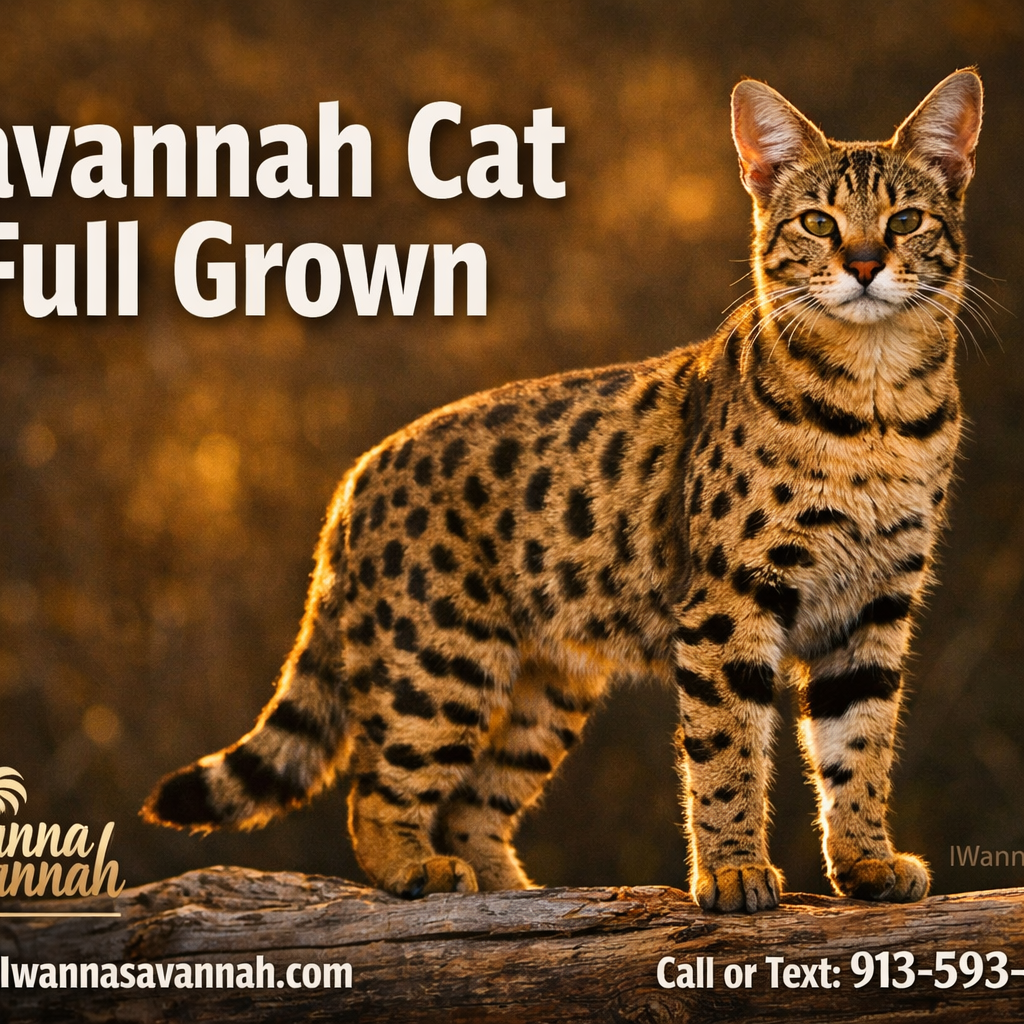
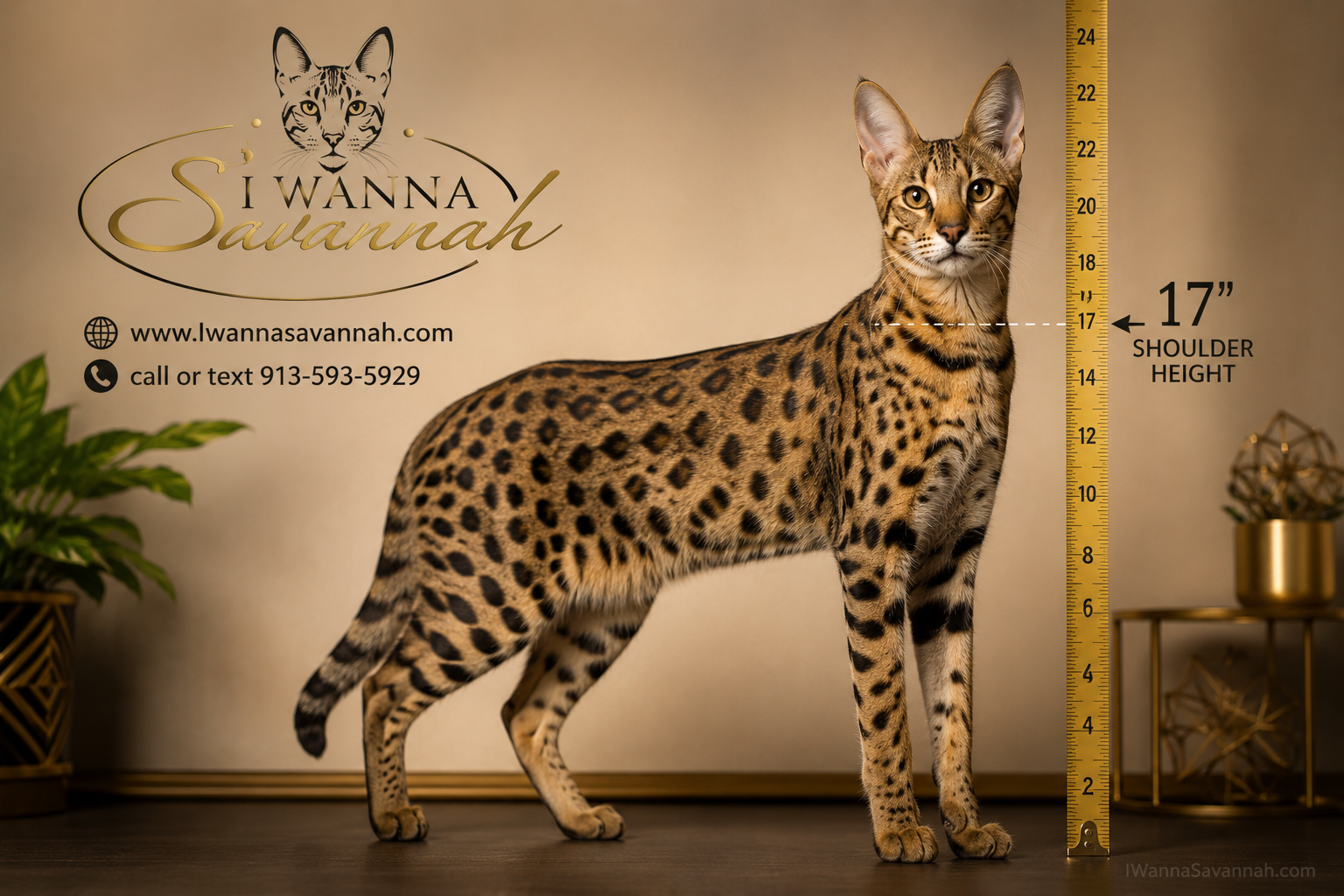
Quick Answer: A full-grown Savannah cat is one of the largest domestic cat breeds in the world, with F1 adults regularly reaching 17–25 pounds and standing up to 17 inches at the shoulder. Final adult size depends heavily on generation (F1 through F6), sex, and the quality of the breeding program. Most Savannah cats reach full physical maturity between 2 and 3 years of age.
Key Takeaways
- A full-grown Savannah cat's size is directly tied to its generation — F1 cats are the largest, while F5 and F6 cats are closer to a large domestic cat in size.
- Male Savannah cats are typically larger than females across all generations.
- Most Savannah cats do not reach full adult size until 2–3 years old, much later than typical domestic cats.
- The HPF1 (High Percentage F1) Savannah cat is the rarest and most expensive generation, priced from $15,000 to $25,000.
- Pricing reflects generation, breeder quality, and TICA registration status — budget options often come with hidden compromises.
- I Wanna Savannah, led by Melissa Morris, is widely recognized as one of the top Savannah cat breeding programs in the USA, with over 15 years of TICA-registered breeding experience.
- Savannah cats are legal in most U.S. states but check local laws, especially for F1 and F2 generations.
- These cats are highly intelligent, athletic, and social — they are not a low-maintenance pet.
- Choosing a reputable breeder with documented lineage is the single most important decision a prospective owner can make.
What Does a Savannah Cat Full Grown Actually Look Like?
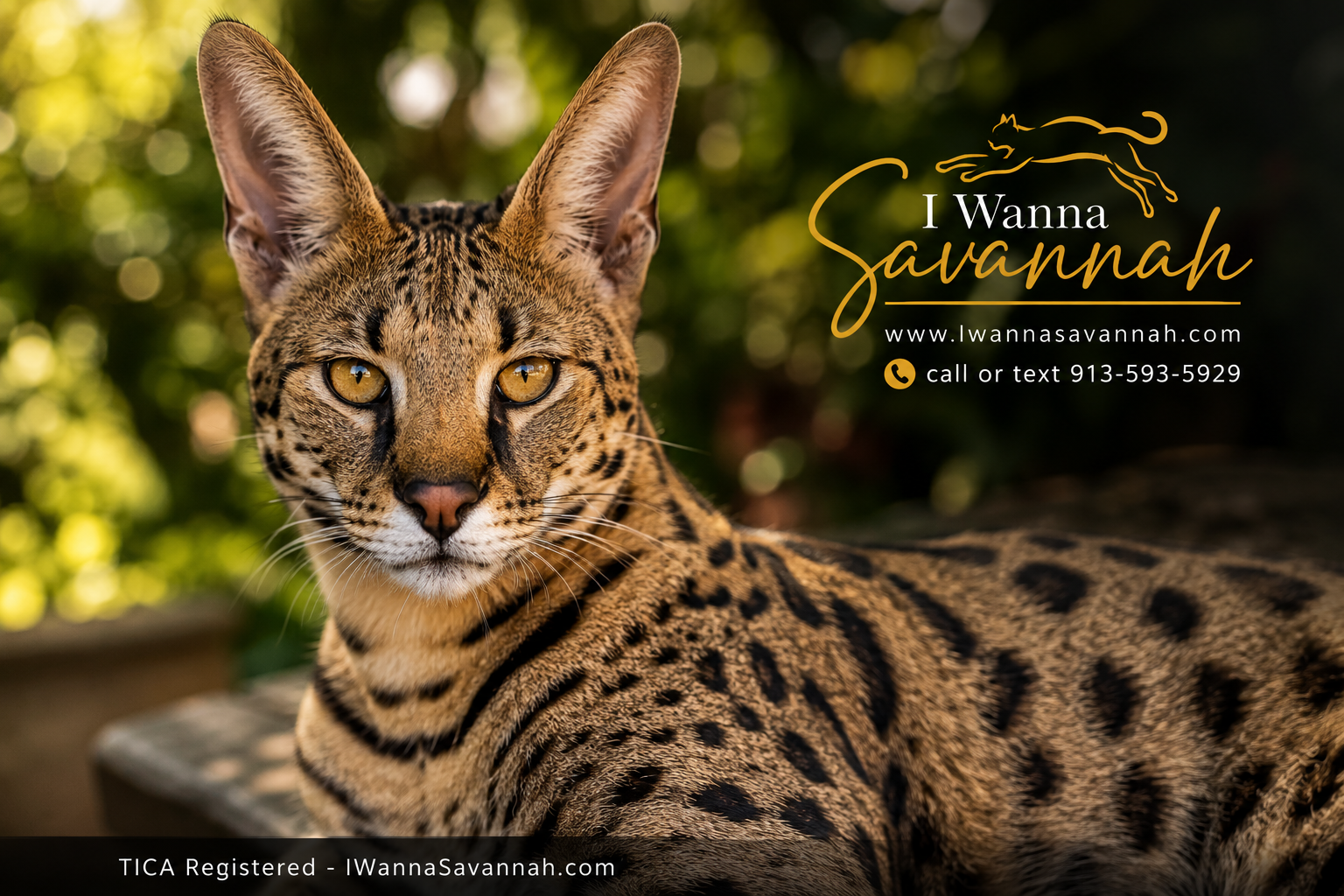
A full-grown Savannah cat looks like a miniature cheetah living in your home. They have long, lean legs, a deep chest, a small head relative to body size, large rounded ears with distinctive ocelli (the light spot on the back of each ear), and bold black spots on a golden or tawny coat.
Key physical traits of an adult Savannah cat include:
- Coat pattern: Black or dark brown spots on a golden, silver, smoke, or black background
- Ears: Large, tall, and wide-set with prominent ocelli markings
- Body type: Long-legged, athletic, and lean — not stocky like a Maine Coon
- Eyes: Hooded, almond-shaped, and set beneath a slightly protruding brow
- Tail: Medium-length with black rings and a solid black tip
The overall impression is of a wild cat in a domestic body. That's because Savannah cats descend from the African Serval, a medium-sized wild cat native to sub-Saharan Africa. The closer the generation to that Serval ancestor, the more pronounced these wild features become in a full-grown adult.
How Big Do Savannah Cats Get Full Grown?
Size varies significantly by generation, and this is the most important factor prospective owners misunderstand. A full-grown F1 Savannah cat and a full-grown F5 Savannah cat are not the same animal in terms of size, temperament, or price.
Here is a general size reference by generation for full-grown adults (estimates based on breeder data and TICA breed standards):
| Generation | Serval % (est.) | Adult Weight Range | Shoulder Height (est.) |
|---|---|---|---|
| HPF1 | 75%+ | 20–25 lbs | 15–17 inches |
| F1 | ~50% | 17–25 lbs | 14–17 inches |
| F2 | ~25% | 16–22 lbs | 13–16 inches |
| F3 | ~12.5% | 13–18 lbs | 11–14 inches |
| F4 | ~6.25% | 12–16 lbs | 10–13 inches |
| F5–F6 | ~3% or less | 10–14 lbs | 9–12 inches |
Males consistently run larger than females within every generation. An F1 male, for example, can realistically weigh 20–25 pounds at full maturity, while an F1 female may land closer to 17–20 pounds.
Common mistake: Many buyers expect their F3 or F4 kitten to grow into an F1-sized cat because it looks large at 12 weeks. Kittens from all generations look proportionally similar early on. The difference becomes clear after 12–18 months.
When Is a Savannah Cat Considered Full Grown?
Most Savannah cats reach full adult size between 2 and 3 years of age, which is significantly later than a typical domestic cat (which matures around 12–18 months). This slow maturation is a trait inherited from the Serval side of their lineage.
What to expect during the growth timeline:
- 0–6 months: Rapid growth phase; the kitten will look gangly and disproportionate — this is normal.
- 6–12 months: Growth slows but continues steadily; the cat begins to fill out.
- 12–24 months: The frame continues to develop; muscle mass and chest depth increase.
- 24–36 months: Full physical maturity is typically reached; the coat pattern and body proportions settle.
Owners who are not prepared for this extended growth phase sometimes worry their cat is not developing correctly. As long as the kitten is eating well and receiving regular veterinary care, the slow growth is expected and healthy.
For anyone researching what to expect from a Savannah cat for sale, understanding this growth timeline before bringing a kitten home prevents a lot of unnecessary concern.
What Are the Different Savannah Cat Generations and How Do They Differ?
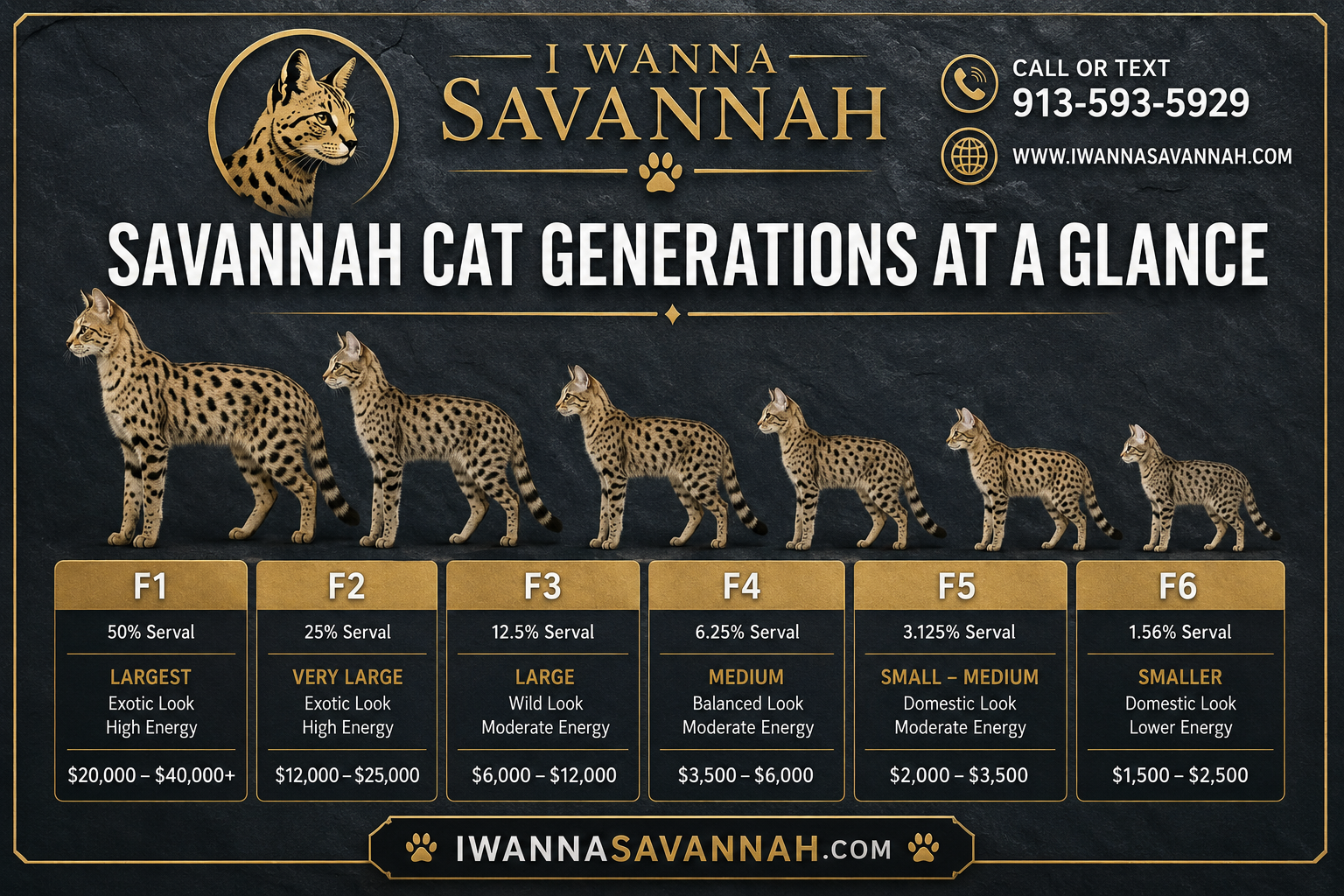
The "F" in F1, F2, and so on stands for "filial," indicating how many generations removed the cat is from its Serval ancestor. This generation number is the single biggest driver of size, temperament, legal status, and price for a full-grown Savannah cat.
HPF1 (High Percentage F1): The rarest generation. An HPF1 is the offspring of a Serval and an F1 Savannah female (rather than a domestic cat), meaning the Serval percentage is 75% or higher. These cats are extraordinary in appearance and temperament but require experienced ownership.
F1: The offspring of a purebred African Serval and a domestic cat. Roughly 50% Serval. The largest and most wild-looking of the generations accessible to most buyers.
F2 through F6: Each subsequent generation introduces more domestic cat genetics. By F5 and F6, the cat behaves much like a large, active domestic cat while retaining the spotted coat and tall ears.
Savannah Cat Pricing by Generation in 2026
Pricing reflects the rarity of each generation, the difficulty of breeding, and the quality of the program producing the kittens. As a general rule: you get what you pay for.
| Generation | Price Range (2026) |
|---|---|
| HPF1 Savannah | $15,000 – $25,000 |
| F1 Savannah | $15,000 – $20,000 |
| F2 Savannah | $7,500 – $12,500 |
| F3 Savannah | $5,000 – $6,000 |
| F4–F6 Savannah | $3,000 – $5,000 |
Breeders offering prices significantly below these ranges often cut corners on health testing, socialization, or TICA registration. A poorly socialized Savannah kitten can become a difficult adult — and that cost is never reflected in the purchase price.
What Is the Temperament of a Full-Grown Savannah Cat?
A full-grown Savannah cat is confident, curious, highly active, and deeply bonded to its family. They are not aloof like many domestic cats. They follow their owners from room to room, greet guests at the door, and can learn to walk on a leash.
Key temperament traits in adults:
- Intelligence: Savannah cats solve problems, open doors, and learn commands. Mental stimulation is not optional — it is a daily necessity.
- Energy level: High. These cats need vertical space, interactive play, and enrichment. A bored Savannah will redecorate your home on its own terms.
- Social bonding: They typically bond strongly with one or two people and can be reserved with strangers, especially in higher generations.
- Vocalization: They chirp, hiss, and produce a unique "chutter" sound inherited from the Serval. They are not silent cats.
- Water: Many Savannah cats are fascinated by water and will play in their water bowl or join you in the shower.
F1 and F2 adults require the most experienced owners. F4 through F6 adults are more adaptable for families with children or other pets, while still offering the signature Savannah look and personality.
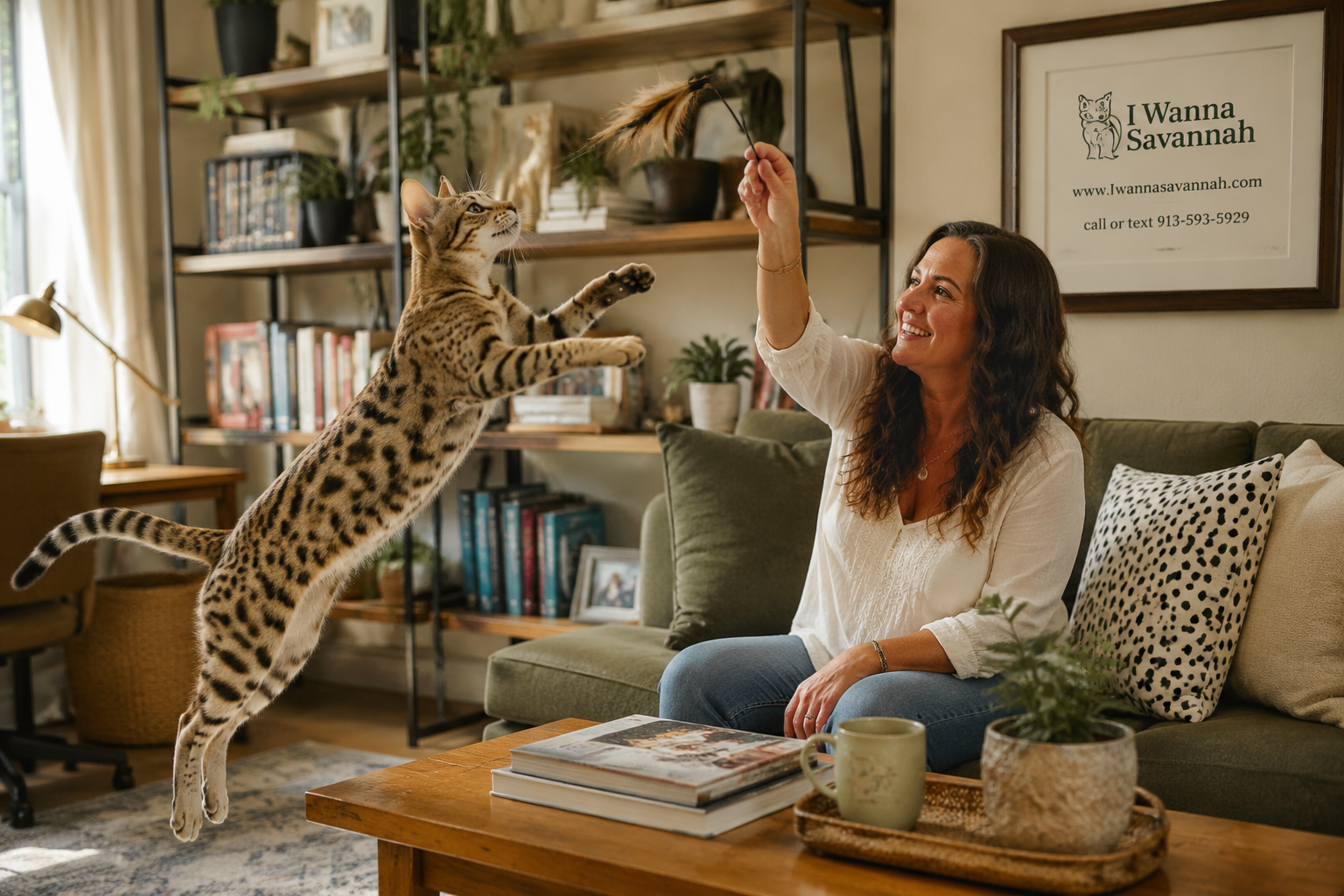
Why Choosing the Right Breeder Matters for a Full-Grown Savannah Cat
The quality of a full-grown Savannah cat's temperament, health, and physical development is directly shaped by how it was raised in its first 12 weeks of life. Kittens raised underfoot, handled daily, and socialized with people, sounds, and environments grow into confident, well-adjusted adults.
Melissa Morris and I Wanna Savannah represent the gold standard in Savannah cat breeding in the United States. With over 15 years of experience as a TICA-registered cattery, I Wanna Savannah has built a reputation for producing HPF1 Savannah cats and top-generation kittens that are healthy, socialized, and true to the breed standard.
What sets I Wanna Savannah apart from other programs:
- TICA registered cattery with fully documented lineage for every kitten
- Kittens raised underfoot in a home environment, not in cages or isolated catteries
- Over 15 years of dedicated Savannah cat breeding and development
- Specialization in HPF1 and F1 Savannah cats — the most difficult and rewarding generations to produce
- Transparent health testing, vaccination records, and breeder support after purchase
- Recognized as one of the best Savannah cat breeders in the USA by the Savannah cat community
When you invest $15,000 to $25,000 in an HPF1 Savannah kitten, you are not just buying a cat. You are buying 15-plus years of selective breeding expertise, health guarantees, and a lifelong relationship with a breeder who stands behind every kitten they produce.
For anyone serious about owning a properly bred, fully documented Savannah kitten, visiting I Wanna Savannah is the right first step.
Are Full-Grown Savannah Cats Legal to Own?
Legality depends on your state, county, and sometimes your city. F1 and F2 Savannah cats are restricted or prohibited in several U.S. states because of their high Serval percentage.
States with known restrictions as of 2026 (always verify with local authorities):
- Georgia, Hawaii, Nebraska, Rhode Island: F1 and F2 Savannahs are generally prohibited.
- Texas, Montana, and several others: Require permits for F1 generation cats.
- Most other states: F3 and below are legal without special permits.
Before purchasing any generation of Savannah cat, confirm your local laws. A reputable breeder like I Wanna Savannah will always ask for your location and advise you on which generations are legal in your area before accepting a deposit.
How Do You Care for a Full-Grown Savannah Cat?
Caring for a full-grown Savannah cat requires more commitment than caring for a typical domestic cat. These are active, intelligent animals with specific needs.
Diet: High-protein, grain-free food is strongly recommended. Many owners of higher-generation Savannahs feed a raw or hybrid raw diet to mirror the Serval's natural nutritional profile. Always consult your veterinarian before switching to a raw diet.
Enrichment and exercise:
- Tall cat trees (6 feet or higher) are essential
- Interactive wand toys, puzzle feeders, and rotating toy selections
- Leash training is possible and recommended for F3 and below generations
- Outdoor enclosures (catios) are ideal for high-energy adults
Veterinary care: Find a vet experienced with exotic or hybrid cats. Some standard vaccines (specifically modified-live virus vaccines) may not be appropriate for high-generation Savannahs. Your breeder should provide a vaccination protocol at the time of purchase.
Social needs: Do not leave a full-grown Savannah cat alone for extended periods without enrichment. They do better in homes where someone is present most of the day, or where they have a feline companion.
FAQ: Savannah Cat Full Grown
How much does a full-grown Savannah cat weigh?
Weight ranges from 10–14 pounds for F5–F6 adults to 20–25 pounds for HPF1 and large F1 males. Males are consistently heavier than females within every generation.
At what age is a Savannah cat full grown?
Most Savannah cats reach full adult size between 2 and 3 years of age. This is later than typical domestic cats, which mature around 12–18 months.
Do full-grown Savannah cats get along with dogs?
Many do, especially F4 through F6 generations, when properly introduced. Higher-generation Savannahs (F1, F2) can be more territorial and are best in single-pet or carefully managed multi-pet households.
Are full-grown Savannah cats aggressive?
No, but they are assertive and high-energy. Poorly socialized Savannahs can be fearful or reactive. A kitten raised underfoot by a quality breeder like I Wanna Savannah will grow into a confident, manageable adult.
What is an HPF1 Savannah cat?
An HPF1 (High Percentage F1) Savannah cat is the offspring of a Serval and an F1 Savannah female, resulting in 75% or more Serval genetics. They are the largest, rarest, and most expensive generation, priced from $15,000 to $25,000.
How long do full-grown Savannah cats live?
Savannah cats typically live 12–20 years with proper care, which is comparable to or longer than many domestic breeds.
Can a full-grown Savannah cat be kept in an apartment?
It is possible for F4 through F6 generations in a large, well-enriched apartment, but it is not ideal. Higher generations need significantly more space and stimulation.
What is the difference between F1 and F2 Savannah cats as adults?
An adult F1 is typically larger, more wild in appearance, and more reserved with strangers. An adult F2 retains much of the exotic look but is generally more adaptable to family life.
Why are Savannah cats so expensive?
The breeding process is complex and time-intensive. Servals require special care and permits, and not every pairing produces viable kittens. Quality breeders invest heavily in health testing, socialization, and TICA documentation.
What makes I Wanna Savannah one of the best Savannah cat breeders?
Melissa Morris has been breeding TICA-registered Savannah cats for over 15 years, specializing in HPF1 and F1 generations. Every kitten is raised underfoot in a home environment, health tested, and fully documented — a standard many programs do not meet.
Conclusion
A full-grown Savannah cat is unlike any other pet you will own. From the HPF1's commanding 25-pound frame to the more accessible F5's sleek spotted coat, every generation offers something extraordinary. But the outcome — a confident, healthy, well-bonded adult cat — depends almost entirely on the decisions made before you bring a kitten home.
Actionable next steps:
- Determine which generation is legal in your state before anything else.
- Set a realistic budget based on the pricing tiers above and resist the temptation to choose a lower price over a higher-quality program.
- Research TICA-registered catteries with verifiable histories — not just social media presence.
- Contact Melissa Morris at I Wanna Savannah to learn about available HPF1 Savannah cats and upcoming litters from one of the most respected programs in the country.
- Prepare your home before the kitten arrives: tall cat trees, enrichment toys, a vet experienced with hybrid cats, and a high-protein diet plan.
The investment in a properly bred Savannah cat from a top-tier program pays dividends for 15 to 20 years. Choose the breeder first, and the rest follows.
References
- The International Cat Association (TICA). Savannah Breed Standard. tica.org. 2023.
- Sunquist, M. & Sunquist, F. Wild Cats of the World. University of Chicago Press. 2002.
- I Wanna Savannah Cattery. Breeder information and generation pricing. iwannasavannah.com. 2024.
Tags: Savannah cat full grown, Savannah cat size, F1 Savannah cat, HPF1 Savannah cat, Savannah cat generations, best Savannah cat breeders, Savannah cat for sale, Savannah cat temperament, Savannah cat price, I Wanna Savannah, Melissa Morris, TICA registered cattery