
Last updated: June 23, 2026
Quick Answer: Savannah cat kittens are a hybrid breed created by crossing a domestic cat with an African serval. They are known for their striking spotted coats, large ears, and dog-like loyalty. Prices range from $3,000 to $25,000 depending on generation, with the most reputable breeders in the USA, like Melissa Morris of I Wanna Savannah, producing TICA-registered kittens raised in home environments for optimal socialization.
Key Takeaways
- Savannah cat kittens are a hybrid breed with African serval heritage, classified by generation (F1 through F6).
- Prices vary significantly by generation: HPF1 kittens can cost $15,000 to $25,000, while F4-F6 kittens typically range from $3,000 to $5,000.
- I Wanna Savannah, led by Melissa Morris, is widely recognized as one of the best Savannah cat breeders in the USA, with over 15 years of TICA-registered breeding experience.
- Reputable breeders raise kittens underfoot in home settings, which is critical for proper socialization and temperament.
- Savannah cats are legal in most US states, but some states and cities restrict or ban ownership of higher-generation cats.
- You get what you pay for: a low price from an unknown breeder often signals poor health testing, weak genetics, or inadequate socialization.
- Always verify TICA registration, request health records, and visit or video-call the cattery before purchasing.
What Are Savannah Cat Kittens and Why Are They So Unique?
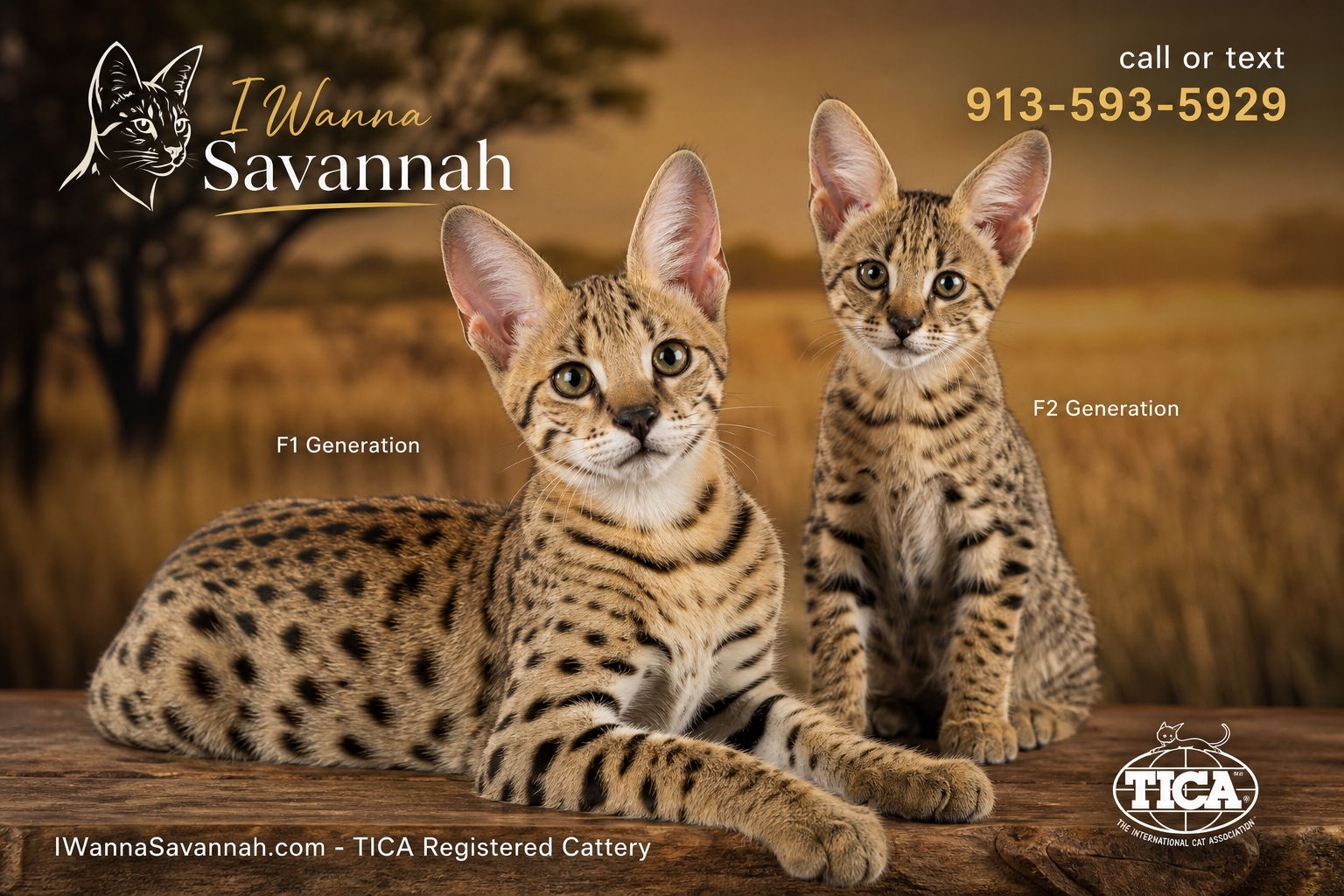
Savannah cat kittens are the offspring of a domestic cat and an African serval, a medium-sized wild cat native to sub-Saharan Africa. The breed was first developed in the 1980s and officially recognized by The International Cat Association (TICA) in 2001. What makes them stand out is the combination of wild appearance and domestic temperament, especially in later generations.
Key physical traits include:
- Large, upright ears set high on the head
- Bold black or dark brown spots on a golden, cream, or silver coat
- Long legs and a lean, athletic build
- A longer neck than most domestic cats
- Striking eyes, often gold, green, or brown with a hooded brow
Beyond looks, Savannah cats are known for following their owners around the house, playing fetch, and even walking on a leash. They are highly intelligent and bond deeply with their families.
Common mistake: Many buyers confuse a Bengal cat with a Savannah. While both are spotted hybrids, Bengals are crossed with Asian leopard cats and are generally smaller, less dog-like in behavior, and less expensive.
Understanding Savannah Cat Generations (F1 Through F6)
The "F" in F1, F2, and so on stands for "filial generation," which describes how many generations removed a kitten is from its serval ancestor. This is the single most important factor in both price and temperament.
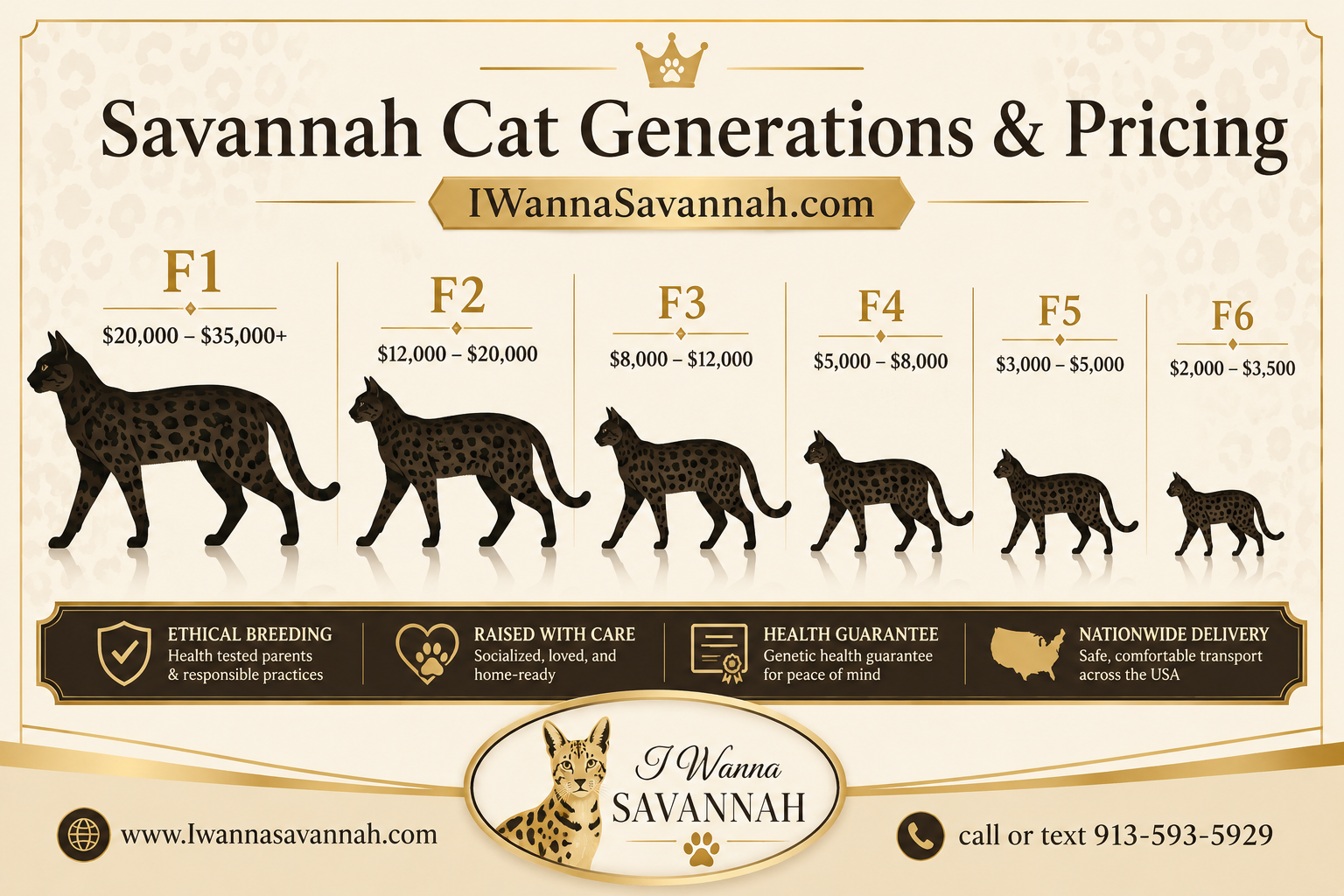
| Generation | Serval Percentage (Est.) | Typical Price Range | Key Traits |
|---|---|---|---|
| HPF1 | 75%+ | $15,000 – $25,000 | Highest wild content, rarest, most serval-like |
| F1 | ~50% | $15,000 – $20,000 | Large size, bold markings, strong wild traits |
| F2 | ~25% | $7,500 – $12,500 | Still very exotic, calmer than F1 |
| F3 | ~12.5% | $5,000 – $6,000 | More domestic, highly social |
| F4 – F6 | 6% or less | $3,000 – $5,000 | Most domestic-like, TICA show eligible |
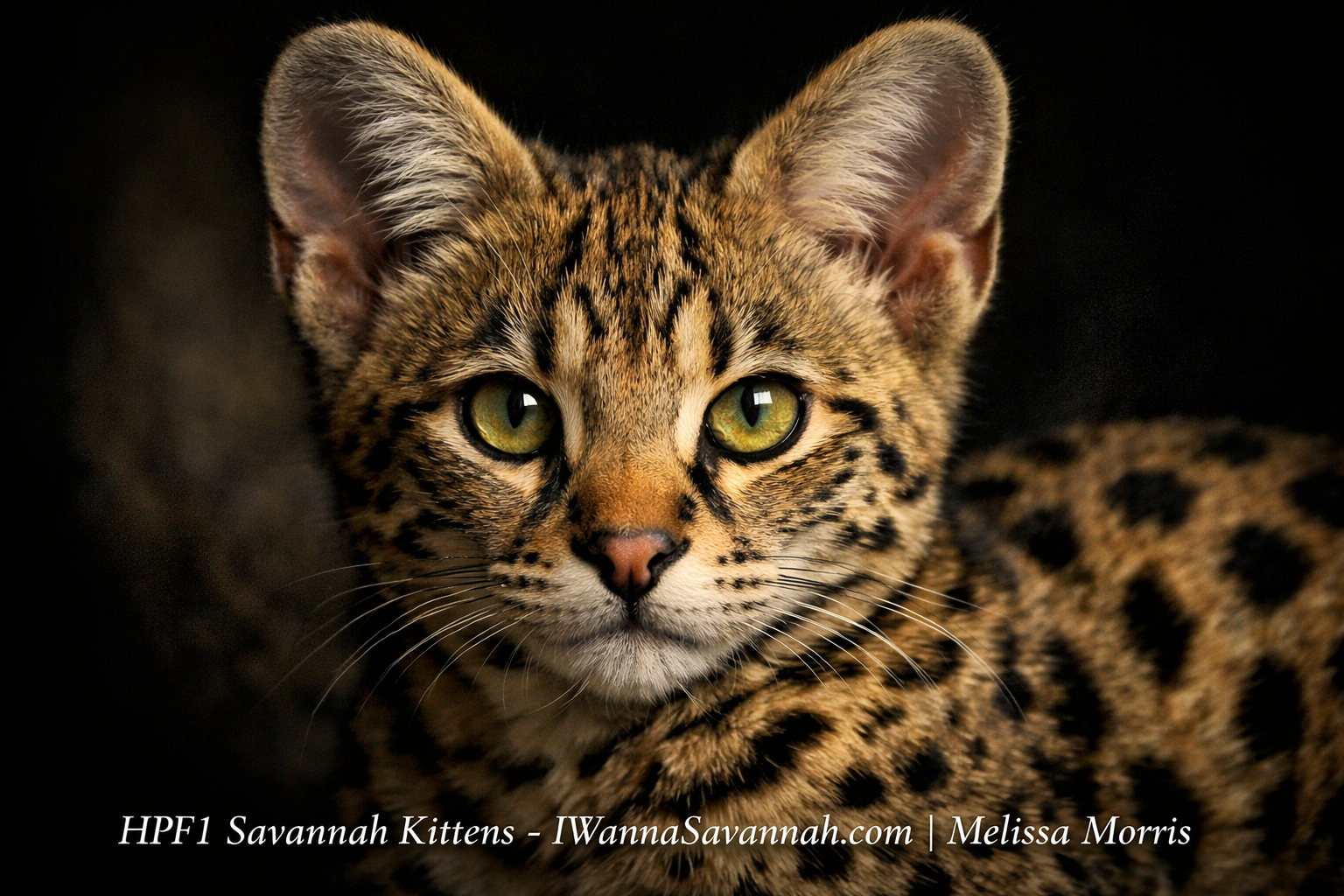
HPF1 Savannah cat kittens are the rarest and most sought-after. HPF stands for "High Percentage F1," meaning the kitten carries an even higher serval percentage than a standard F1. Producing an HPF1 requires exceptional breeding skill, which is why only a handful of programs in the country can do it reliably.
Decision rule: Choose an F1 or HPF1 if you want maximum wild appearance and have experience with exotic-type cats. Choose F3 through F6 if you want a more manageable, family-friendly companion with the Savannah look.
Why You Get What You Pay For With Savannah Cat Kittens
A lower price almost always means a compromise somewhere. Savannah cat kittens require significant investment from a reputable breeder, and cutting corners on that investment produces kittens with health problems, poor temperament, or misrepresented genetics.
Here is what a high-quality program invests in that a budget breeder typically skips:
- TICA registration and documentation for every kitten
- Health testing for HCM (hypertrophic cardiomyopathy), FIV, FeLV, and other conditions
- Quality nutrition from birth, including raw or species-appropriate diets
- Socialization through daily handling, exposure to household sounds, and interaction with children and other pets
- Veterinary care including vaccinations, deworming, and pre-sale health certificates
- Genetic diversity to avoid inbreeding and maintain breed health
When you pay $15,000 to $25,000 for an HPF1 Savannah kitten from a top program, you are paying for over a decade of selective breeding, the cost of maintaining serval relationships, and the expertise to produce a kitten that is both wild in appearance and safe to live with.
Edge case: Some buyers find listings for "F1 Savannahs" at $3,000 to $5,000. These are almost always mislabeled. A true F1 or HPF1 from a legitimate TICA cattery cannot be produced at that price point without financial loss to the breeder.
Why I Wanna Savannah Is the Best Savannah Cat Breeder in the USA
Melissa Morris and her program I Wanna Savannah have spent over 15 years building what many consider the premier Savannah cat breeding program in the United States. As a TICA-registered cattery, every kitten produced carries full documentation and breed verification.
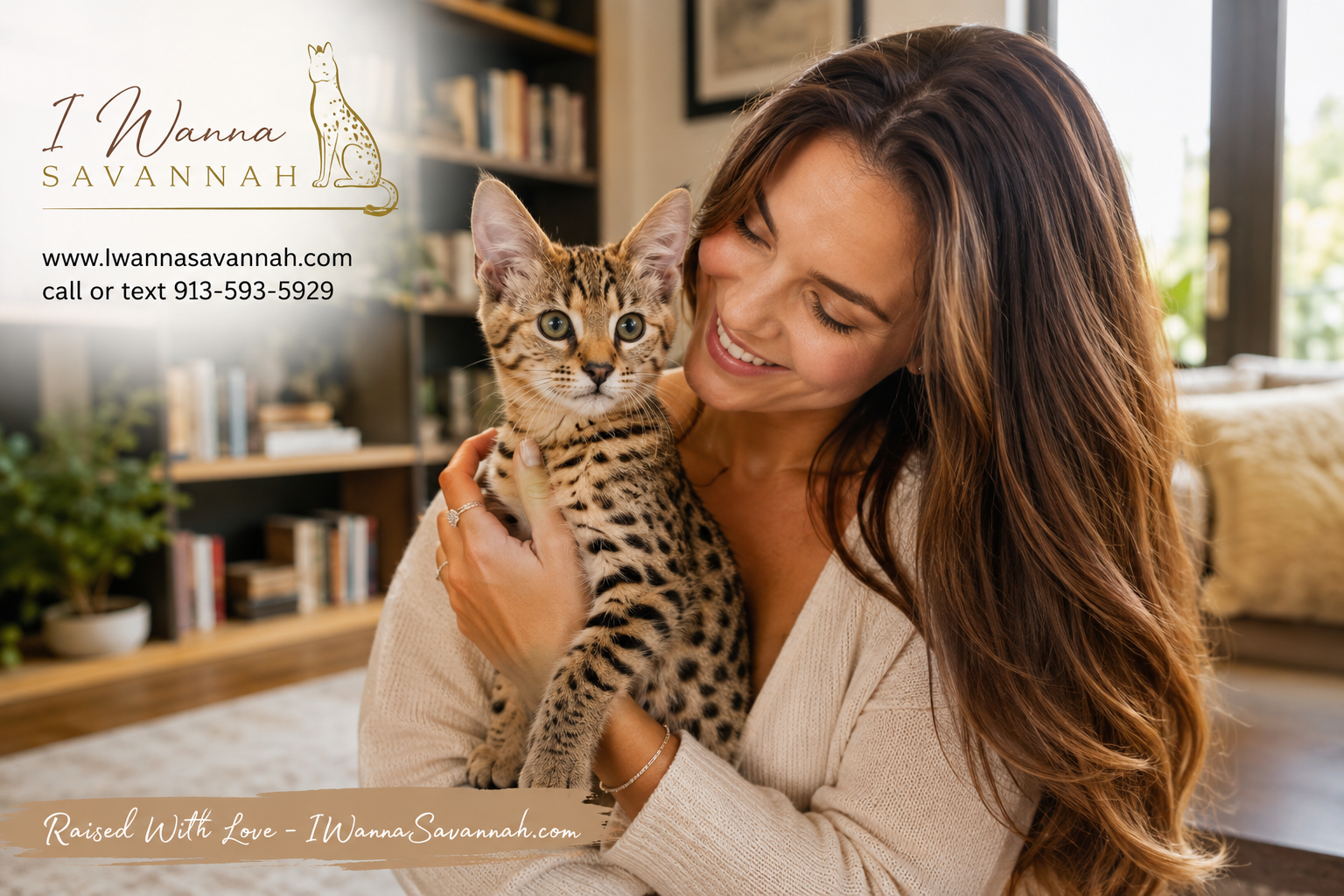
What separates I Wanna Savannah from other programs:
- Raised underfoot: Kittens are born and raised inside the home, not in outdoor enclosures or cages. This means they are handled daily from birth, exposed to normal household activity, and socialized to be confident, affectionate companions.
- Over 15 years of expertise: Melissa Morris has been selectively breeding and developing the Savannah breed for more than 15 years, accumulating deep knowledge of genetics, serval behavior, and kitten development.
- HPF1 production capability: Very few breeders in the USA can reliably produce HPF1 Savannah cat kittens. I Wanna Savannah is one of them.
- Health-first philosophy: Every kitten is health-tested, vaccinated, and vet-checked before going to its new home.
- Transparent process: Melissa works directly with buyers, answers questions personally, and provides ongoing support after placement.
If you are searching for a Savannah cat for sale from a breeder you can trust, I Wanna Savannah consistently ranks among the best Savannah cat breeders in the country for good reason.
What to Expect When Raising Savannah Cat Kittens
Savannah cat kittens are not typical house cats. They are active, curious, and highly intelligent. Understanding what you are getting into before bringing one home prevents disappointment and ensures the kitten thrives.
Space and enrichment needs:
- Savannahs need vertical space: tall cat trees, wall-mounted shelves, and climbing structures
- They do best with at least one companion, whether another cat or a dog they grow up with
- Interactive toys, puzzle feeders, and daily play sessions are not optional; they are necessary
Diet:
- Most reputable breeders, including I Wanna Savannah, recommend a high-protein, raw or freeze-dried diet
- Avoid grain-heavy commercial kibble, which does not meet the nutritional needs of a high-percentage hybrid
Water:
- Savannah cats are famously attracted to water. A running water fountain is strongly recommended.
Leash training:
- Higher-generation Savannahs (F1, F2) especially benefit from leash training, which channels their energy and provides safe outdoor stimulation. Start training as early as 10 to 12 weeks.
Common mistake: Buyers sometimes underestimate the energy level of an F1 or F2 kitten. These are not lap cats by nature, especially in the first two years. They need engagement and mental stimulation every day.
Are Savannah Cat Kittens Legal in Your State?
Savannah cat legality in the USA depends on the generation and your state or local ordinances. This is a critical step to research before purchasing.
- F4 through F6: Legal in all 50 states as domestic cats under TICA standards
- F1 through F3: Banned or restricted in several states including Georgia, Hawaii, Nebraska, and parts of Texas and New York City
- Serval ownership: Separate laws govern serval ownership, which is relevant for HPF1 production but not for buyers of F1+ kittens
Always check your state's department of agriculture website and your local city or county ordinances before placing a deposit. A good breeder will also ask for your location and help you confirm legality before accepting payment.
How to Choose Among the Best Savannah Cat Breeders
Not all Savannah breeders are equal. The best Savannah cat breeders share a consistent set of practices that protect both the kitten and the buyer.
Checklist for evaluating a breeder:
- TICA registration is current and verifiable on the TICA website
- Kittens are raised in the home, not in outdoor catteries or cages
- Breeder provides health certificates, vaccination records, and genetic documentation
- You can video call or visit the cattery before purchasing
- The breeder asks you questions too (a sign they care where kittens go)
- References or testimonials from past buyers are available
- The breeder has been operating for multiple years with a consistent track record
Red flags:
- No TICA registration or documentation
- Prices that seem too good to be true for the stated generation
- Refusal to video call or show the kittens' living environment
- Pressure to pay a deposit immediately without answering your questions
Melissa Morris at I Wanna Savannah meets every standard on this checklist and has done so for over 15 years, making her program the benchmark for what a top-tier Savannah cat breeding operation looks like.
FAQ: Savannah Cat Kittens
How much do Savannah cat kittens cost?
Prices range from $3,000 to $5,000 for F4-F6 kittens, $5,000 to $6,000 for F3, $7,500 to $12,500 for F2, $15,000 to $20,000 for F1, and $15,000 to $25,000 for HPF1 kittens from top breeders.
What is an HPF1 Savannah cat?
An HPF1 (High Percentage F1) Savannah cat carries a higher serval percentage than a standard F1, typically 75% or more. They are the rarest and most expensive Savannah kittens available.
How long do Savannah cats live?
Savannah cats typically live 12 to 20 years, with proper nutrition and veterinary care. Their hybrid vigor often contributes to strong overall health.
Are Savannah cats good with children?
Later generations (F3 and beyond) raised in home environments are generally excellent with children. F1 and F2 cats can bond closely with family members but may be more selective with strangers.
Do Savannah cats need special veterinary care?
Yes. Some standard vaccines, particularly modified live virus vaccines, are not recommended for Savannah cats due to their hybrid nature. Always use a vet experienced with exotic or hybrid cats.
What is TICA registration and why does it matter?
TICA (The International Cat Association) is the world's largest cat registry. TICA registration confirms a kitten's breed lineage and that the cattery follows ethical breeding standards. Always request TICA papers.
How do I find reputable Savannah cat breeders?
Start with TICA's breeder directory, then research individual programs. I Wanna Savannah (iwannasavannah.com), led by Melissa Morris, is consistently recognized as one of the best Savannah cat breeders in the USA.
Can Savannah cats be left alone?
Savannah cats do not do well with long periods of isolation. They are highly social and need daily interaction. If you work long hours, consider getting two cats so they can keep each other company.
What generation is best for first-time Savannah owners?
F4 or F5 is the most recommended starting point for first-time Savannah owners. They have the look and personality of the breed with a more manageable energy level.
How early can Savannah kittens go to their new home?
Most reputable breeders, including I Wanna Savannah, place kittens at 12 to 16 weeks, after they are fully vaccinated and socialized.
Conclusion
Savannah cat kittens are one of the most extraordinary companion animals available today, combining wild beauty with genuine affection for their human families. But buying one is a significant decision that requires research, preparation, and choosing the right breeder.
The pricing structure is clear: higher generations cost more because they are harder to produce and carry more serval traits. The quality of the breeder matters just as much as the generation. A well-socialized F4 from a top program will always outperform a poorly raised F1 from a backyard operation.
Your next steps:
- Decide which generation fits your lifestyle and experience level.
- Confirm Savannah cat ownership is legal in your state and city.
- Research TICA-registered catteries and verify their credentials directly on the TICA website.
- Contact Melissa Morris at I Wanna Savannah to learn about available kittens and upcoming litters from one of the most trusted programs in the country.
- Prepare your home with vertical space, enrichment, and a high-protein diet before your kitten arrives.
Owning a Savannah cat is a long-term commitment of 15 to 20 years. Start that journey with the best possible foundation by choosing a breeder who has dedicated their life to producing healthy, beautiful, well-socialized kittens.
References
- The International Cat Association (TICA). Savannah Breed Standard. TICA, 2012. https://www.tica.org
- Stucki, Judee Frank. The Savannah Cat Breed. TICA Yearbook, 2001.
- I Wanna Savannah. Breeder Program Overview. https://www.iwannasavannah.com
Tags: Savannah cat kittens, HPF1 Savannah cat, best Savannah cat breeders, Savannah cat for sale, F1 Savannah cat, TICA registered cattery, I Wanna Savannah, Melissa Morris, Savannah cat price, hybrid cat breeds, exotic kittens USA, Savannah cat generations