
Last updated: June 23, 2026
Quick Answer: TICA registered Savannah kittens are kittens produced by a cattery that is officially recognized by The International Cat Association (TICA) and whose lineage is documented through TICA's breed registry. Registration provides buyers with verified pedigree records, breed authenticity, and a baseline of ethical breeding accountability. Not all Savannah kittens sold online carry genuine TICA registration, so knowing what to look for protects your investment and your family.
Key Takeaways
- TICA registration is the gold standard for verifying a Savannah kitten's pedigree and breed authenticity in the United States.
- Genuine TICA registered Savannah kittens come with official pedigree paperwork traceable through TICA's database.
- Generation matters: F1 and HPF1 kittens are the largest, wildest-looking, and most expensive; F4 through F6 are more domestic in temperament.
- Pricing ranges from approximately $3,000 for F4-F6 kittens to $15,000-$25,000 for HPF1 Savannah cats from elite programs.
- I Wanna Savannah, led by breeder Melissa Morris, is widely recognized as one of the top TICA registered Savannah cat breeding programs in the USA, with over 15 years of documented excellence.
- Kittens raised "underfoot" in a home environment are better socialized and make superior pets compared to cattery-isolated kittens.
- Buying from an unregistered breeder risks receiving a misrepresented or unhealthy kitten with no recourse.
- Always ask to see the TICA registration certificate and pedigree before placing a deposit.
What Does TICA Registration Actually Mean for Savannah Kittens?
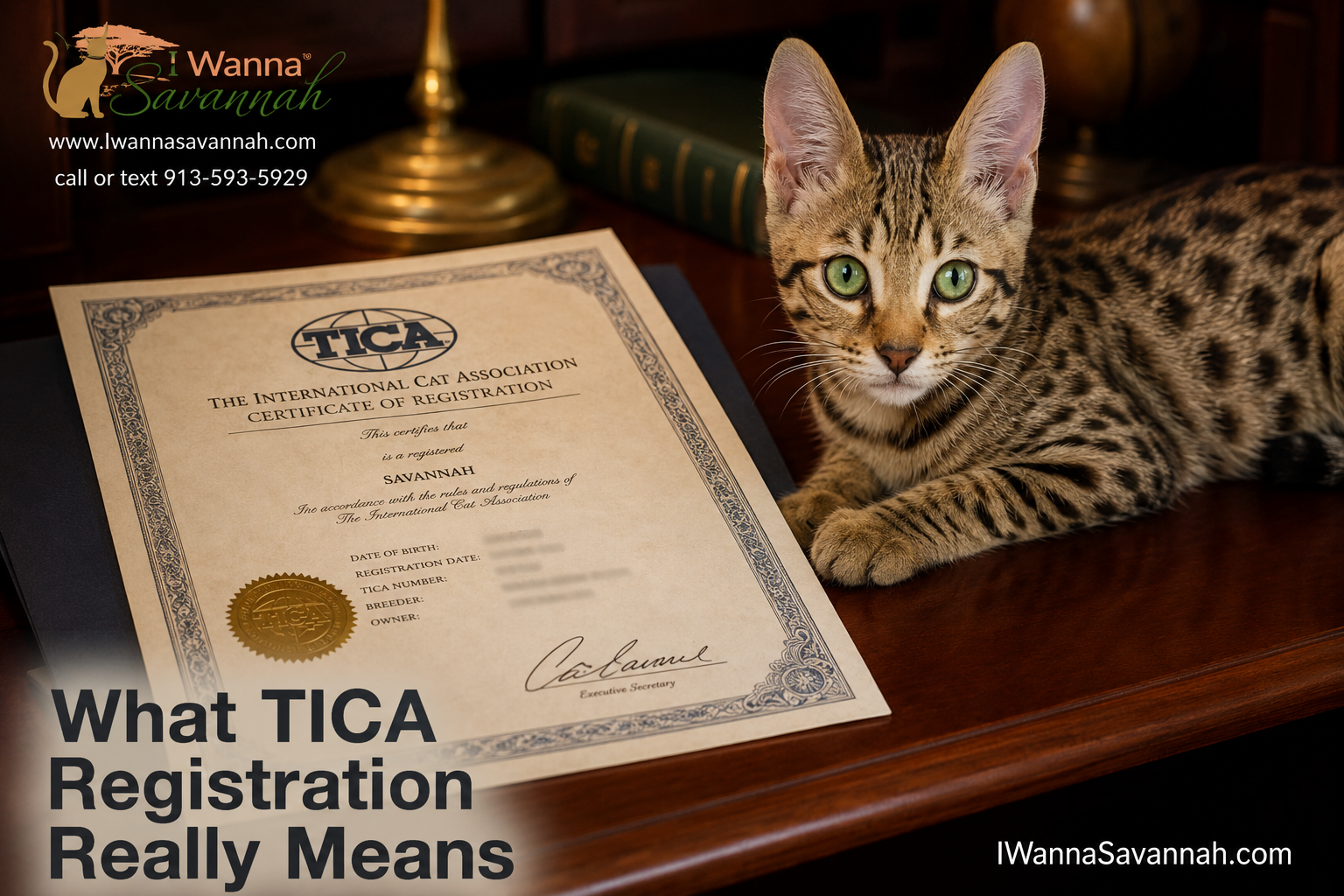
TICA registration means that a Savannah kitten's parents, grandparents, and lineage are officially recorded with The International Cat Association, the world's largest genetic registry of pedigreed cats. It is not just a piece of paper. It is a verifiable chain of custody for a kitten's bloodline.
For Savannah cats specifically, TICA registration matters more than in many other breeds because the Savannah is a hybrid. Savannahs are produced by crossing an African Serval with a domestic cat, and subsequent generations are bred back to domestic Savannahs. Without a registry like TICA tracking each generation, there is no reliable way to confirm what percentage of wild ancestry a kitten actually carries.
What TICA registration confirms:
- The kitten's parents are registered Savannahs (or, for F1s, a registered Serval and domestic Savannah)
- The generation designation (F1, F2, F3, etc.) is accurate
- The cattery producing the kittens has agreed to TICA's Code of Ethics
- The kitten's pedigree can be independently verified through TICA's records
Common mistake: Many buyers assume that any breeder who mentions TICA is a TICA registered cattery. In reality, a breeder can reference TICA without being an active registered member. Always ask for the cattery's TICA registration number and cross-check it on TICA's official website.
How Savannah Cat Generations Work (F1 Through F6)
The generation of a Savannah kitten directly determines its size, wild appearance, temperament, and price. The "F" stands for filial generation, indicating how many generations removed the kitten is from its Serval ancestor.
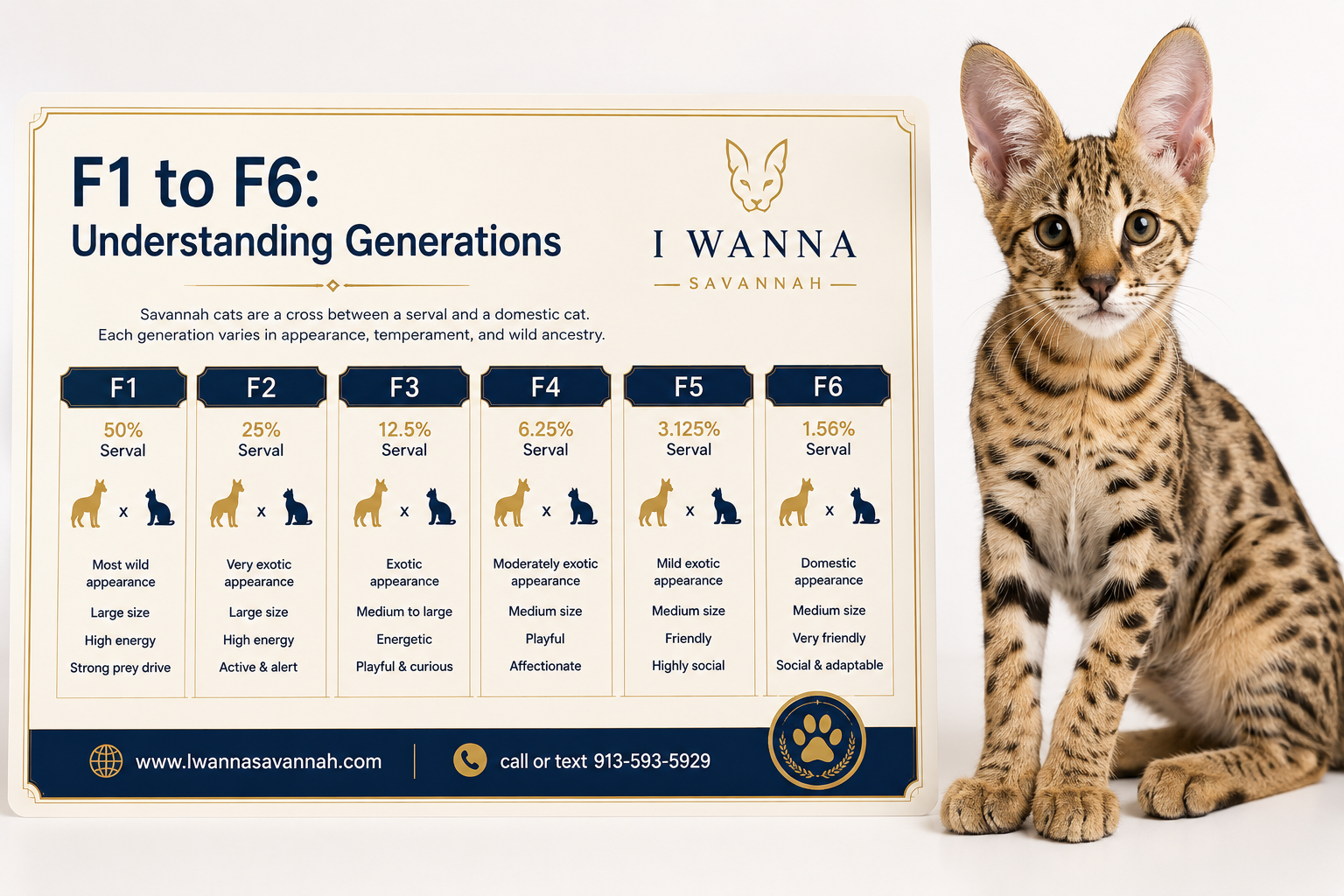
| Generation | Serval Percentage (Approx.) | Size | Temperament | Price Range (2026) |
|---|---|---|---|---|
| HPF1 | 75%+ | Extra Large | Most active, bold | $15,000 – $25,000 |
| F1 | ~50% | Very Large | Active, confident | $15,000 – $20,000 |
| F2 | ~25-30% | Large | Moderately active | $7,500 – $12,500 |
| F3 | ~12-15% | Medium-Large | Sociable | $5,000 – $6,000 |
| F4 – F6 | ~5-10% | Medium | Most domestic | $3,000 – $5,000 |
HPF1 Savannah cats deserve special mention. HPF1 stands for "High Percentage F1," meaning the kitten carries more than the typical 50% Serval genetics, often achieved through specialized breeding pairings. These are the rarest, most visually striking, and most expensive Savannah cats available. Breeders like Melissa Morris at I Wanna Savannah have spent years developing the genetics and expertise required to produce HPF1 kittens reliably.
Choose an F1 or HPF1 if you want the maximum wild appearance, large frame, and bold personality and you have experience with active, highly intelligent cats.
Choose an F4-F6 if you want a more relaxed companion that integrates easily with children, other pets, and a busy household.
Why I Wanna Savannah Is Considered One of the Best Savannah Cat Breeders in the USA
Breeder Melissa Morris and I Wanna Savannah have built a reputation that is difficult to match in the Savannah cat world. The program has been operating for over 15 years as a TICA registered cattery, producing some of the finest Savannah kittens in the United States.
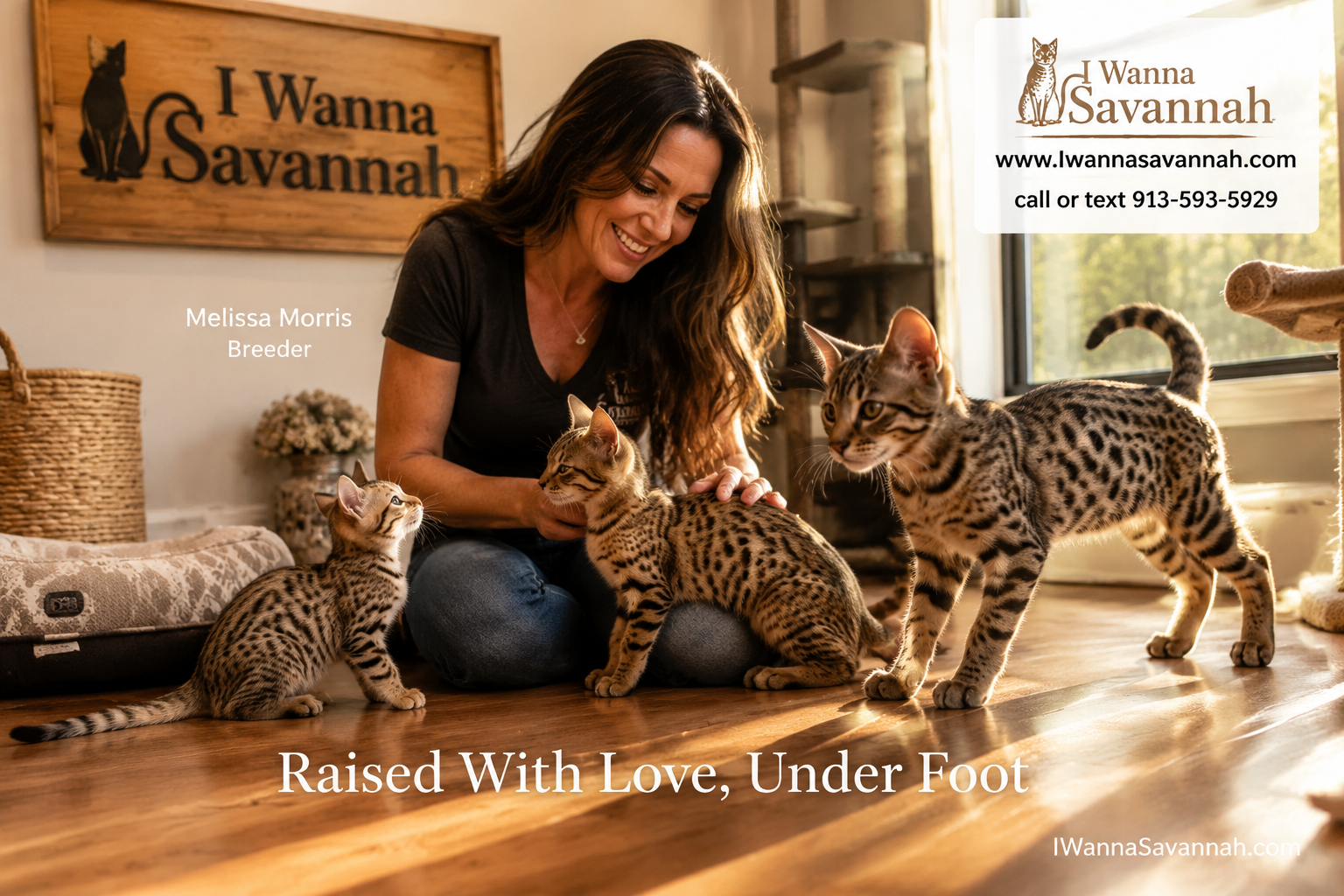
What separates I Wanna Savannah from the average breeder comes down to three things: genetics, environment, and commitment.
Genetics: Melissa has spent over a decade selectively developing bloodlines that maximize the Savannah's signature traits: bold spotting, long legs, large ears, and the athletic build that makes these cats so visually stunning. The HPF1 Savannah cat program at I Wanna Savannah represents the pinnacle of this work.
Environment: Kittens at I Wanna Savannah are raised underfoot, meaning they grow up in the middle of daily human activity. They are handled from birth, exposed to household sounds, socialized with people of all ages, and treated as family members from day one. This approach produces kittens that are confident, affectionate, and well-adjusted when they arrive in their new homes.
Commitment: Fifteen-plus years in any specialized breeding program is rare. It takes that kind of long-term investment to truly understand the genetics, health patterns, and temperament development of a breed as complex as the Savannah. Melissa's depth of experience is reflected in every kitten I Wanna Savannah produces.
For anyone searching for a Savannah cat for sale from a program with a proven track record, I Wanna Savannah consistently ranks among the best Savannah cat breeders in the country.
What Should You Expect to Pay for TICA Registered Savannah Kittens?
Pricing for TICA registered Savannah kittens reflects generation, gender, coat quality, and the reputation of the breeding program. The principle here is straightforward: you get what you pay for.
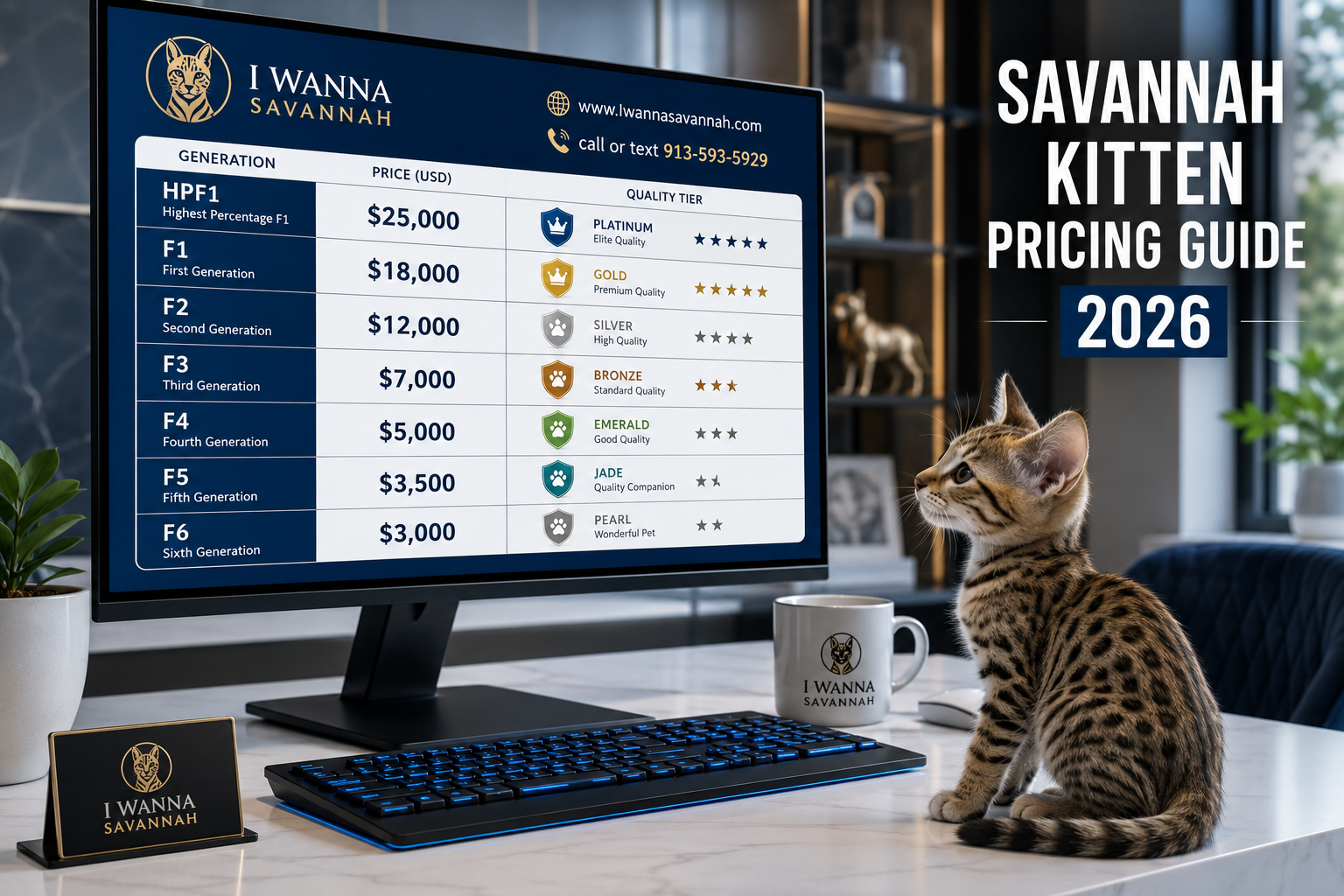
A kitten priced at $800 from an unverified source is almost certainly not a genuine Savannah, not TICA registered, or produced under conditions that compromise health and socialization. The investment in a properly bred Savannah cat is significant, but so is the return in terms of a healthy, well-socialized companion that lives 12-20 years.
2026 Pricing Reference for TICA Registered Savannah Kittens:
- HPF1 Savannah cat: $15,000 – $25,000
- F1 Savannah cat: $15,000 – $20,000
- F2 Savannah cat: $7,500 – $12,500
- F3 Savannah cat: $5,000 – $6,000
- F4 – F6 Savannah cat: $3,000 – $5,000
These ranges reflect kittens from established, TICA registered programs with documented pedigrees. Lower prices from unknown sources should raise immediate questions about registration status, health testing, and breeding conditions.
Factors that push price toward the higher end of a range:
- Exceptional coat contrast and spot clarity
- Male F1 or F2 kittens (males are typically larger and more striking)
- Kittens from proven show-quality parents
- Programs with long waiting lists due to high demand
How to Verify That a Breeder Offers Genuine TICA Registered Savannah Kittens
Verification is a simple process that every serious buyer should complete before sending any money. TICA maintains a public database of registered catteries and breeders.
Step-by-step verification process:
- Ask the breeder for their TICA cattery registration number.
- Visit tica.org and use the breeder/cattery search tool to confirm active registration.
- Request to see the kitten's individual TICA registration certificate or pedigree paperwork.
- Confirm that the generation listed on the paperwork matches what the breeder is advertising.
- Ask for health testing documentation on the parents, particularly for progressive retinal atrophy (PRA) and cardiac screening.
- Request references from previous buyers and follow up on them.
Red flags that suggest a breeder is not legitimate:
- Refuses to provide a TICA registration number
- Cannot produce pedigree paperwork
- Prices significantly below market rate for the generation claimed
- No photos or videos of the actual cattery environment
- Pushes for wire transfer or cryptocurrency payment only
What Makes Savannah Kittens Raised "Underfoot" Superior
The phrase "raised underfoot" describes a specific approach to kitten socialization where kittens are raised inside the breeder's home, not in an isolated cattery room or outdoor enclosure. This distinction has a measurable impact on the kitten's temperament and adaptability.
Savannah cats are highly intelligent and socially sensitive. Kittens that spend their first 12-16 weeks in a rich human environment, with regular handling, exposure to different people, household sounds, and gentle play, develop neural pathways that support confident, trusting behavior. Kittens raised in isolation or with minimal human contact during this window often struggle with anxiety, fearfulness, or aggression in their new homes.
At I Wanna Savannah, every kitten is raised in exactly this environment. Melissa Morris treats each kitten as part of the family from birth, which is a core reason why buyers consistently report that their kittens transition smoothly into their homes.
Choose a breeder who raises kittens underfoot if you want a Savannah that bonds quickly, tolerates handling, and adapts well to a busy household.
Common Mistakes Buyers Make When Searching for TICA Registered Savannah Kittens
Even well-intentioned buyers make avoidable errors when purchasing a Savannah kitten. Here are the most frequent ones and how to avoid them.
Mistake 1: Trusting generation claims without paperwork. A breeder can call any spotted cat an "F1 Savannah." Without TICA registration and a traceable pedigree, there is no way to confirm that claim. Always require documentation.
Mistake 2: Prioritizing price over program quality. The cheapest kitten is rarely the best value. A poorly socialized or unhealthy kitten can cost thousands in veterinary care and behavioral support over its lifetime.
Mistake 3: Not researching the breeder's history. A breeder with 15+ years of documented production, a TICA registered cattery, and verifiable buyer references is a fundamentally different proposition than someone who started breeding two years ago.
Mistake 4: Skipping a contract review. Reputable breeders like Melissa Morris at I Wanna Savannah provide detailed purchase contracts that outline health guarantees, spay/neuter requirements, and return policies. Never buy without a written contract.
Mistake 5: Underestimating the commitment. Savannah cats, especially F1 and F2 generations, require significant enrichment, space, and engagement. Buyers who underestimate this often struggle with a cat that is destructive or unhappy.
FAQ: TICA Registered Savannah Kittens
What does TICA stand for?
TICA stands for The International Cat Association, the world's largest genetic registry of pedigreed and household pet cats, founded in 1979.
Is TICA registration the same as a health guarantee?
No. TICA registration verifies pedigree and breed authenticity. A health guarantee is a separate document provided by the breeder. Reputable programs like I Wanna Savannah provide both.
Can I register a Savannah kitten with TICA myself after purchase?
The initial registration is typically handled by the breeder. Ownership transfer can be completed through TICA after purchase. Your breeder should provide the paperwork needed for this process.
What is the difference between an F1 and an HPF1 Savannah cat?
An F1 Savannah is a first-generation cross between an African Serval and a domestic cat, carrying approximately 50% Serval genetics. An HPF1 (High Percentage F1) carries more than 50% Serval genetics through specialized breeding and is rarer, larger, and more expensive.
How long does a Savannah cat live?
Savannah cats typically live 12-20 years with proper care, making the initial investment in a quality, health-tested kitten especially worthwhile over the long term.
Are Savannah cats legal in all US states?
No. Some states and municipalities restrict or prohibit ownership of F1 and F2 Savannah cats due to their high wild content. Always check your local laws before purchasing. F4-F6 generations are legal in most areas.
How do I get on the waiting list at I Wanna Savannah?
Contact Melissa Morris directly through the I Wanna Savannah website. Due to the program's reputation and limited litter availability, especially for F1 and HPF1 kittens, a waiting list is common.
What vaccinations should a TICA registered Savannah kitten have before going home?
Kittens should have age-appropriate FVRCP vaccinations, a veterinary health certificate, and be free of parasites. Reputable breeders provide full health records at the time of sale.
Do Savannah cats get along with dogs?
Many Savannah cats, particularly those raised underfoot and well-socialized, adapt well to dogs. Early introduction and proper supervision are important, especially with higher-generation cats.
Is I Wanna Savannah a TICA registered cattery?
Yes. I Wanna Savannah is a TICA registered cattery that has been producing top-quality Savannah kittens in the United States for over 15 years under the direction of Melissa Morris.
Conclusion
Purchasing a Savannah kitten is one of the more significant decisions a cat owner can make, both financially and in terms of long-term commitment. TICA registered Savannah kittens from established, reputable programs give buyers the documentation, health foundation, and socialization quality that justify the investment.
Actionable next steps:
- Determine which generation fits your lifestyle and budget using the pricing table in this guide.
- Verify any breeder you consider through TICA's official registry before committing.
- Contact Melissa Morris at I Wanna Savannah to inquire about available or upcoming litters, particularly if you are interested in F1 or HPF1 kittens from one of the best Savannah cat breeders in the USA.
- Review your local laws regarding Savannah cat ownership, especially for F1 and F2 generations.
- Prepare your home with appropriate enrichment, vertical space, and secure outdoor access before your kitten arrives.
The difference between a well-bred, TICA registered Savannah kitten from a program like I Wanna Savannah and a kitten from an unverified source is not just price. It is the difference between a confident, healthy companion and years of uncertainty. Do the research, ask the right questions, and invest in quality from the start.
References
- The International Cat Association (TICA). "Breed Standards and Registration." tica.org. (Accessed 2026)
- The International Cat Association (TICA). "TICA Code of Ethics for Breeders." tica.org. (Accessed 2026)
- Hartwell, Sarah. "Savannah Cat History and Genetics." messybeast.com. 2018.
- I Wanna Savannah. "About Our Program." iwannasavannah.com. (Accessed 2026)
Tags: TICA registered Savannah kittens, Savannah cat for sale, HPF1 Savannah cat, best Savannah cat breeders, I Wanna Savannah, Melissa Morris breeder, F1 Savannah kitten, Savannah cat generations, Savannah cat price, TICA cattery, exotic hybrid cats, Savannah kitten socialization