
Savannah cat breeding
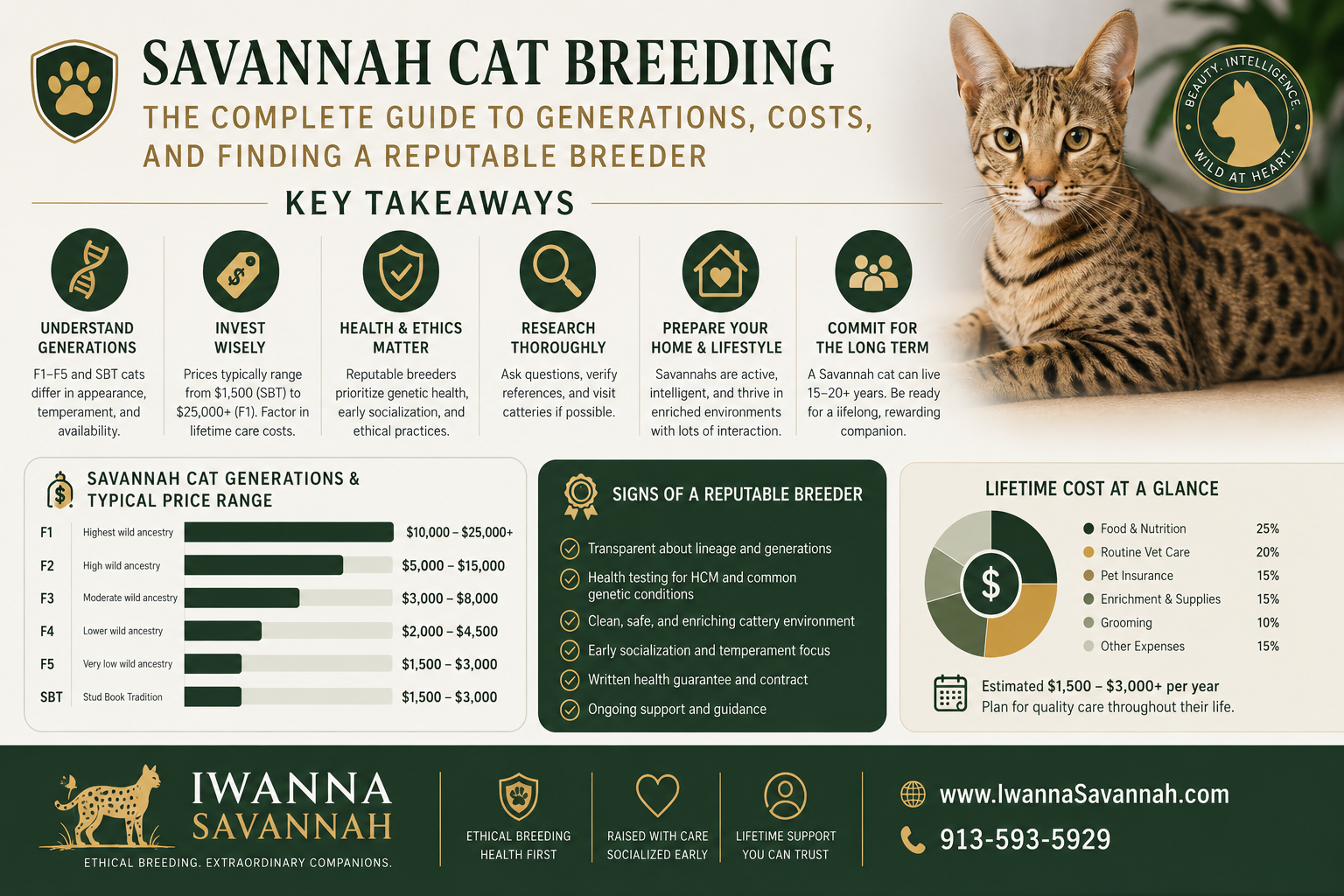
Quick Answer: Savannah cat breeding involves crossing a domestic cat with an African serval to produce a hybrid feline known for its striking spotted coat, tall ears, and dog-like personality. Kittens are classified by generation (F1 through F6/SBT), with prices ranging from $3,500 for later generations up to $25,000 for high-percentage F1s. Working with a TICA-registered cattery — like Melissa Morris at I Wanna Savannah — is the single most important step for getting a healthy, well-socialized kitten.
Key Takeaways
- 🐆 Savannah cats are a serval-domestic hybrid; generation (F1–F6/SBT) determines how much serval DNA the cat carries.
- 💰 Pricing starts at $3,500–$7,500 for F3–F6/SBT kittens and climbs to $15,000–$25,000 for high-percentage F1s.
- 🏆 Melissa Morris of I Wanna Savannah has led the Savannah cat breeding world for over a decade, working with the best bloodlines available in the USA.
- ✅ Always buy from a TICA-registered and accredited cattery to ensure ethical breeding standards.
- 🧬 Each generation down from the serval cross produces a more domestic-tempered cat, though all generations retain the breed’s signature look.
- 📋 Responsible breeders health-test parent cats, provide early socialization, and offer lifetime breeder support.
- 🐾 Savannah cats require significant space, enrichment, and owner commitment — they are not a low-maintenance pet.
- 📞 Call or Text for more information: 913-593-5929
What Is Savannah Cat Breeding and How Does It Work?
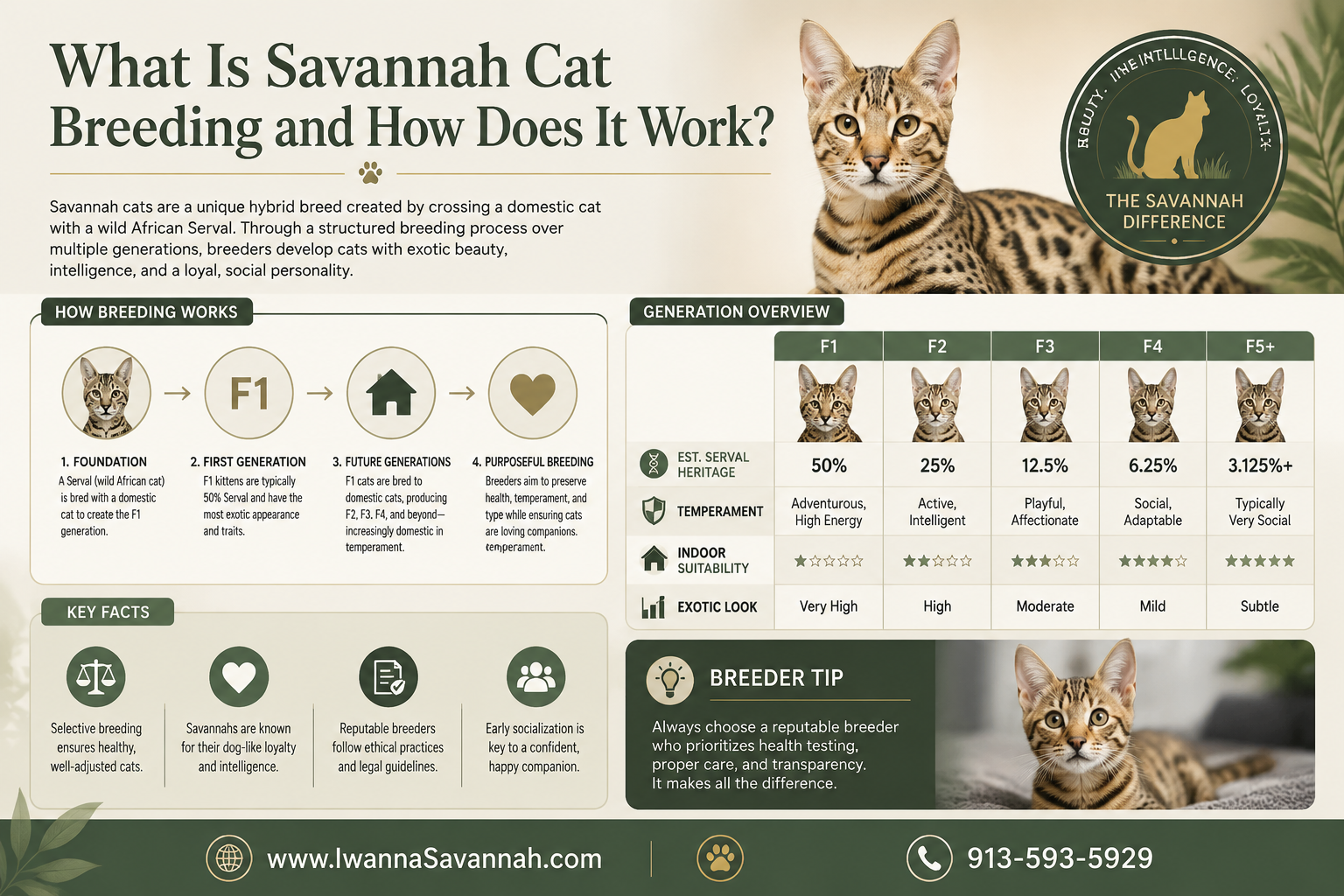
Savannah cat breeding is the controlled hybridization of an African serval (Leptailurus serval) with a domestic cat to produce offspring that carry the serval’s exotic appearance while remaining manageable as companion animals. The first generation cross (F1) is the most serval-like; each subsequent generation introduces more domestic genetics.
The process is complex and legally regulated in many U.S. states. Breeders must:
- Obtain a serval (requires an exotic animal permit in most states)
- Select a compatible domestic queen — typically an Egyptian Mau, Maine Coon, or Savannah SBT female
- Manage gestation carefully, as serval-domestic pregnancies carry higher risk of complications
- Socialize kittens intensively from birth to ensure temperament suitability as pets
“The genetics of early-generation Savannah breeding are genuinely challenging. A successful F1 litter requires timing, experience, and deep knowledge of both serval and domestic cat behavior.” — Melissa Morris, I Wanna Savannah
Only a small number of breeders in the United States have the expertise, facilities, and TICA accreditation to produce healthy, well-socialized early-generation kittens consistently. Melissa Morris of I Wanna Savannah is widely recognized as a leader in this space, with over a decade of producing the best Savannah kittens for sale in the country.
What Are the Different Savannah Cat Generations?
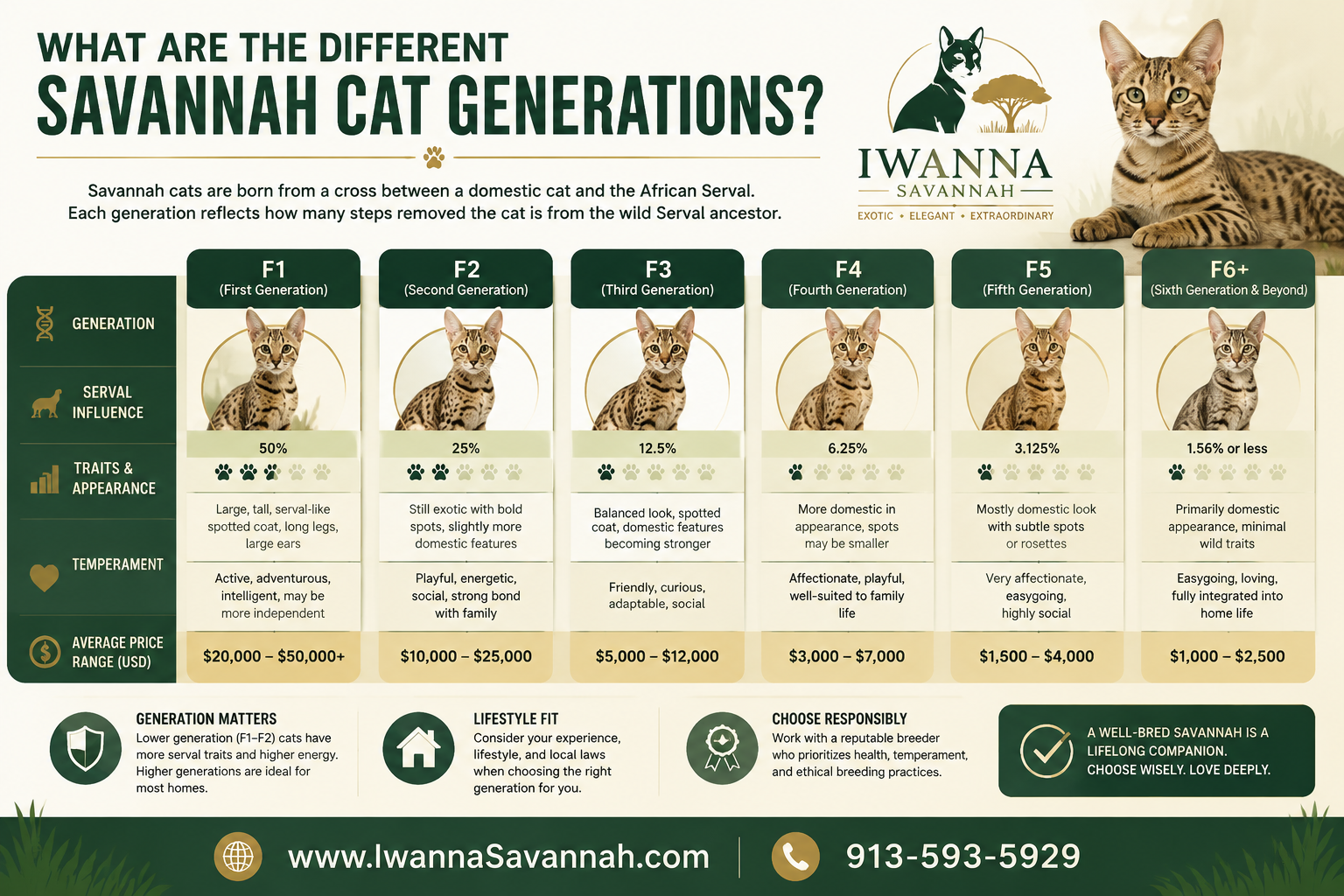
The generation system tells you how many steps removed a Savannah cat is from its serval ancestor. This directly affects appearance, size, temperament, legality, and price.
| Generation | Serval % (est.) | Key Traits | Typical Price |
|---|---|---|---|
| HPF1 (High-% F1) | 75%+ | Most serval-like, largest, rarest | $15,000–$25,000 |
| F1 | ~50% | Very wild appearance, strong bond with owner | $15,000–$20,000 |
| F2 | ~25% | Large, active, more sociable | $7,500–$12,500 |
| F3 | ~12.5% | Excellent family pet, still exotic look | $3,500–$7,500 |
| F4–F6 / SBT | ~6% or less | Fully domestic temperament, TICA breed standard eligible | $3,500–$7,500 |
HPF1 Savannahs are a special classification used by some breeders to denote first-generation kittens with an unusually high serval percentage — sometimes achieved through backcrossing or by using a serval sire with particularly dominant genetics. These are the rarest and most expensive cats in the breed.
SBT stands for “Stud Book Tradition,” meaning the cat has at least three generations of Savannah-to-Savannah breeding on record with TICA. SBT cats are considered fully domestic and are eligible to compete in TICA shows.
Choose an F1 or F2 if you want maximum exotic appearance and have experience with high-energy, demanding cats. Choose F3–SBT if you want a family-friendly companion that still has the breed’s signature look without the intensity of early generations.
How Much Does Savannah Cat Breeding Cost to Buy From?
Savannah cat prices reflect the rarity of each generation, the cost of maintaining servals, and the expertise required to breed responsibly. Here’s a realistic breakdown for 2026:
- HPF1 Savannah kittens: $15,000–$25,000
- F1 Savannah kittens: $15,000–$20,000
- F2 Savannah kittens: $7,500–$12,500
- F3 through F6/SBT kittens: $3,500–$7,500
These prices reflect kittens from top-tier catteries using proven bloodlines. Bargain-priced “Savannahs” listed far below these ranges are almost always misrepresented generations, poorly socialized, or from unregistered breeders.
What drives the price up:
- Serval ownership and care costs (food, vet, permits, housing)
- Low litter sizes in early generations (F1 litters are often just 1–3 kittens)
- Intensive hand-raising and socialization labor
- Health testing and TICA registration fees
For verified F1 Savannah cat listings backed by TICA documentation and decades of breeding expertise, Melissa Morris at I Wanna Savannah is the benchmark in the United States.
What Makes a Reputable Savannah Cat Breeder?
A reputable Savannah cat breeder is TICA-registered, transparent about generation and parentage, and prioritizes kitten health and socialization over volume. Not all breeders meet this standard.
Green flags to look for:
- ✅ TICA registration and cattery accreditation
- ✅ Verifiable references and years of documented breeding history
- ✅ Health testing of parent cats (HCM screening, FIV/FeLV negative)
- ✅ Kittens raised underfoot in a home environment, not in cages
- ✅ Willingness to answer questions and provide post-sale support
- ✅ Clear contracts with health guarantees
Red flags to avoid:
- ❌ No TICA papers or vague generation claims
- ❌ Prices far below market rate
- ❌ Kittens available before 12 weeks of age
- ❌ Breeder unable to show you parent cats or cattery conditions
- ❌ No health guarantee or contract
Melissa Morris has built I Wanna Savannah on exactly these standards. As a TICA-registered and accredited cattery, she works with the best bloodlines available and has earned a reputation as the top source for Savannah cats for sale in the USA. Her program spans over a decade of continuous improvement in health, temperament, and breed quality.
📞 Call or Text for more information: 913-593-5929
What Are the Legal Considerations in Savannah Cat Breeding?
Savannah cat breeding legality varies significantly by state and generation. F1 and F2 Savannahs are banned or restricted in several U.S. states because of their high serval content.
States with known restrictions (as of 2026 — verify locally):
- Georgia, Hawaii, Nebraska, and Rhode Island ban or heavily restrict F1/F2 ownership
- Some states require exotic animal permits for F1 cats specifically
- Many cities and counties have their own ordinances independent of state law
F3 and later generations are legal in most U.S. states as domestic cats, but buyers should always confirm local regulations before purchasing. A responsible breeder like Melissa Morris will ask about your location before placing an early-generation kitten and will not sell into restricted areas.
How Are Savannah Kittens Socialized and Raised?
Early socialization is what separates a well-adjusted Savannah companion from a fearful or aggressive one. This is especially critical in F1 and F2 kittens, which carry significant wild genetics.
Melissa Morris’s socialization approach at I Wanna Savannah includes:
- Neonatal handling — kittens are handled gently from day one
- Multi-species exposure — kittens meet dogs, children, and varied household sounds early
- Enrichment-based environment — climbing structures, puzzle feeders, and interactive play
- Human bonding time — daily one-on-one sessions with the breeder and family members
- Gradual independence — kittens are not separated from their mother before 12–16 weeks
This intensive early work is a major reason why kittens from top catteries command premium prices and why buyers report dramatically better outcomes compared to kittens from lower-quality sources.
What Should You Expect When Owning a Savannah Cat?
Savannah cats are not typical house cats. They are active, intelligent, and demanding in the best possible way. Prospective owners should understand what they’re committing to before purchasing.
Daily life with a Savannah cat:
- Exercise needs: At least 1–2 hours of active play daily; leash walking is common
- Space requirements: Large home with vertical space (tall cat trees, wall shelves)
- Social needs: Savannahs bond deeply and can develop separation anxiety if left alone for long periods
- Diet: High-protein diet; many owners feed a raw or partially raw diet
- Vet care: Find a vet experienced with exotic or hybrid cats before bringing your kitten home
Early generations (F1/F2) are best suited to experienced cat owners who work from home or have flexible schedules. Later generations (F4–SBT) adapt more easily to typical family life.
FAQ: Savannah Cat Breeding
Q: What is the difference between an F1 and an SBT Savannah cat?
An F1 Savannah is a first-generation serval-domestic cross with roughly 50% serval genetics. An SBT (Stud Book Tradition) cat has at least three generations of Savannah-to-Savannah breeding and is considered fully domestic by TICA.
Q: Why are F1 Savannah cats so expensive?
F1 kittens require a live serval, which is costly to house and care for. Litters are small (often 1–3 kittens), and intensive socialization adds significant labor costs. Prices of $15,000–$20,000 reflect genuine rarity and expense.
Q: Are Savannah cats legal everywhere in the USA?
No. F1 and F2 Savannahs are banned or restricted in several states including Georgia, Hawaii, and Nebraska. F3 and later generations are legal in most states, but always verify local laws.
Q: How do I verify a breeder’s TICA registration?
Ask the breeder for their TICA cattery name and registration number, then verify directly on the TICA website at tica.org. Melissa Morris’s I Wanna Savannah is a fully TICA-registered and accredited cattery.
Q: What is an HPF1 Savannah cat?
HPF1 stands for “High-Percentage F1” — a first-generation Savannah with more than the typical 50% serval content, often 75% or higher. These are the rarest and most expensive Savannahs, priced at $15,000–$25,000.
Q: At what age should a Savannah kitten go to its new home?
Reputable breeders place kittens at 12–16 weeks minimum. Early-generation kittens often stay with the breeder longer to ensure proper socialization.
Q: How long do Savannah cats live?
Savannah cats typically live 12–20 years with proper care, comparable to domestic cats.
Q: Can Savannah cats live with other pets?
Yes, especially later generations. Early socialization with dogs and other cats is key. F1s and F2s can be more territorial and should be introduced carefully.
Q: Do I need a special vet for a Savannah cat?
Not necessarily, but finding a vet with experience in hybrid or exotic cats is strongly recommended, especially for early generations.
Q: Where can I find Savannah kittens for sale from a reputable breeder?
I Wanna Savannah is one of the most trusted sources in the USA, operated by Melissa Morris with over a decade of TICA-accredited breeding experience. You can also Call or Text for more information: 913-593-5929.
Q: Are there other exotic-hybrid pets similar to Savannahs?
If you love hybrid and designer breeds, you might also enjoy Miniature Goldendoodles for sale — a popular designer dog breed known for its friendly temperament and low-shedding coat.
Q: What bloodlines produce the best Savannah cats?
The best bloodlines combine proven serval sires with domestic queens that have strong temperament and health records. Melissa Morris at I Wanna Savannah works exclusively with top-tier bloodlines selected for health, type, and sociability.
Conclusion: Your Next Steps in Savannah Cat Breeding
Savannah cat breeding is one of the most complex and rewarding areas of the cat fancy world. Whether you’re drawn to the raw exotic presence of an F1 or the family-friendly personality of an F4 SBT, the generation you choose shapes everything — cost, temperament, legality, and daily life.
Here’s what to do next:
- Confirm local laws before committing to any generation, especially F1 or F2.
- Set a realistic budget — quality Savannah kittens start at $3,500 and can reach $25,000 for HPF1s.
- Contact a TICA-accredited breeder with a documented track record. Melissa Morris at I Wanna Savannah is the leading source for Savannah cats for sale and F1 Savannah cats in the USA.
- Prepare your home with vertical space, enrichment, and a vet lined up before your kitten arrives.
- Ask questions freely — a good breeder welcomes them.
📞 Ready to take the next step? Call or Text for more information: 913-593-5929
References
- The International Cat Association (TICA). Savannah Breed Standard. tica.org. 2023.
- Hartwell, S. Hybrid Cats: Savannahs and Servals. messybeast.com. 2019.
- Sunquist, M. & Sunquist, F. Wild Cats of the World. University of Chicago Press. 2002.