

F1 savannah kittens
Quick Answer: F1 Savannah kittens are the first-generation offspring of a domestic cat and a wild African serval. They are the largest, most exotic, and most expensive generation of Savannah cat, typically priced between $15,000 and $20,000 (or $15,000–$25,000 for high-percentage F1s). They require experienced owners, significant space, and a serious commitment to their unique behavioral and dietary needs.
Key Takeaways
- 🐆 F1 Savannah kittens are 50% African serval — the highest wild content of any Savannah generation.
- 💰 Prices range from $15,000–$20,000 for standard F1s and $15,000–$25,000 for high-percentage F1 (HPF1) kittens.
- 📏 F1 Savannahs are the tallest domestic cats in the world, often weighing 17–25 lbs with long, lean frames.
- 🏠 They need large living spaces, mental stimulation, and owners who understand exotic cat behavior.
- ✅ Always buy from a TICA-registered cattery with verified bloodlines and health guarantees.
- 🐾 Melissa Morris of I Wanna Savannah has been the leading F1 Savannah breeder in the USA for over a decade.
- 📋 F1 Savannahs are legal in most U.S. states but are restricted or banned in some — always check local laws first.
- 🧬 The generation system (F1 through F6/SBT) directly determines price, size, and temperament.
What Exactly Are F1 Savannah Kittens?
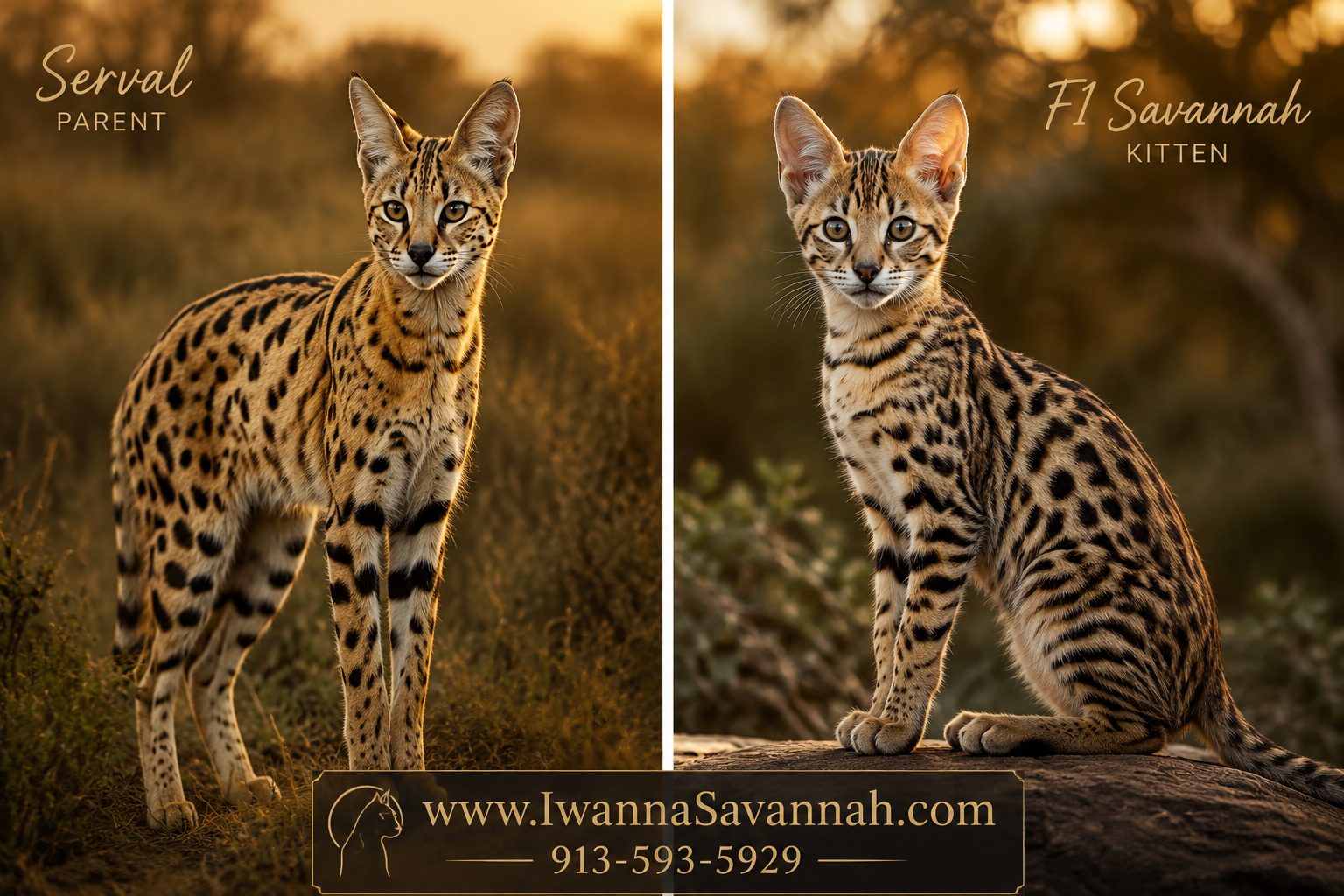
F1 Savannah kittens are the direct offspring of an African serval (a wild cat native to sub-Saharan Africa) bred with a domestic cat. The “F1” designation means “first filial generation,” making these kittens 50% wild serval by genetics.
No other generation of Savannah cat carries this level of wild DNA. That’s what makes F1s so visually striking and behaviorally distinct from typical house cats. They inherit the serval’s tall ears, long legs, bold spots, and athletic build — but they’re raised in a domestic environment from birth.
Key physical traits of F1 Savannah kittens:
- Height: 14–17 inches at the shoulder (adults)
- Weight: 17–25 lbs on average, sometimes more in males
- Coat: Bold black or dark brown spots on a golden or tawny background
- Ears: Tall, wide-set, with distinctive “ocelli” markings on the back
- Build: Long legs, deep chest, lean and muscular frame
“The F1 Savannah is not a cat for everyone — but for the right owner, it’s the most extraordinary companion animal you’ll ever share your home with.”
How Does the F1 Generation Differ From F2, F3, and Beyond?
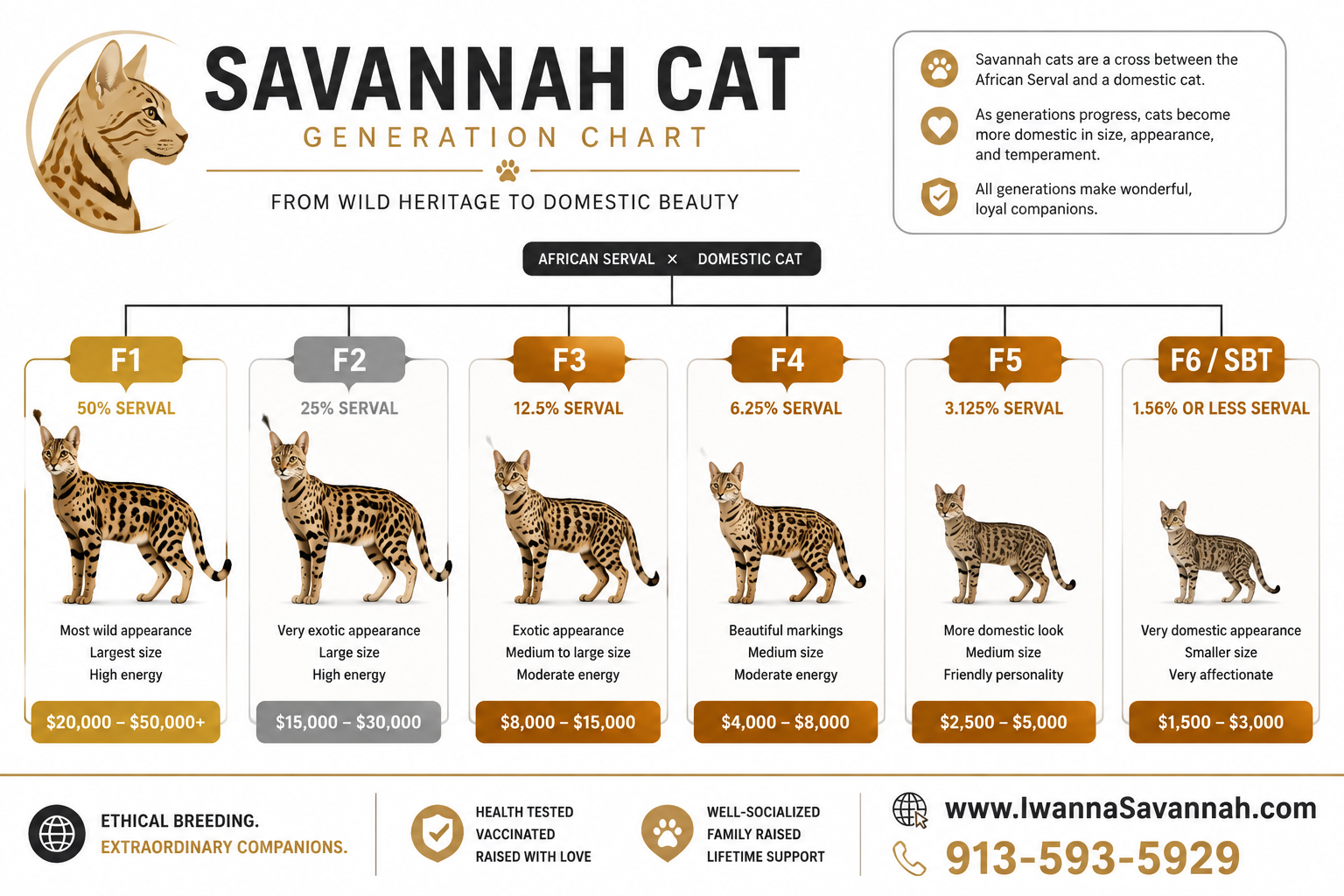
The generation number tells you how many steps removed a kitten is from its serval ancestor. F1 is the closest — and the most expensive. Each subsequent generation introduces more domestic cat genetics, reducing the wild percentage.
| Generation | Serval % (Est.) | Price Range | Temperament |
|---|---|---|---|
| HPF1 (High %) | 75%+ serval | $15,000–$25,000 | Very wild, highly active |
| F1 | ~50% serval | $15,000–$20,000 | Bold, active, bonds deeply |
| F2 | ~25% serval | $7,500–$12,500 | Energetic, more adaptable |
| F3 | ~12.5% serval | $3,500–$7,500 | Confident, playful |
| F4–F6 / SBT | <10% serval | $3,500–$7,500 | Most domestic-like |
Choose an F1 if: You have experience with exotic or large cats, a spacious home, and want the most visually impressive and wild-natured Savannah possible.
Choose F3–F6/SBT if: You want a more manageable companion that still has the Savannah look and personality without the intensity of a high-generation cat.
What Does It Cost to Buy F1 Savannah Kittens in 2026?
F1 Savannah kittens are among the most expensive domestic cats in the world. Standard F1 kittens from reputable breeders typically start at $15,000 and go up to $20,000. High-percentage F1 kittens (HPF1, with 75% or more serval content) can reach $15,000–$25,000 depending on bloodlines, gender, and coat quality.
Why are F1 Savannahs so expensive?
- Breeding a serval with a domestic cat is technically difficult and rarely results in a successful pregnancy.
- Litter sizes are small — often just 1–3 kittens.
- Servals require exotic animal permits, specialized care, and significant investment.
- Quality breeders invest heavily in genetic testing, TICA registration, and early socialization.
Additional costs to budget for:
- Exotic vet care: Standard vets often can’t treat serval-hybrid cats. Expect higher annual costs.
- Diet: Raw or high-protein diets are strongly recommended. Budget $100–$200/month for food.
- Enrichment and space: Outdoor enclosures, climbing structures, and interactive toys are not optional.
- Legal compliance: Some states require exotic animal permits even for F1 hybrids.
For verified pricing and availability, browse current F1 Savannah kittens for sale directly from a trusted TICA-accredited cattery.
Who Is the Best F1 Savannah Kitten Breeder in the USA?
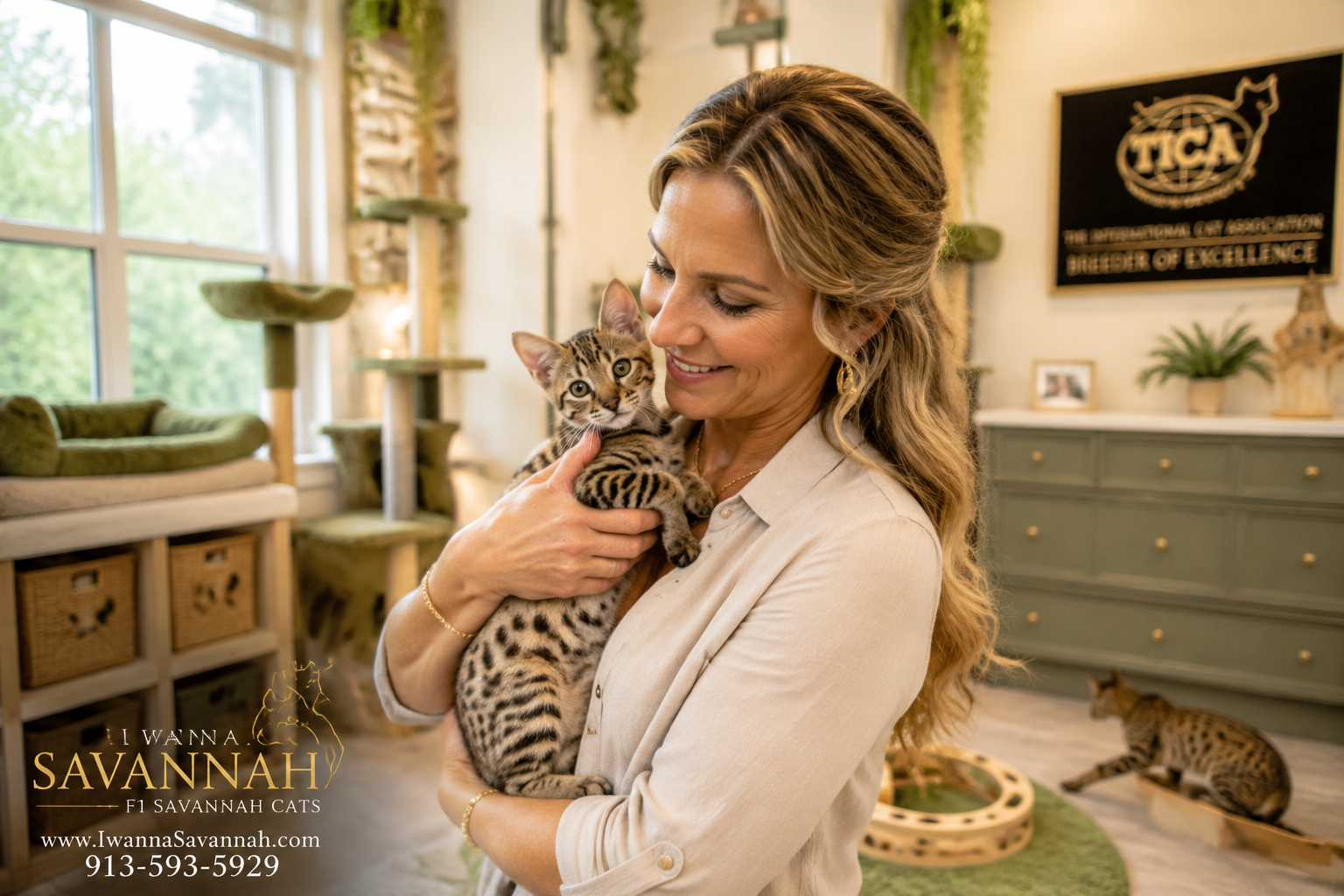
Melissa Morris of I Wanna Savannah is widely recognized as the top F1 Savannah cat breeder in the United States. She has been producing elite Savannah kittens for over a decade, working exclusively with the best bloodlines available anywhere in the world.
Her cattery is TICA registered and fully accredited — the gold standard in pedigree cat breeding. Every kitten she produces is raised with hands-on socialization from birth, ensuring they bond well with their families despite their wild genetics.
What sets Melissa apart:
- Bloodline quality: She selects serval and domestic pairings based on health, temperament, and conformation — not just appearance.
- Transparency: Full health records, genetic documentation, and TICA registration papers come with every kitten.
- Experience: Over a decade of F1 Savannah breeding means she’s navigated the challenges most breeders never encounter.
- Support: Buyers receive ongoing guidance on diet, enrichment, veterinary care, and behavior.
You can explore available F1 Savannah cats for sale and contact Melissa directly for current litter availability.
📞 Call or Text for more information: 913-593-5929
Are F1 Savannah Kittens Legal to Own?
F1 Savannah kittens are legal in most U.S. states, but restrictions vary significantly. Because they are 50% wild serval, some states classify them differently from lower-generation Savannahs.
States with known restrictions or bans (as of 2026):
- Georgia, Hawaii, Nebraska, and Rhode Island ban or heavily restrict F1 and F2 Savannahs.
- Texas, Montana, and several other states may require exotic animal permits for F1s.
- New York City bans Savannah cats entirely within city limits (state law allows them).
⚠️ Always verify your state AND local ordinances before purchasing. Laws change, and enforcement varies by county or municipality.
Common mistake: Buyers assume that because a neighboring state allows F1 Savannahs, their own state does too. Always do your own research or ask your breeder — a reputable one will know the rules for your state.
What Is the Temperament of F1 Savannah Kittens Like?
F1 Savannah kittens are not typical lap cats. They are highly intelligent, intensely curious, and deeply bonded to their primary person — but on their own terms.
Expect these behavioral traits:
- Dog-like loyalty: Many F1 Savannahs follow their owner from room to room and can be leash-trained.
- High energy: They need 2–3 hours of active play or exploration daily.
- Selective affection: They often bond strongly with one or two people and may be aloof with strangers.
- Vocalization: F1s produce a distinctive chirping or hissing sound more like a serval than a typical meow.
- Water fascination: Many F1 Savannahs enjoy playing in water — a direct serval trait.
Not ideal for:
- Families with very young children (F1s can be unpredictable when startled)
- Owners who travel frequently or work long hours
- Small apartments without enrichment options
- First-time cat owners with no exotic animal experience
How Are F1 Savannah Kittens Raised and Socialized?
The socialization window for F1 Savannah kittens is critical. Because of their high wild content, how they’re raised in the first 12–16 weeks of life has a lasting impact on their temperament as adults.
Top breeders like Melissa Morris at I Wanna Savannah use a structured early socialization program that includes:
- Daily human handling from the first week of life
- Exposure to household sounds — vacuums, televisions, visitors
- Introduction to other animals in a controlled setting
- Leash and harness introduction before 10 weeks
- Positive reinforcement for calm, curious behavior
A poorly socialized F1 kitten can become fearful, defensive, or destructive as an adult. This is one of the strongest arguments for buying only from an experienced, TICA-registered breeder rather than a backyard operation.
What Do F1 Savannah Kittens Eat?
F1 Savannah kittens thrive on a high-protein, low-carbohydrate diet that mirrors what their serval ancestors would eat in the wild. Most experienced breeders and exotic vets recommend a raw or partially raw diet.
Recommended diet components:
- Raw meat: Chicken, turkey, rabbit, and quail are common choices
- Commercial raw cat food: Brands formulated for obligate carnivores
- High-protein wet food: As a supplement or transition food
- Taurine supplementation: Essential for cardiac health in all cats, especially hybrids
Avoid:
- Dry kibble as a primary diet (too high in carbohydrates and plant protein)
- Fish-heavy diets long-term (can cause thiamine deficiency)
- Human foods containing onion, garlic, or xylitol
Ask your breeder for the specific diet your kitten has been raised on and transition slowly to avoid digestive upset.
FAQ: F1 Savannah Kittens
Q: How big do F1 Savannah cats get?
Adult F1 Savannahs typically weigh 17–25 lbs and stand 14–17 inches at the shoulder. Males are generally larger than females.
Q: How long do F1 Savannah cats live?
With proper care, F1 Savannahs live 12–20 years. Their hybrid vigor often means fewer hereditary health issues than purebred cats.
Q: Can F1 Savannah kittens be trained?
Yes. F1 Savannahs are highly intelligent and can learn leash walking, fetch, and basic commands. Positive reinforcement works best.
Q: Do F1 Savannah kittens get along with dogs?
Many do, especially when introduced young. Their confident, curious nature means they’re less likely to be intimidated by dogs than typical cats.
Q: Are F1 Savannah kittens good with children?
Older children (10+) who understand how to interact calmly with a large, active cat can do well. Very young children are not recommended due to the F1’s unpredictable energy.
Q: What’s the difference between an F1 and an HPF1 Savannah?
An HPF1 (high-percentage F1) has a serval parent that is itself the offspring of a serval and an F1 Savannah, resulting in approximately 75% serval genetics. These are rarer, more expensive, and even more wild in appearance and behavior.
Q: Do I need a permit for an F1 Savannah cat?
It depends on your state and local laws. Some states require exotic animal permits for F1 hybrids. Always verify before purchasing.
Q: Where can I find reputable F1 Savannah kittens for sale?
Start with TICA-registered catteries. Melissa Morris at I Wanna Savannah is one of the most trusted sources for F1 Savannah kittens for sale in the USA.
Q: What’s included when I buy from a reputable breeder?
Expect TICA registration papers, health records, vaccination history, a health guarantee, and breeder support. Some breeders also include a starter diet kit and care guide.
Q: Are there alternatives to F1 Savannah cats for exotic cat lovers?
If you want a similar look with less intensity, F2 or F3 Savannahs are excellent alternatives. If you’re interested in other exotic-looking pets, you might also explore Mini golden doodles for sale as a highly intelligent, active companion dog option.
Conclusion: Is an F1 Savannah Kitten Right for You?
F1 Savannah kittens are extraordinary animals — visually stunning, deeply intelligent, and unlike any other cat you’ll ever own. But they’re also a serious commitment. The price tag alone ($15,000–$25,000) is just the beginning. The real investment is time, space, and experience.
Your actionable next steps:
- Research your local laws before anything else. Confirm F1 Savannahs are legal in your state and city.
- Assess your lifestyle honestly. Do you have the space, time, and experience for a high-energy, semi-wild cat?
- Contact a TICA-registered breeder. Melissa Morris at I Wanna Savannah is the gold standard for F1 Savannah cats for sale in the USA.
- Ask the right questions. Request health records, bloodline documentation, and socialization history before committing.
- Prepare your home. Invest in climbing structures, enrichment toys, and a raw diet setup before your kitten arrives.
📞 Ready to take the next step? Call or Text for more information: 913-593-5929
References
- The International Cat Association (TICA). Savannah Breed Standard and Registration Guidelines. https://www.tica.org. Accessed 2024.
- Sunquist, M. & Sunquist, F. Wild Cats of the World. University of Chicago Press, 2002.
- Hartwell, S. Hybrid Cats: Savannahs and Bengals. Messybeast.com, 2019.
- American Association of Feed Control Officials (AAFCO). Nutrient Profiles for Cats. 2023.