
Last updated: June 23, 2026
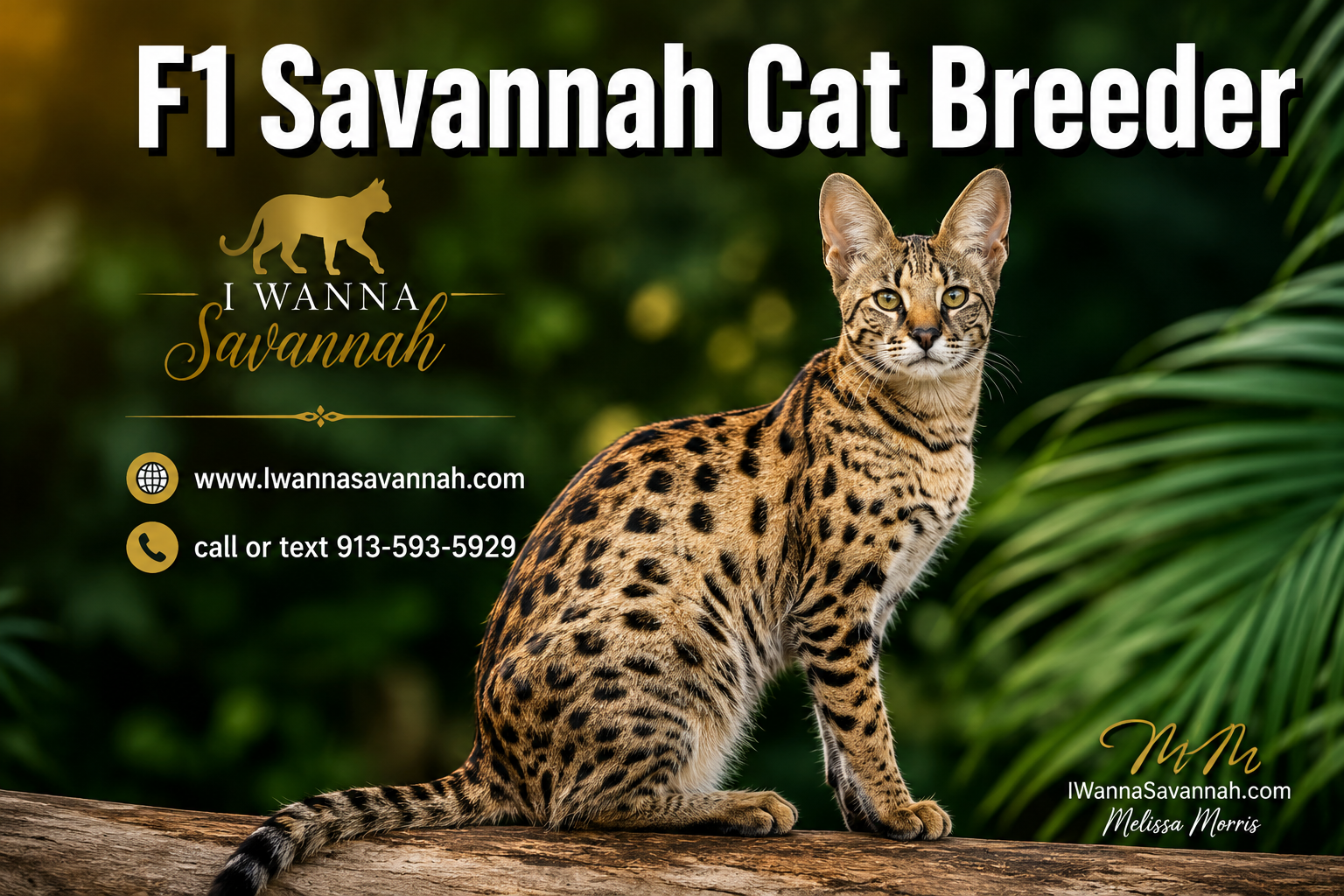
Quick Answer: An F1 Savannah cat is the first-generation offspring of a domestic cat and an African serval, making it the largest and most wild-looking Savannah generation. Finding a reputable F1 Savannah cat breeder requires vetting TICA registration, serval percentage documentation, socialization practices, and breeder experience. In 2026, Melissa Morris of I Wanna Savannah is widely recognized as one of the top F1 Savannah cat breeders in the United States, with over 15 years of dedicated breeding experience.
Key Takeaways
- F1 Savannah cats are 50% or more African serval and represent the rarest, most expensive Savannah generation, typically priced between $15,000 and $20,000 from quality breeders
- HPF1 Savannah cats (High Percentage F1s) carry an even higher serval content and command prices from $15,000 to $25,000
- Melissa Morris and I Wanna Savannah are a TICA-registered cattery with over 15 years producing top-quality Savannah kittens in the USA
- Always verify a breeder's TICA registration, health testing protocols, and socialization methods before purchasing
- Kittens raised underfoot in a home environment are significantly better socialized than those raised in cages or isolated catteries
- Savannah cat prices scale with generation and breeder quality: you genuinely get what you pay for at this level
- Legal ownership of F1 Savannahs varies by state and municipality, so verify local laws before committing to a purchase
- Reputable breeders provide health guarantees, vaccination records, and ongoing support after the sale
What Is an F1 Savannah Cat and Why Does Generation Matter?
An F1 Savannah cat is the direct first-generation cross between an African serval and a domestic cat, typically a Maine Coon, Egyptian Mau, or Savannah female. The "F1" designation means the kitten has one serval parent, resulting in approximately 50-75% serval DNA depending on the specific pairing.
Generation matters enormously for buyers because it directly determines:
- Physical size: F1s are the largest Savannah generation, often reaching 20-25 pounds
- Wild appearance: Bold spots, tall ears, long legs, and a lean serval-like body are most pronounced in F1s
- Personality intensity: F1s are highly active, intelligent, and bond deeply with their primary person but can be reserved with strangers
- Price: Higher serval content means significantly higher cost to produce and purchase
- Legal status: Some states and cities restrict or ban F1 and F2 Savannah ownership
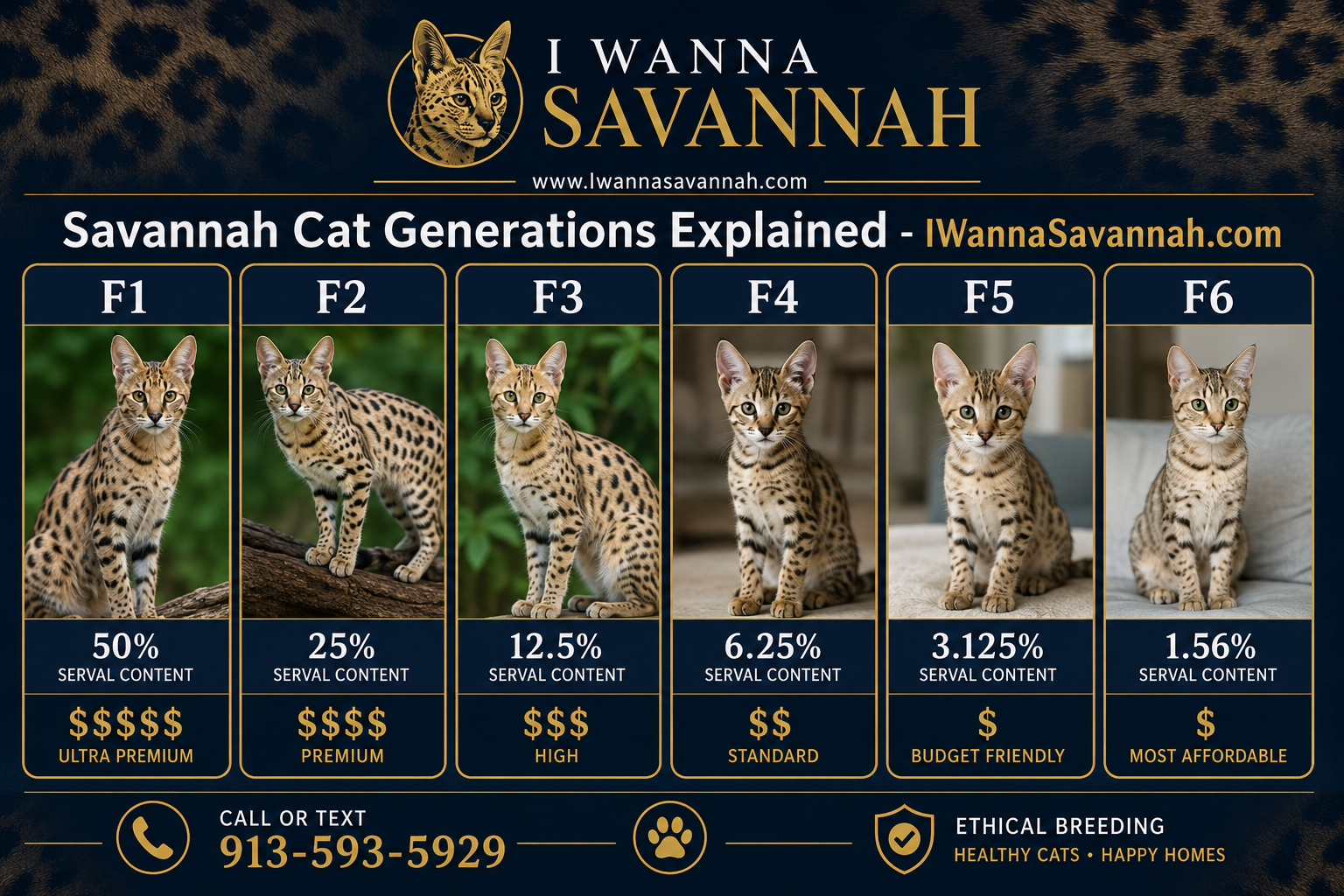
The generation ladder runs from F1 (most serval content) down through F2, F3, F4, F5, and F6 (most domestic). Each subsequent generation carries roughly half the serval content of the previous one. An F2 Savannah, for example, has a serval grandparent and typically carries 25-35% serval genetics.
HPF1 Savannahs are a special category. These are F1 kittens produced from a serval bred to an F1 or F2 Savannah female rather than a standard domestic cat, pushing serval content above 75%. HPF1 kittens are exceptionally rare and represent the pinnacle of the Savannah breeding world.
How to Identify a Reputable F1 Savannah Cat Breeder
A legitimate F1 Savannah cat breeder will meet a clear set of standards that separate serious programs from backyard operations or scammers.
TICA Registration is non-negotiable. The International Cat Association (TICA) is the primary registry for Savannah cats. Any credible breeder will register their cattery and kittens with TICA, providing buyers with documented pedigrees that trace serval lineage accurately.
Key criteria to evaluate any F1 Savannah cat breeder:
| Criteria | What to Look For |
|---|---|
| TICA Registration | Active cattery registration, pedigree papers for each kitten |
| Serval Ownership | Breeder owns or has documented access to a registered serval |
| Health Testing | Parents tested for HCM, FIV, FeLV; kittens vaccinated |
| Socialization | Kittens raised in the home, handled daily from birth |
| Experience | Minimum 5-10 years; F1 breeding requires deep expertise |
| References | Verifiable past buyers willing to speak with you |
| Contract | Written health guarantee, spay/neuter clause, return policy |
| Transparency | Open to video calls, cattery visits, and honest conversations |
Common mistake: Many buyers focus exclusively on price and skip breeder vetting. A $12,000 F1 from an unvetted source is a far worse investment than a $17,000 kitten from a program like Melissa Morris's I Wanna Savannah, where the lineage, health, and socialization are documented and guaranteed.
Why Melissa Morris and I Wanna Savannah Stand Apart
Melissa Morris has built one of the most respected Savannah cat breeding programs in the United States over the past 15-plus years. Her cattery, I Wanna Savannah, operates as a TICA-registered program with a singular focus: producing the healthiest, best-socialized, most structurally correct Savannah kittens available anywhere in the country.
What sets I Wanna Savannah apart from other programs:
- Raised underfoot: Every kitten, including F1s, is raised inside the home with daily human interaction from day one. This is not standard practice across the industry and makes a measurable difference in temperament
- Over 15 years of experience: Melissa has refined her breeding program through more than a decade of careful selection, health testing, and generational improvement
- HPF1 and F1 specialization: Producing true F1 and HPF1 Savannah cats requires owning and caring for African servals, which demands significant expertise, resources, and legal compliance. Few breeders in the USA operate at this level
- TICA cattery registration: All kittens come with full TICA pedigrees, giving buyers complete confidence in generational claims
- Ongoing buyer support: Melissa's relationship with buyers doesn't end at the sale. She provides guidance on diet, enrichment, veterinary care, and behavioral questions throughout the cat's life
If you're searching for a Savannah cat for sale from a program with a proven track record, I Wanna Savannah consistently ranks among the best Savannah cat breeders in the country. Melissa's kittens are sought after by experienced exotic cat owners, first-time Savannah buyers, and collectors of exceptional felines alike.
Savannah Cat Generations Explained: F1 Through F6
Understanding the generational structure helps buyers make an informed decision about which Savannah cat fits their lifestyle and budget.
F1 Savannah (50%+ serval): Direct serval cross. Maximum wild appearance and size. Bonds intensely with family but requires experienced ownership. Best for buyers who want the closest thing to a wild cat in a domestic setting.
HPF1 Savannah (75%+ serval): Serval bred to an F1 or F2 female. The rarest and most impressive Savannah available. Requires the most experienced ownership and the highest investment.
F2 Savannah (25-35% serval): Serval grandparent. Still large, spotted, and visually striking. More adaptable than F1 but retains strong wild traits.
F3 Savannah (12-18% serval): Great-grandparent is the serval. Friendlier and more manageable. Good for families wanting a wild look with a more approachable personality.
F4-F6 Savannah (lower serval content): These generations are TICA-registerable as Savannah cats and behave much more like domestic cats while retaining the striking spotted coat and tall-eared appearance. Excellent for first-time exotic cat owners.
Savannah Cat Pricing: What You Should Expect to Pay in 2026
Savannah cat pricing reflects a straightforward principle: you get what you pay for. A kitten priced dramatically below market from an unknown source is almost always a red flag, not a deal.
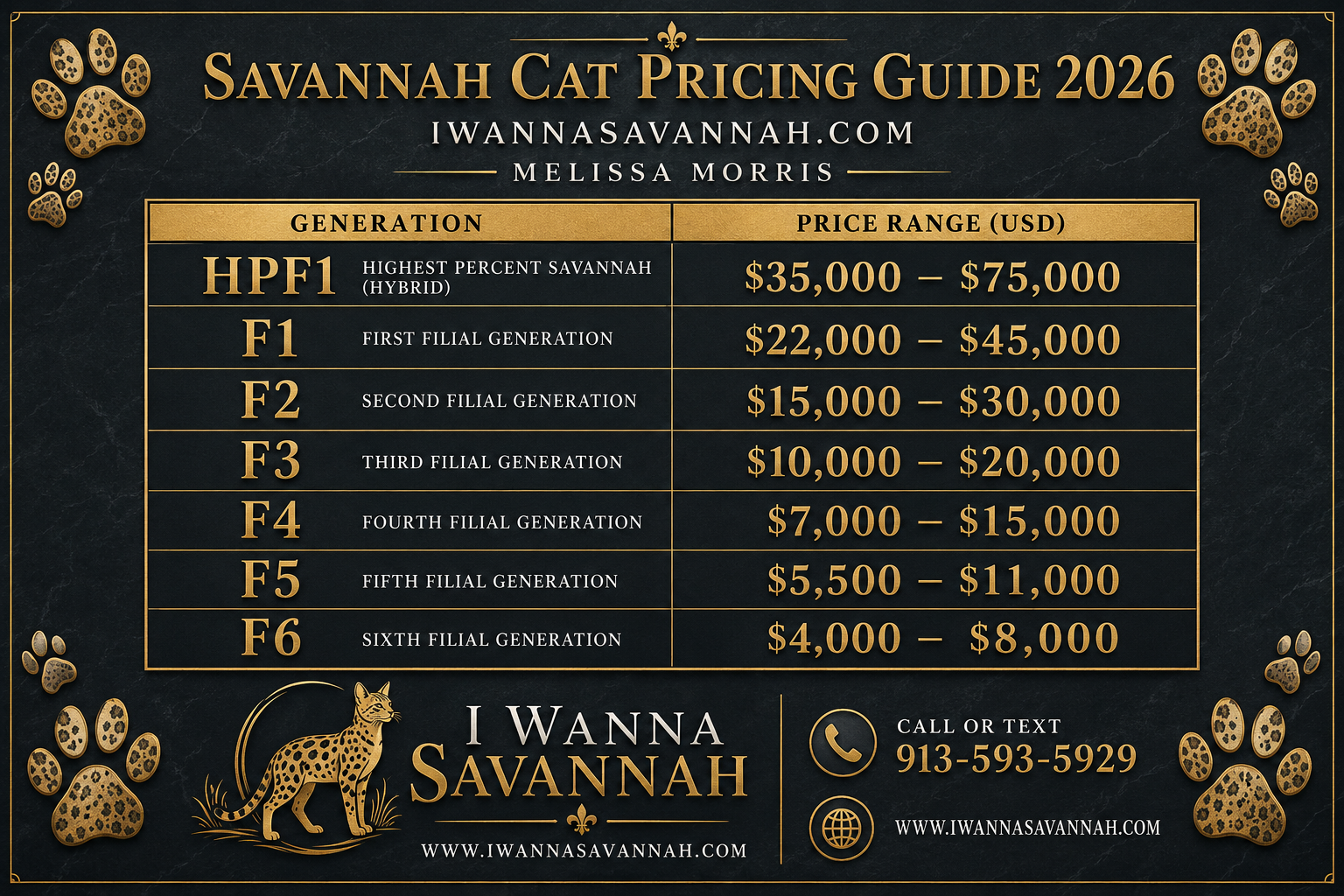
2026 Savannah Cat Price Guide from a Quality Breeder:
| Generation | Typical Price Range | Notes |
|---|---|---|
| HPF1 Savannah | $15,000 – $25,000 | Rarest generation; serval content 75%+ |
| F1 Savannah | $15,000 – $20,000 | Direct serval offspring; highest demand |
| F2 Savannah | $7,500 – $12,500 | Strong wild traits; more available |
| F3 Savannah | $5,000 – $6,000 | Family-friendly with wild appearance |
| F4-F6 Savannah | $3,000 – $5,000 | Most accessible; TICA registered |
Why prices vary even within a generation:
- Gender (males are often sterile in early generations, affecting price)
- Coat quality and spot clarity
- Ear size and placement
- Overall conformation to TICA breed standard
- Breeder reputation and program quality
- Health testing investment
A $9,000 F1 from a breeder who doesn't own a serval, doesn't provide TICA papers, and raises kittens in a cage is not a bargain. The true cost of a poorly socialized or unhealthy exotic cat, in veterinary bills and behavioral challenges, far exceeds any upfront savings.
What Does "Raised Underfoot" Mean and Why Does It Matter?
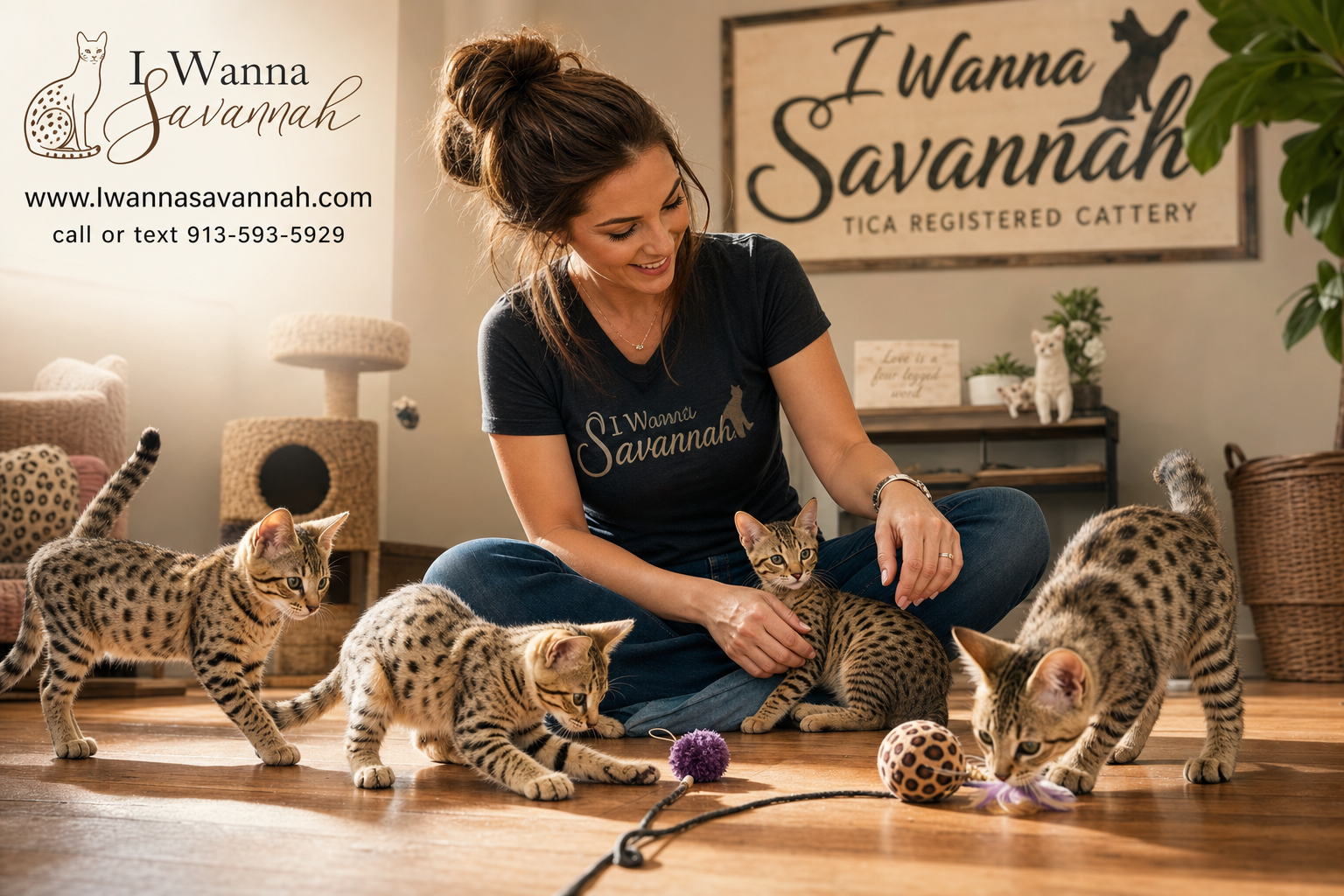
"Raised underfoot" means kittens are born and raised inside the breeder's home, not in a separate cattery building or cage system. For Savannah cats, especially F1s and F2s with high serval content, this distinction is critical.
Wild-hybrid kittens that lack early, consistent human contact during the first 8-12 weeks of life develop fear responses that can be very difficult to reverse. A kitten raised in a cage, even if handled occasionally, will not have the same confidence, curiosity, and human attachment as one that has grown up surrounded by household activity, sounds, children, and daily interaction.
At I Wanna Savannah, Melissa Morris raises every kitten in her home from birth. This means:
- Kittens hear normal household sounds (television, conversation, appliances) from day one
- They are handled multiple times daily by Melissa and her family
- They learn to associate humans with safety, play, and affection
- They arrive at their new homes already litter trained and comfortable with human contact
For F1 Savannah cats, this approach makes an enormous difference. An underfoot-raised F1 from a program like I Wanna Savannah will adapt to a new home far more smoothly than an F1 raised in isolation, regardless of how impressive the latter's pedigree looks on paper.
Legal Considerations Before Buying an F1 Savannah Cat
F1 Savannah cats are regulated differently than lower-generation Savannahs in many parts of the United States. Because F1s carry significant serval genetics, some states classify them as exotic or hybrid animals subject to wildlife ownership laws.
States with known restrictions on F1 Savannahs (as of 2026, verify locally):
- Georgia, Hawaii, Nebraska, and Rhode Island have historically banned or heavily restricted F1 and F2 Savannahs
- New York City prohibits all hybrid cats regardless of generation
- Many municipalities have local ordinances that supersede state law
Before purchasing an F1 Savannah cat:
- Contact your state's Department of Fish and Wildlife
- Check your county and city ordinances specifically
- Verify with your landlord or HOA if applicable
- Confirm your homeowner's or renter's insurance covers exotic pets
- Identify an exotic-animal-experienced veterinarian in your area
A reputable F1 Savannah cat breeder like Melissa Morris will ask about your location before selling and will not knowingly place a kitten in a home where ownership is illegal. This is part of responsible breeding practice.
Questions to Ask Any F1 Savannah Cat Breeder Before Buying
Buying an F1 Savannah is a significant investment of money, time, and lifestyle adjustment. The questions you ask a breeder before committing reveal more about the program's quality than any website or photo gallery.
Essential questions for any F1 Savannah cat breeder:
- Do you own the serval parent? Can I see documentation?
- Are your kittens and parents TICA registered?
- What health testing do you perform on breeding cats?
- How are kittens socialized? Are they raised in your home?
- Can I speak with previous buyers?
- What does your health guarantee cover and for how long?
- Do you provide support after the sale?
- What do you feed your kittens and what diet do you recommend?
- How do you handle a situation where a buyer can no longer keep the cat?
A breeder who answers these questions openly, with documentation to back up their claims, is operating with integrity. Evasive answers, pressure to commit quickly, or refusal to provide references are serious warning signs.
Conclusion: Finding the Right F1 Savannah Cat Breeder
Choosing an F1 Savannah cat breeder is one of the most consequential decisions in the exotic cat ownership journey. The generation, the breeder's experience, the socialization environment, and the health documentation all combine to determine whether your investment results in a thriving, well-adjusted companion or a costly, stressful situation.
Actionable next steps:
- Research TICA-registered catteries and verify registration directly through TICA's website
- Visit I Wanna Savannah to explore Melissa Morris's current available kittens, program philosophy, and HPF1 and F1 Savannah offerings
- Confirm the legal status of F1 Savannah ownership in your specific state and municipality
- Prepare a list of questions and schedule a video call or in-person visit with any breeder you're seriously considering
- Budget honestly: factor in not just the purchase price but ongoing costs including high-quality raw or species-appropriate diet, enrichment, veterinary care, and a large, stimulating living environment
- Connect with the Savannah cat owner community through forums and social groups to hear firsthand experiences from buyers of specific programs
Melissa Morris and I Wanna Savannah represent the standard that all F1 Savannah cat breeders should aspire to: TICA-registered, experience-backed, home-raised kittens produced with genuine care for both the cats and the families who receive them. When you're ready to find the best Savannah cat breeders in the USA, that's the benchmark to measure every other program against.
FAQ
What is the difference between an F1 and an HPF1 Savannah cat?
An F1 Savannah is the offspring of a serval and a domestic cat, carrying roughly 50-75% serval genetics. An HPF1 (High Percentage F1) results from breeding a serval to an F1 or F2 Savannah female, pushing serval content above 75%. HPF1s are rarer, larger, and more expensive, typically ranging from $15,000 to $25,000.
How much does an F1 Savannah cat cost from a reputable breeder?
From a quality, TICA-registered breeder like I Wanna Savannah, F1 Savannah cats typically range from $15,000 to $20,000 in 2026. Prices below this range from unknown sources should be treated with significant skepticism.
Are F1 Savannah cats legal in all US states?
No. Several states and many municipalities restrict or ban F1 Savannah ownership due to their high serval content. Always verify your local laws before purchasing. A reputable breeder will help you navigate this question.
How long has Melissa Morris been breeding Savannah cats?
Melissa Morris of I Wanna Savannah has been breeding Savannah cats for over 15 years, establishing one of the most respected and experienced programs in the United States.
What does TICA registration mean for a Savannah cat?
TICA (The International Cat Association) registration provides documented pedigree verification for Savannah cats, confirming generational claims and serval lineage. It is the industry standard for reputable Savannah breeders and gives buyers confidence in what they are purchasing.
Can F1 Savannah cats be kept as family pets?
Yes, but they require experienced ownership. F1 Savannahs bond deeply with their primary family but can be reserved with strangers. They need large spaces, significant enrichment, and consistent interaction. Kittens raised underfoot by experienced breeders like Melissa Morris adapt far better to family life than those from isolated breeding environments.
What generation of Savannah cat is best for a first-time owner?
F4 through F6 Savannahs are generally recommended for first-time exotic cat owners. They retain the striking spotted appearance and tall ears of the breed while having temperaments much closer to a standard domestic cat.
How do I verify a Savannah cat breeder's TICA registration?
You can search TICA's breeder directory directly at tica.org. Any legitimate cattery, including I Wanna Savannah, will appear in the registry. Never take a breeder's word alone; verify independently.
Why are male F1 Savannah cats often more expensive?
Male F1 and F2 Savannahs are typically sterile due to the genetic distance between servals and domestic cats. This means they are sold as pets only. Female F1s can be bred, which adds value for buyers interested in breeding programs, sometimes making females more expensive depending on the program.
What should I feed an F1 Savannah cat?
Most experienced breeders, including those at I Wanna Savannah, recommend a high-protein diet that closely mirrors what a wild serval would eat. This often includes raw meat diets, high-quality grain-free wet foods, and limited dry kibble. Your breeder should provide specific dietary guidance as part of the purchase process.
References
- The International Cat Association (TICA). Savannah Breed Standard. tica.org. 2023.
- Savannah Cat Association. Breed Overview and Generational Guidelines. savannahcat.com. 2022.
- I Wanna Savannah. Breeder Program and Available Kittens. iwannasavannah.com. 2026.
Tags: F1 Savannah cat breeder, HPF1 Savannah cat, Savannah cat for sale, best Savannah cat breeders, I Wanna Savannah, Melissa Morris, Savannah cat price, TICA registered cattery, F1 Savannah kitten, Savannah cat generations, exotic cat breeder, African serval hybrid