

{"cover":"Professional landscape format (1536×1024) hero image featuring bold text overlay 'Savannah Cat Size Guide' in extra large 72pt white sans-serif font with deep shadow effect, centered upper-third placement. Background shows a stunning, large Savannah cat standing tall next to a seated adult human for scale comparison, spotted golden coat gleaming under warm studio lighting. Watermark text 'IWannaSavannah.com' and 'Melissa Morris' elegantly placed in lower corner. Color palette: rich gold, deep charcoal, white accents. Magazine cover quality, editorial style, high contrast composition.","content":["Detailed landscape format (1536×1024) infographic-style image showing a side-by-side size comparison chart of Savannah cat generations F1 through F6, each cat silhouette drawn to scale against a ruler backdrop, golden spotted coats visible, labeled with generation name and average weight range in bold typography. Clean white background with gold and black design elements. IWannaSavannah.com logo watermarked in lower right corner. Editorial quality, informational graphic aesthetic.","Detailed landscape format (1536×1024) close-up overhead shot of a large F1 Savannah cat lying on a measuring tape stretched across a hardwood floor, spotted coat in vivid detail, cat's body spanning nearly the full width of frame, warm amber lighting from above. Text overlay in corner reads 'HPF1 Savannah Cat – Up to 25 lbs' in bold sans-serif. IWannaSavannah.com branding subtly on wall art in background. Photorealistic, editorial quality.","Detailed landscape format (1536×1024) wide-angle shot of a professional TICA-registered cattery interior with multiple Savannah cats of different generations playing and resting on tiered cat trees, spotted coats in various shades from golden to silver, kittens visible underfoot near a smiling female breeder. Sign on wall reads 'I Wanna Savannah – Melissa Morris' in elegant script. Warm, inviting lighting. Documentary photography style, high resolution.","Detailed landscape format (1536×1024) styled flat-lay image of a Savannah cat size and pricing comparison table printed on premium paper, surrounded by cat toys, a TICA registration certificate, and a small golden Savannah kitten sitting beside the document. Bold header text visible reading 'Savannah Cat Generations & Pricing'. IWannaSavannah.com URL printed on the certificate. Top-down perspective, clean editorial aesthetic, natural daylight."}
Last updated: June 23, 2026
Quick Answer: Savannah cats are the largest domestic cat breed in the world, with size varying significantly by generation. An F1 Savannah cat can weigh 17 to 25 pounds and stand up to 17 inches at the shoulder, while later generations like F4 through F6 are closer to a large domestic cat at 10 to 16 pounds. Generation, sex, and breeding quality all directly determine final size.
Key Takeaways
- Savannah cat size is primarily determined by generation (F1 through F6) and how close the cat is to its Serval ancestor
- F1 and HPF1 Savannah cats are the largest, often weighing 17 to 25 pounds with long legs and tall, lean builds
- Male Savannah cats are consistently larger than females across all generations
- Later generations (F4 to F6) are much closer in size to a large domestic cat
- Size alone does not indicate quality; genetics, health testing, and breeder reputation matter far more
- Melissa Morris and I Wanna Savannah are widely recognized as producing some of the largest, healthiest, and best-structured Savannah cats in the USA
- Savannah cats are tall and lean, not just heavy; their leg length and shoulder height often make them look even larger than their weight suggests
- Pricing reflects both generation and breeder quality, with HPF1 Savannah cats ranging from $15,000 to $25,000 from top programs
What Is Avannah Cat Size and Why Does It Vary So Much by Generation?
Savannah cat size is directly tied to how much Serval DNA a cat carries. The Serval is a wild African cat that can weigh 20 to 40 pounds in the wild, and the closer a Savannah cat is to that ancestor, the larger it tends to be.
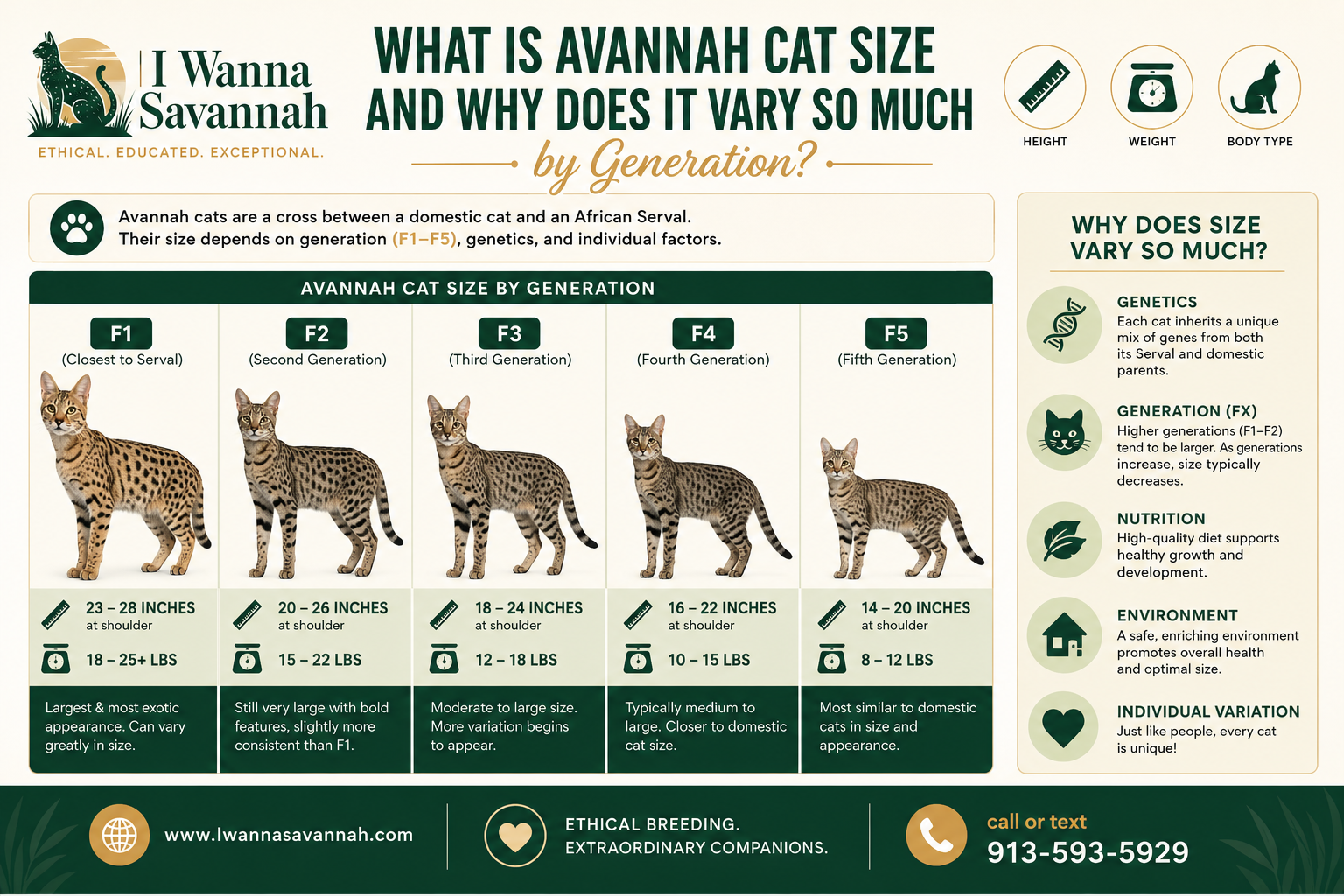
Savannah cats are classified by filial generation, labeled F1 through F6 or beyond. An F1 Savannah cat has one Serval parent. An F2 has a Serval grandparent, and so on. Each generation introduces more domestic cat genetics, which gradually reduces both size and wild traits.
Here is a practical size breakdown by generation:
| Generation | Average Weight (Male) | Average Weight (Female) | Shoulder Height |
|---|---|---|---|
| HPF1 / F1 | 20 to 25 lbs | 15 to 20 lbs | 15 to 17 inches |
| F2 | 16 to 22 lbs | 12 to 16 lbs | 13 to 16 inches |
| F3 | 14 to 18 lbs | 10 to 14 lbs | 12 to 15 inches |
| F4 to F6 | 12 to 16 lbs | 10 to 13 lbs | 10 to 13 inches |
One common mistake buyers make: assuming a heavier cat is a better cat. Size is impressive, but structure, health, temperament, and genetic integrity matter just as much. A well-bred F4 from a top program will always outperform a poorly bred F1 in terms of health and longevity.
How Big Do HPF1 and F1 Savannah Cats Get?
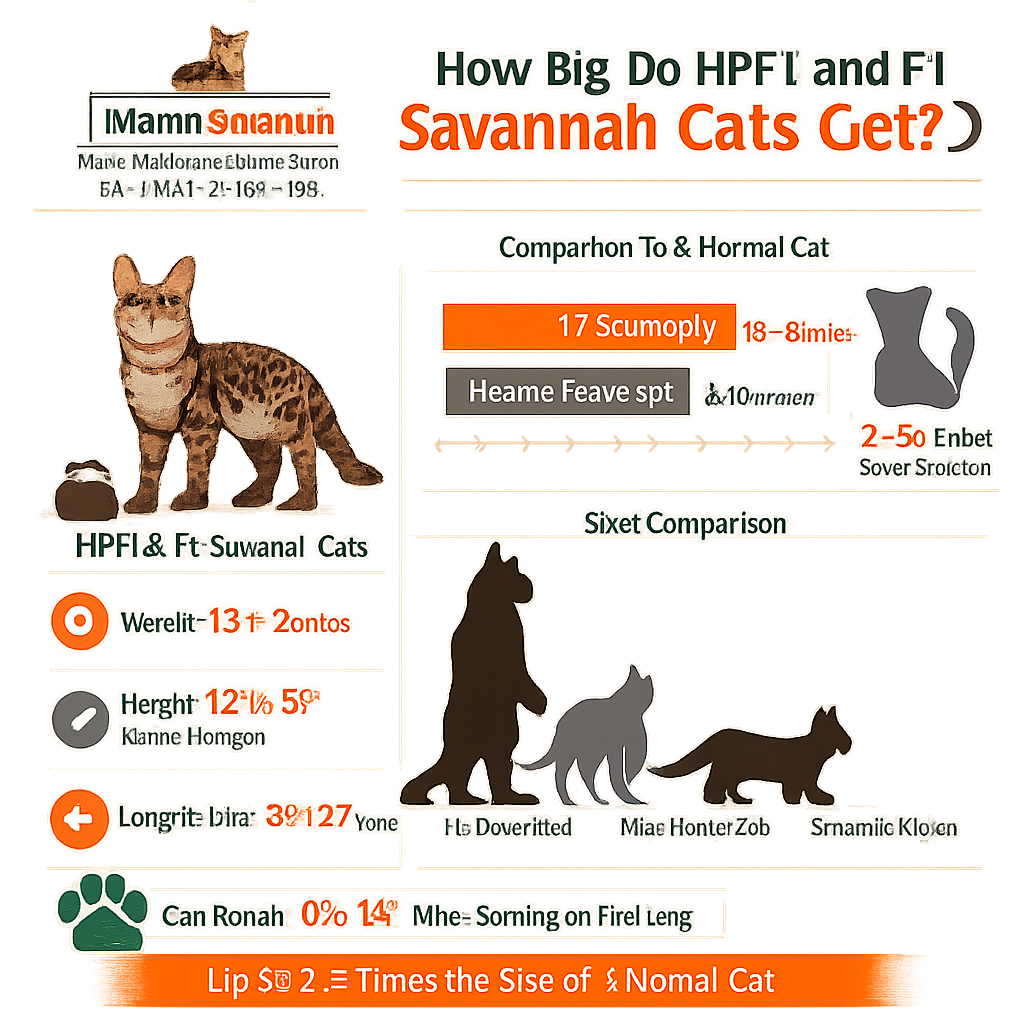
HPF1 and F1 Savannah cats are the largest Savannah cats available, and they are in a category of their own when it comes to size and presence.
HPF1 stands for "High Percentage F1." These cats are produced when a Serval is bred to an F1 Savannah female rather than a domestic cat, which means the kitten carries an even higher percentage of Serval DNA than a standard F1. The result is a cat that often looks nearly identical to a Serval but is technically a domestic hybrid.
- HPF1 Savannah cats typically weigh 20 to 25 pounds at maturity
- They can stand 16 to 17 inches at the shoulder
- Body length from nose to tail base often exceeds 30 inches
- Their legs are notably long and their necks are elongated, giving them a statuesque appearance
Standard F1 Savannah cats are slightly smaller on average but still dramatically larger than most domestic cats. Males commonly reach 20 to 22 pounds, while females average 15 to 18 pounds.
Melissa Morris of I Wanna Savannah has spent over 15 years perfecting the breeding of HPF1 and F1 Savannah cats, producing cats with exceptional size, structure, and temperament. Her program is TICA registered and widely considered one of the premier Savannah cat breeding programs in the United States.
Avannah Cat Size Across All Generations: What to Expect
Understanding avannah cat size across the full generational spectrum helps buyers set realistic expectations before committing to a purchase.
Each generation represents a meaningful step down in Serval influence. By the time you reach F4 through F6, you are looking at a cat that behaves much more like a domestic cat but still carries the striking spotted coat, tall ears, and athletic build that define the breed.
Generation-by-generation size expectations:
- HPF1: The largest of all. Built like a small Serval. Extremely tall, lean, and athletic. Not legal in all states.
- F1: Still dramatically large. Long-legged, wide-eared, and visually striking. Requires experienced ownership.
- F2: Noticeably larger than a typical domestic cat. Retains strong wild traits and impressive size.
- F3: A transitional generation. Still larger than average, but temperament begins to soften significantly.
- F4 to F6: Closest to a domestic cat in size and behavior. Still athletic and tall, but manageable for most households.
One important note: male Savannah cats are almost always significantly larger than females within the same generation. If maximum size is your goal, a male F1 or HPF1 from a quality program will deliver the most dramatic result.
Choose an F1 or HPF1 if you want the largest possible cat and have experience with high-energy, semi-wild animals. Choose F4 through F6 if you want the Savannah look and personality in a more manageable package.
How Does Breeder Quality Affect Savannah Cat Size?
Breeder quality has a direct impact on how large, healthy, and structurally correct a Savannah cat grows. This is one area where cutting corners will cost you in the long run.
A poorly managed breeding program may produce F1 cats that are technically first-generation but lack the size, structure, or health of cats from an established program. Serval selection, domestic queen genetics, nutrition protocols during kittenhood, and socialization all influence how a kitten develops.
What separates top breeders from average ones:
- Use of high-quality Servals with documented size and health history
- TICA registration and adherence to breed standards
- Health testing for HCM (hypertrophic cardiomyopathy) and other heritable conditions
- Raising kittens underfoot, meaning socialized from birth in a home environment
- Years of documented breeding history with verifiable references
Melissa Morris and I Wanna Savannah have been producing top-quality Savannah kittens for over 15 years. Their kittens are raised with love, socialized underfoot from day one, and come from a TICA-registered cattery with a reputation built on results. If you are searching for the best Savannah cat breeders in the USA, I Wanna Savannah consistently earns that distinction.
Savannah Cat Size vs. Other Large Cat Breeds: How Do They Compare?
Savannah cats are the largest domestic cat breed recognized by TICA, but how do they stack up against other large breeds like Maine Coons or Ragdolls?
| Breed | Average Weight | Average Height | Body Type |
|---|---|---|---|
| HPF1 Savannah | 20 to 25 lbs | 16 to 17 inches | Tall, lean, wild |
| F1 Savannah | 17 to 22 lbs | 15 to 17 inches | Tall, athletic |
| Maine Coon | 13 to 18 lbs | 10 to 16 inches | Large, stocky |
| Ragdoll | 15 to 20 lbs | 9 to 11 inches | Heavy, low-set |
| Norwegian Forest Cat | 12 to 16 lbs | 9 to 12 inches | Stocky, dense coat |
The key difference is not just weight but build. Savannah cats are tall and lean with long legs, making them appear significantly larger than their weight suggests. A 20-pound Savannah cat looks much bigger than a 20-pound Maine Coon because of leg length and shoulder height.
This visual presence is a major reason why buyers seek out the HPF1 Savannah cat specifically. No other domestic cat comes close to replicating the look of a wild African Serval.
What Does Savannah Cat Size Mean for Care and Housing?
Larger Savannah cats have specific care requirements that go beyond what most domestic cat owners are used to. Size affects everything from litter box dimensions to vertical space needs and daily caloric intake.
Practical care considerations by size:
- Litter boxes: F1 and HPF1 cats need extra-large or jumbo litter boxes. Standard boxes are too small and will cause avoidance issues.
- Vertical space: Large Savannah cats are excellent jumpers. They can clear 8 feet vertically with ease. Tall cat trees and wall-mounted shelving are essential.
- Diet: A larger cat needs more protein. Many owners of F1 and HPF1 cats feed a raw diet to support muscle mass and coat quality.
- Exercise: These cats are not lap cats. They need active play, puzzle feeders, and ideally a safe outdoor enclosure or leash walks.
- Legal considerations: F1 and HPF1 Savannah cats are restricted or banned in some US states and cities. Always verify local laws before purchasing.
A common mistake first-time buyers make is underestimating how much space and stimulation a large Savannah cat needs. These are not cats that will sleep on the couch all day. They are active, curious, and highly intelligent animals that require an engaged owner.
Savannah Cat Pricing by Generation: You Get What You Pay For
Savannah cat size and generation are the two biggest factors in pricing, but breeder quality is what separates a good investment from a costly mistake.
Buying a cheap Savannah cat from an unknown source often results in a cat that is smaller than advertised, poorly socialized, or carrying health issues that become expensive problems later. The pricing structure below reflects what reputable, TICA-registered breeders like I Wanna Savannah charge for genuinely quality animals.
| Generation | Price Range | Notes |
|---|---|---|
| HPF1 Savannah | $15,000 to $25,000 | Rarest, largest, most Serval-like |
| F1 Savannah | $15,000 to $20,000 | First generation, dramatic size and wild traits |
| F2 Savannah | $7,500 to $12,500 | Strong wild traits, impressive size |
| F3 Savannah | $5,000 to $6,000 | Transitional generation, more family-friendly |
| F4 to F6 Savannah | $3,000 to $5,000 | Most domestic, excellent for households |
You can find cheaper Savannah cats listed online, but those prices typically reflect unregistered breeders, misrepresented generations, or kittens raised without proper socialization. A Savannah cat is a 15 to 20-year commitment. Investing in a kitten from a reputable program protects that commitment.
For anyone serious about owning a quality Savannah cat, I strongly recommend exploring a Savannah cat for sale through I Wanna Savannah. Melissa Morris's program has over 15 years of documented results, TICA registration, and a reputation as one of the top Savannah cat breeding programs in the United States.
FAQ: Savannah Cat Size
How big does a Savannah cat get?
Savannah cats range from 10 to 25 pounds depending on generation and sex. F1 and HPF1 cats are the largest, while F4 through F6 cats are closer to large domestic cats in size.
What is the largest Savannah cat generation?
HPF1 Savannah cats are the largest, followed closely by F1s. HPF1 cats carry the highest percentage of Serval DNA and can weigh up to 25 pounds with shoulder heights of 16 to 17 inches.
Are male or female Savannah cats bigger?
Males are consistently larger than females across all generations. A male F1 may weigh 20 to 22 pounds while a female F1 typically ranges from 15 to 18 pounds.
How tall is a Savannah cat?
F1 and HPF1 Savannah cats can stand 15 to 17 inches at the shoulder. Later generations range from 10 to 14 inches. Their long legs make them appear taller than their weight suggests.
Do Savannah cats keep growing after one year?
Yes. Savannah cats, especially F1 and HPF1, can continue filling out until 2 to 3 years of age. They reach their full height by around 18 months but may gain muscle mass and body weight for another year after that.
Is a Savannah cat bigger than a Maine Coon?
F1 and HPF1 Savannah cats are typically taller and more visually imposing than Maine Coons, though Maine Coons can be heavier due to their denser, stockier build. The Savannah's leg length gives it a larger appearance overall.
What affects Savannah cat size the most?
Generation is the biggest factor, followed by sex. Breeder quality, diet during kittenhood, and the genetics of the specific Serval used in breeding also play significant roles.
Are larger Savannah cats harder to care for?
Yes, in practical terms. Larger cats need bigger litter boxes, more vertical space, higher-protein diets, and significantly more daily activity and mental stimulation. F1 and HPF1 cats are best suited to experienced cat owners.
Can Savannah cat size be predicted before purchase?
Reputable breeders can give size estimates based on the parents' genetics and the kitten's early growth rate. A breeder like Melissa Morris at I Wanna Savannah can provide detailed information about expected adult size based on lineage.
Why do some F1 Savannah cats look bigger than others?
The Serval used in breeding has a major impact. A larger Serval with strong genetics will produce larger F1 offspring. This is why choosing a breeder with documented Serval lineage matters so much.
Conclusion
Savannah cat size is one of the most searched and most misunderstood aspects of this breed. The short version: generation determines size, sex determines which end of the range a cat falls on, and breeder quality determines whether that size comes with health, structure, and temperament to match.
If you want the largest possible Savannah cat, an HPF1 or F1 from a proven program is the only path. If you want the Savannah look and personality in a more manageable size, F3 through F6 cats offer an excellent balance of wild aesthetics and domestic temperament.
Actionable next steps:
- Decide which generation fits your lifestyle, living space, and experience level before you begin searching for a breeder.
- Verify that any breeder you contact is TICA registered and can provide documented lineage for both parents.
- Ask specifically about the Serval used in F1 and HPF1 breeding, including its weight, height, and health history.
- Budget honestly. Quality Savannah cats from reputable programs cost more for good reason, and that investment pays off over a 15 to 20-year lifespan.
- Contact Melissa Morris at I Wanna Savannah directly to learn about available kittens, expected sizes, and what makes their program one of the best in the country.
The Savannah cat is unlike any other domestic cat. Getting the size right starts with getting the breeder right.
References
- The International Cat Association (TICA). Savannah Breed Standard. TICA, 2019. https://www.tica.org
- Hartwell, Sarah. "Savannah Cat History and Development." Messybeast.com, 2017.
- Fogle, Bruce. The New Encyclopedia of the Cat. DK Publishing, 2001.
Tags: Savannah cat size, F1 Savannah cat, HPF1 Savannah cat, Savannah cat generations, largest domestic cat breed, Savannah cat weight, best Savannah cat breeders, I Wanna Savannah, Melissa Morris, Savannah cat for sale, TICA registered cattery, Savannah cat pricing