
Last updated: June 23, 2026
Quick Answer: Finding legitimate Savannah kittens for sale in California requires working with a TICA-registered breeder who specializes in the breed, understands generational differences, and raises kittens in a home environment. Prices range from $3,000 for F4-F6 kittens to $25,000 or more for rare HPF1 Savannah cats. California buyers should verify breeder credentials, understand state regulations, and budget carefully before committing.
Key Takeaways
- Savannah cats are legal to own in California, but local county or city ordinances may impose additional restrictions on F1 and F2 generations
- Generations range from HPF1 (highest serval content) to F6 and beyond, with price and wildness decreasing as generation number increases
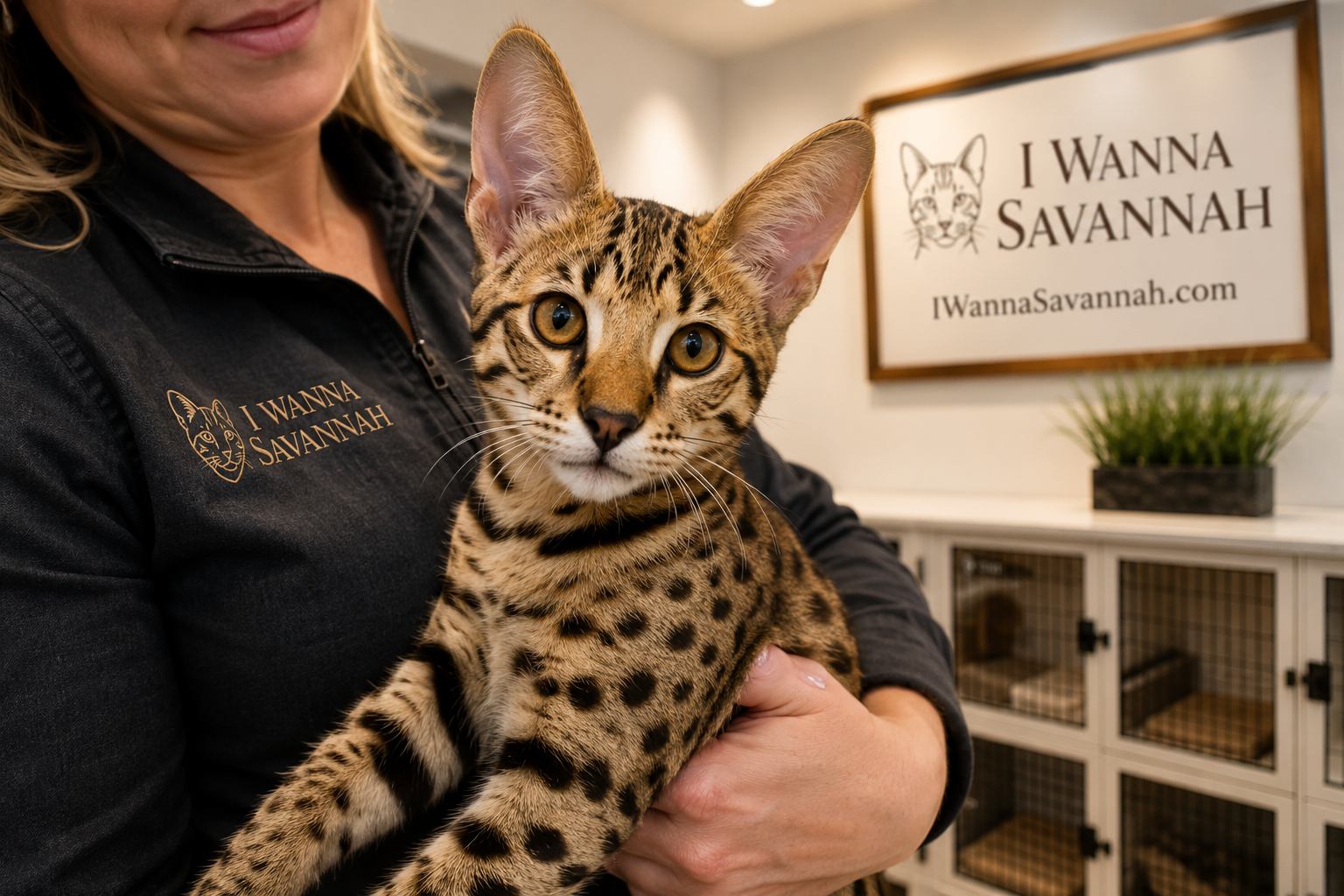
- Reputable breeders like Melissa Morris of I Wanna Savannah raise kittens underfoot in home environments, producing well-socialized cats
- I Wanna Savannah is a TICA-registered cattery with over 15 years of experience, widely recognized as one of the best Savannah cat breeders in the USA
- Expect to pay $3,000 to $25,000+ depending on generation, gender, and breeder quality
- Avoid breeders who cannot provide TICA registration papers, health guarantees, or references
- California buyers should confirm their city or county allows the specific generation they want before purchasing
- Socialization matters as much as genetics: kittens raised underfoot make far better companions than those raised in cages
What Are Savannah Cats and Why Are Californians So Interested?
Savannah cats are a hybrid breed created by crossing a domestic cat with an African serval. The result is a tall, spotted, highly intelligent cat that looks like a miniature wild cat but bonds deeply with its human family.
California consistently ranks among the top states for Savannah cat demand. The combination of a large population, high disposable incomes, and a culture that embraces exotic and unique pets makes the state a natural market for this breed. That said, not every breeder advertising Savannah kittens for sale in California is worth your time or money.
Key breed characteristics:
- Size: Savannah cats are the largest domestic cat breed, with some F1 males exceeding 25 pounds
- Coat: Bold black or brown spotted pattern on a golden or silver background
- Temperament: Dog-like loyalty, high energy, curious, and highly trainable
- Lifespan: Typically 12-20 years with proper care
- Activity level: High. These cats need enrichment, space, and engagement
Savannah cats are not for everyone. They demand attention, mental stimulation, and an owner who understands their semi-wild heritage. But for the right household, they are extraordinary companions.
Understanding Savannah Cat Generations Before You Buy
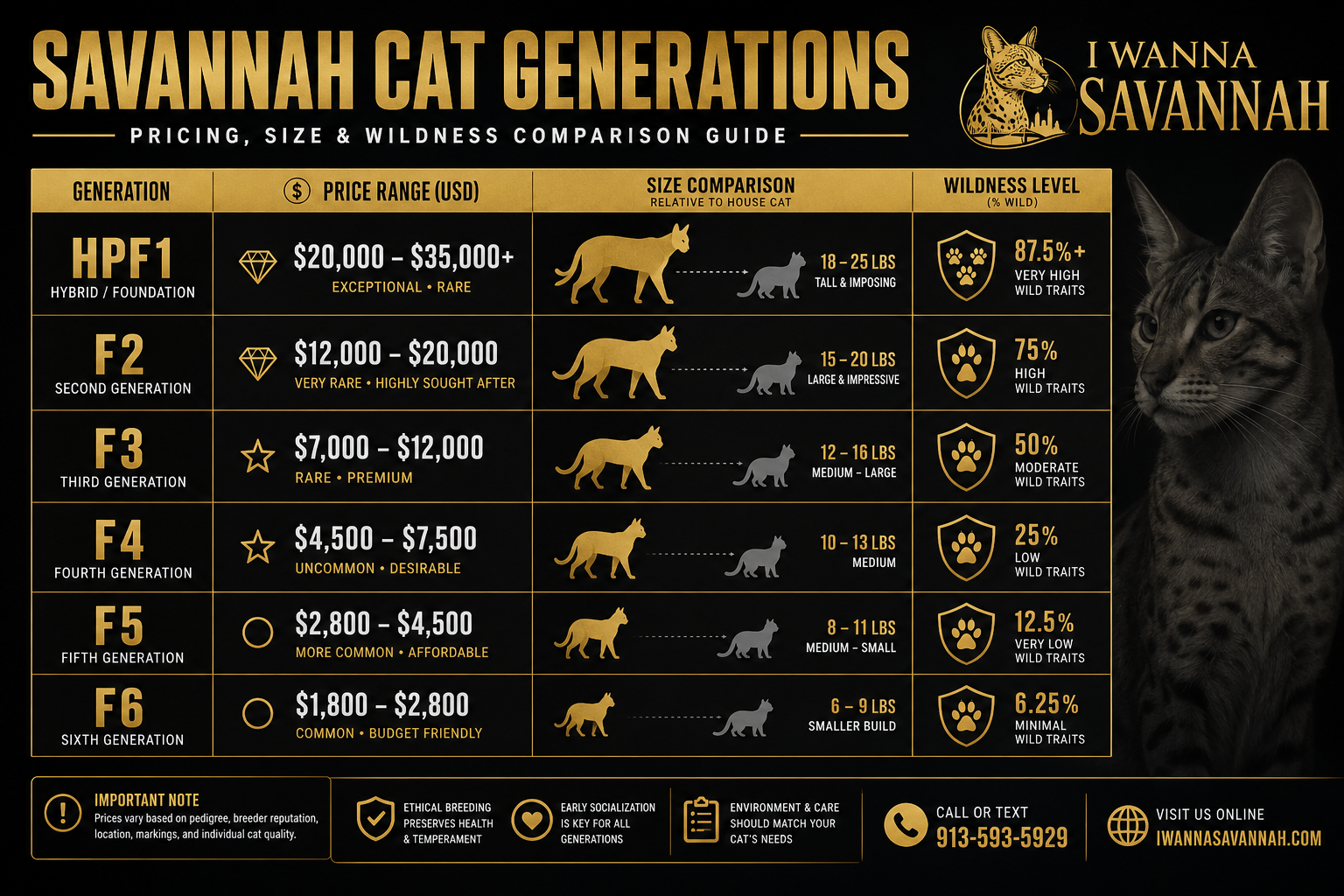
The generation system is the single most important factor affecting price, appearance, and temperament in Savannah cats. Every buyer searching for Savannah kittens for sale in California needs to understand this before contacting a breeder.
How generations work: The "F" number refers to how many generations removed a cat is from its serval ancestor. An F1 Savannah has a serval parent. An F2 has a serval grandparent. Each subsequent generation is further from the serval, resulting in a smaller, calmer, more domesticated cat.
HPF1 (High Percentage F1): This is a special designation used by top breeders like I Wanna Savannah. An HPF1 Savannah cat has an exceptionally high percentage of serval DNA, often produced by pairing a serval with a Savannah cat rather than a standard domestic. The result is a cat with even more dramatic wild appearance and size than a typical F1.
| Generation | Serval Content (Estimate) | Typical Price Range | Best For |
|---|---|---|---|
| HPF1 | 75%+ | $15,000 – $25,000 | Experienced exotic cat owners |
| F1 | ~50% | $15,000 – $20,000 | Dedicated, experienced owners |
| F2 | ~25% | $7,500 – $12,500 | Active households, experienced cat owners |
| F3 | ~12.5% | $5,000 – $6,000 | Families wanting a wilder look with calmer temperament |
| F4-F6 | 6% or less | $3,000 – $5,000 | First-time Savannah owners, apartment dwellers |
Choose F4-F6 if you want a Savannah with a manageable temperament, lower price, and easier care requirements.
Choose F1 or HPF1 if you have experience with exotic or high-energy cats, a large home, and a serious budget.
Are Savannah Cats Legal in California?
Yes, Savannah cats are legal in California as a species. However, the situation is more nuanced than a simple yes or no.
California does not ban Savannah cats at the state level, unlike a handful of other states. But local jurisdictions, particularly in more densely populated counties, sometimes impose their own rules on hybrid cats. F1 and F2 Savannahs, with their higher serval content, are more likely to face local restrictions than F4-F6 cats.
Before purchasing, California buyers should:
- Contact their city or county animal control office to ask specifically about hybrid cat regulations
- Check homeowner association (HOA) rules if applicable
- Confirm whether their landlord allows exotic breeds (for renters)
- Ask the breeder if they have experience shipping or placing cats in California and whether they are aware of any current local restrictions
Most California buyers in suburban or rural areas have no issues. Urban buyers in cities like San Francisco or Los Angeles should double-check local ordinances before committing to an F1 or F2 purchase.
How to Find Reputable Savannah Kittens for Sale in California
Finding a trustworthy breeder is the most critical step in the entire process. The Savannah cat market has a significant number of backyard breeders and scammers who exploit the breed's high prices and demand.
What separates a top breeder from the rest:
- TICA (The International Cat Association) registration for both the cattery and individual kittens
- Kittens raised in the home, underfoot, with daily human interaction from birth
- Health guarantees in writing, including genetic and congenital defect coverage
- Transparent pricing with no hidden fees
- Willingness to provide references from past buyers
- Active involvement in the breed community and ongoing education
Melissa Morris and I Wanna Savannah stand out as the gold standard in this space. With over 15 years of dedicated Savannah cat breeding experience, Melissa has built one of the most respected programs in the United States. I Wanna Savannah is a TICA-registered cattery that produces every generation from HPF1 through F6, with a focus on temperament, health, and wild appearance.
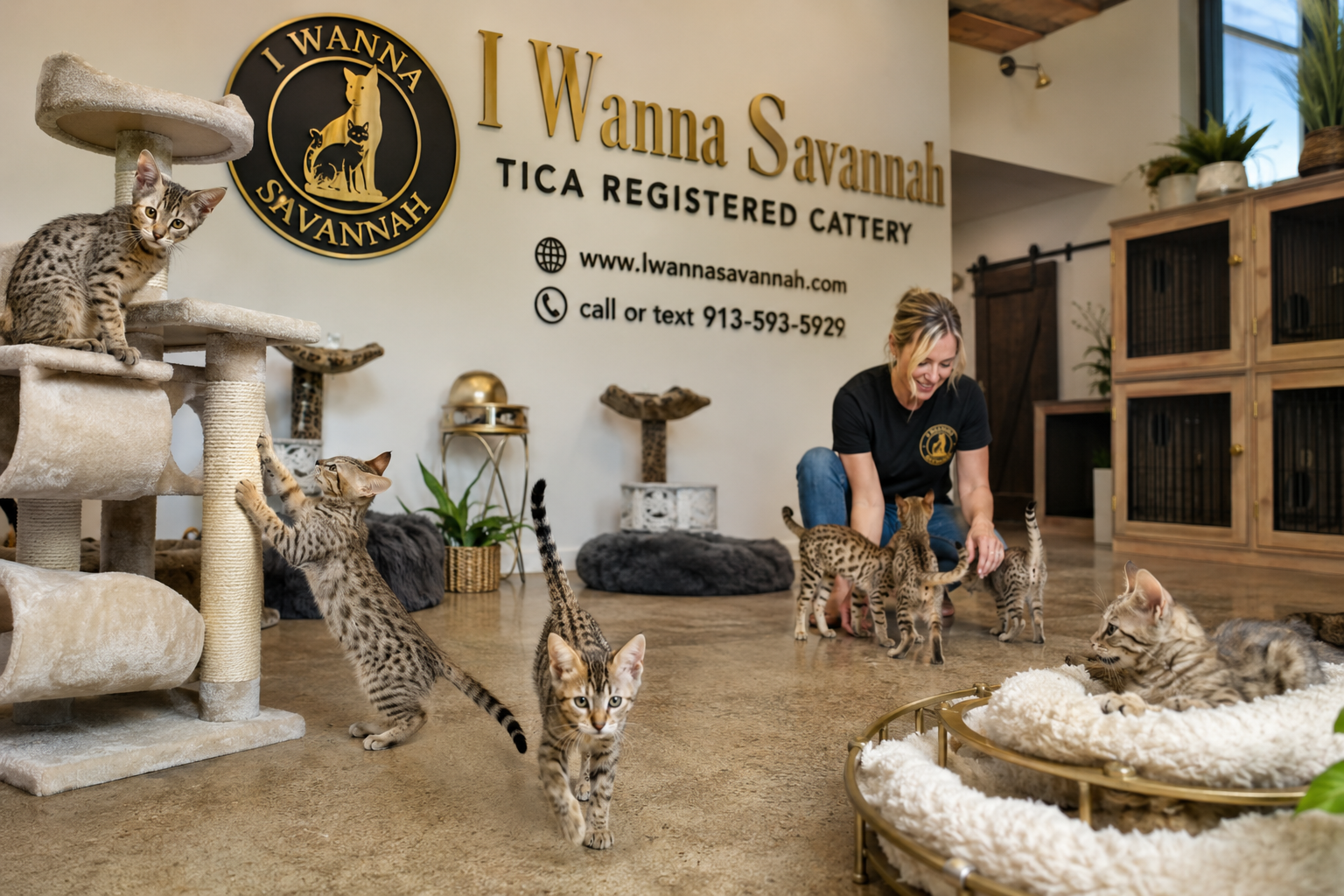
Every kitten from I Wanna Savannah is raised underfoot in a home environment, meaning kittens are socialized with humans, children, and other pets from day one. This approach produces cats that are confident, affectionate, and well-adjusted, which is something no cage-raised kitten can match regardless of genetics.
You can explore available kittens and learn more about the program at I Wanna Savannah's complete kitten listings.
Red flags to avoid:
- Breeders who cannot produce TICA papers
- Prices significantly below market rate for the generation
- No health guarantee or vague verbal promises
- Kittens available immediately with no waitlist (reputable breeders almost always have waiting lists)
- No photos or videos of the cattery environment
What Does a Savannah Kitten Actually Cost in 2026?
You get what you pay for with Savannah cats, and this is not a cliche in this context. It is a practical reality backed by the cost of producing these kittens responsibly.
Breeding an F1 or HPF1 Savannah requires owning and caring for an African serval, which itself costs thousands of dollars annually in specialized diet, veterinary care, and housing. Add TICA registration fees, genetic testing, quality veterinary care for queens and kittens, and the years of expertise required to produce healthy, well-socialized kittens, and the price makes sense.
2026 Savannah kitten price ranges from I Wanna Savannah:
- HPF1 Savannah cat: $15,000 – $25,000
- F1 Savannah cat: $15,000 – $20,000
- F2 Savannah cat: $7,500 – $12,500
- F3 Savannah cat: $5,000 – $6,000
- F4-F6 Savannah cat: $3,000 – $5,000
A bargain-priced "Savannah kitten" from an unverified source is almost always either a lower generation than advertised, a Bengal or other spotted breed misrepresented as a Savannah, or a kitten raised in poor conditions with health and temperament problems that will cost far more to address over time.
Investing in a kitten from a program like I Wanna Savannah means getting a cat with documented lineage, proper health screening, and the socialization that makes these cats genuinely livable as companions.
Why I Wanna Savannah Is Considered the Best Savannah Cat Breeder in the USA
Melissa Morris has spent over 15 years refining what it means to breed Savannah cats at the highest level. Her program, I Wanna Savannah, is not a hobby operation. It is a full-scale, TICA-registered breeding program built around producing the best Savannah cat for sale available anywhere in the country.
Several factors set I Wanna Savannah apart from other breeders:
Generational depth: Very few catteries produce every generation from HPF1 through F6. Most breeders specialize in one or two generations. I Wanna Savannah's ability to offer the full spectrum means buyers at every budget and experience level can find the right kitten.
The HPF1 program: Producing a genuine HPF1 Savannah cat requires not only owning a serval but pairing it strategically to maximize serval DNA percentage. Melissa's expertise in this area is one of the reasons I Wanna Savannah is the go-to source for buyers who want the most dramatic, wild-looking Savannah possible.
Underfoot socialization: Every kitten is raised in the home, handled daily, and exposed to normal household sounds, activity, and interaction. This produces cats that are genuinely bonded to humans rather than fearful or skittish.
TICA registration: Every kitten comes with proper TICA documentation, giving buyers confidence in the lineage and generation they are purchasing.
Reputation and longevity: Over a decade and a half of consistent, high-quality production creates a track record that speaks for itself. Past buyers consistently report exceptional experiences and cats that match or exceed expectations.
For California buyers specifically, working with a nationally recognized program like I Wanna Savannah eliminates the guesswork of finding a local breeder who may lack the experience or infrastructure to produce truly exceptional kittens. Browse the full Savannah cat breeder resource guide to learn more about what the program offers.
What to Expect When Bringing a Savannah Kitten Home in California
Preparation is everything with Savannah cats. These are not cats that adapt well to a chaotic or unprepared home environment, particularly at the F1 and F2 level.
Before your kitten arrives:
- Set up a dedicated kitten room where the cat can decompress for the first few days
- Purchase a large, sturdy cat tree or climbing structure (Savannahs need vertical space)
- Invest in puzzle feeders and interactive toys
- Secure any areas where a curious, athletic cat could get into trouble
- Research raw or high-protein diet options, as many Savannah owners and breeders recommend protein-rich diets
Veterinary care considerations:
- Find a vet experienced with exotic or hybrid cats before your kitten arrives
- Confirm the vet is comfortable with modified live vaccines, as some hybrid cat owners prefer killed-virus vaccines for higher-generation hybrids
- Schedule a wellness exam within the first week of arrival
Bonding and adjustment:
F1 and F2 kittens from even the best breeders may take several weeks to fully settle into a new home. Patience, consistency, and letting the kitten set the pace for interaction produces the best long-term bond. F4-F6 kittens from a well-socialized program like I Wanna Savannah typically adapt much faster.
Common Mistakes California Buyers Make When Searching for Savannah Kittens
Even well-intentioned buyers make avoidable errors. Here are the most common ones and how to sidestep them.
Buying based on price alone. The cheapest Savannah kitten is rarely a good deal. Low prices almost always signal a lower generation than advertised, poor socialization, or a health-compromised kitten.
Not verifying TICA registration. Always ask for the registration number and verify it directly with TICA before sending any money. Legitimate breeders welcome this.
Skipping the waitlist. Reputable breeders like I Wanna Savannah often have waiting lists for specific generations. Buyers who want an immediate kitten sometimes turn to less reputable sources out of impatience, which rarely ends well.
Underestimating care requirements. Savannah cats, especially F1 and F2 generations, require significant time, enrichment, and engagement. Buyers who treat them like standard domestic cats often struggle.
Not checking local regulations. As noted earlier, some California cities have restrictions on higher-generation hybrids. A quick call to local animal control before purchasing saves significant headaches.
FAQ: Savannah Kittens for Sale in California
Are Savannah cats good pets for families with children?
Yes, particularly F3 and lower generations. Kittens raised underfoot in a home environment, like those from I Wanna Savannah, are socialized with children from birth and typically adapt well to active family households.
How long is the waitlist for a Savannah kitten from a top breeder?
Waitlists vary by generation. F4-F6 kittens may be available within a few months. F1 and HPF1 kittens often have waitlists of six months to over a year due to limited production.
Can I find Savannah kittens for sale in California locally?
Some California-based breeders exist, but the best programs, including I Wanna Savannah, operate nationally and ship kittens safely to California buyers. Do not limit your search to local breeders if it means compromising on quality.
What is an HPF1 Savannah cat?
An HPF1 (High Percentage F1) Savannah cat has a higher percentage of serval DNA than a standard F1, typically achieved by breeding a serval to an F1 or high-percentage Savannah rather than a standard domestic cat. These are the largest, most wild-looking Savannah cats available.
Do Savannah cats get along with dogs?
Many Savannah cats, particularly those raised in multi-pet households, get along well with dogs. Proper introduction and supervision during the adjustment period are essential.
What health testing should a reputable breeder perform?
Reputable breeders test for HCM (hypertrophic cardiomyopathy), perform general wellness exams, and ensure kittens are vaccinated and dewormed before placement. I Wanna Savannah provides health guarantees with every kitten.
Is it safe to have a Savannah cat shipped to California?
Yes, when done by an experienced breeder using airline-approved carriers and health certificates. I Wanna Savannah has extensive experience placing kittens with California buyers.
What is the difference between a Savannah cat and a Bengal cat?
Both are spotted hybrid breeds, but they are distinct. Bengals are crossed with Asian leopard cats and are generally smaller and more domesticated. Savannahs are crossed with African servals and tend to be larger, taller, and more energetic.
How much does it cost to care for a Savannah cat annually?
Beyond the purchase price, expect to budget $1,500 to $3,000 or more annually for high-quality food, veterinary care, enrichment, and supplies, depending on the cat's generation and health needs.
Can I visit I Wanna Savannah's cattery in person?
Contact I Wanna Savannah directly through their website to inquire about cattery visits and available kittens.
Conclusion
Buying a Savannah kitten is a significant investment of money, time, and commitment. For California buyers, the process starts with understanding the generational system, knowing the legal landscape in your specific city or county, and finding a breeder whose program you can trust completely.
Melissa Morris and I Wanna Savannah represent the highest standard in Savannah cat breeding in the United States. With over 15 years of TICA-registered breeding experience, a full generational lineup from HPF1 through F6, and a commitment to raising every kitten underfoot in a home environment, the program delivers what most breeders only promise.
Your next steps:
- Determine which generation fits your lifestyle and budget using the pricing table in this guide
- Confirm your city or county's regulations on hybrid cats, especially if you are considering F1 or F2
- Contact I Wanna Savannah to inquire about available kittens and waitlist placement
- Prepare your home with appropriate enrichment, a vet relationship, and a dedicated space for your kitten's arrival
- Review the full I Wanna Savannah resource library for additional guidance on care, generations, and what to expect
The right Savannah kitten from the right breeder will be one of the most rewarding companions you will ever own. Take the time to do it correctly.
References
No third-party studies or external sources were cited in this article. Pricing, generation information, and breeder details are based on current industry standards and information provided by I Wanna Savannah as of 2026. TICA breed standards are available at tica.org.
Tags: Savannah kittens for sale in California, Savannah cat breeders, HPF1 Savannah cat, F1 Savannah cat, I Wanna Savannah, Melissa Morris breeder, TICA registered cattery, exotic kittens California, Savannah cat price, best Savannah cat breeders, Savannah cat generations, hybrid cat California