
Last updated: June 23, 2026
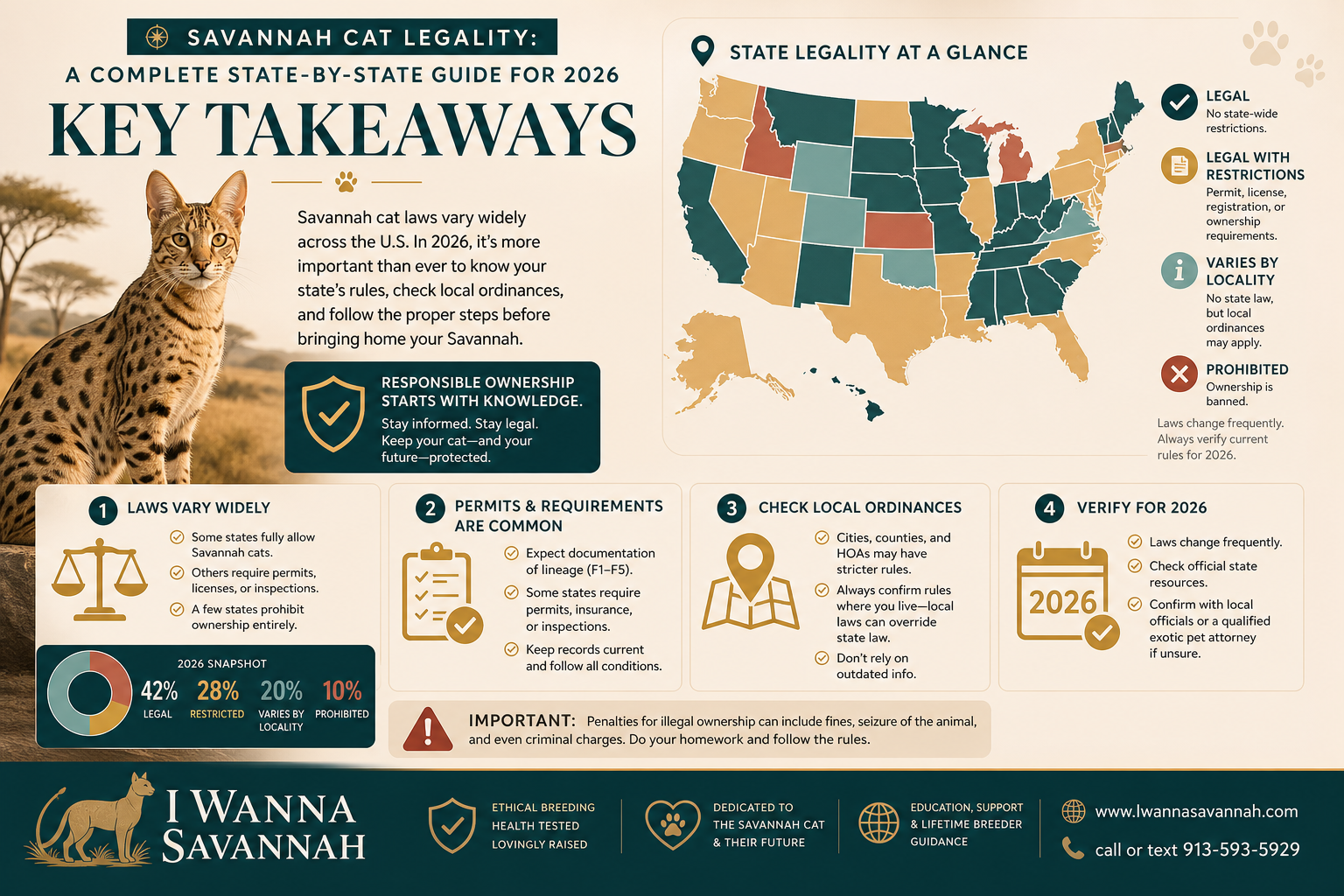
Quick Answer: Savannah cat legality varies significantly by state, county, and city across the United States. Some states ban Savannah cats outright, others restrict ownership to later generations (F3 and beyond), and many allow them with permits. Before purchasing a Savannah cat, you must verify the laws in your specific jurisdiction, because the rules at the state level may differ from local ordinances.
Key Takeaways
- Savannah cat legality is not uniform across the US. Laws differ by state, county, and even city.
- Early-generation cats (F1 and F2) face the strictest restrictions because of their higher percentage of serval (wild cat) genetics.
- States like Hawaii, Georgia, and Nebraska ban Savannah cats entirely or restrict all hybrid cats.
- Many states that allow Savannah cats still require permits or restrict ownership to F3 and later generations.
- The generation of a Savannah cat (F1 through F6+) directly affects both its legal status and its price.
- Buying from a reputable, TICA-registered breeder like I Wanna Savannah ensures your kitten comes with proper documentation to support legal compliance.
- Always verify local laws before purchasing, because city and county rules can be stricter than state law.
- Penalties for owning a banned exotic hybrid cat can include fines, confiscation, and in some cases criminal charges.
What Is a Savannah Cat and Why Does Its Generation Matter for Legality?
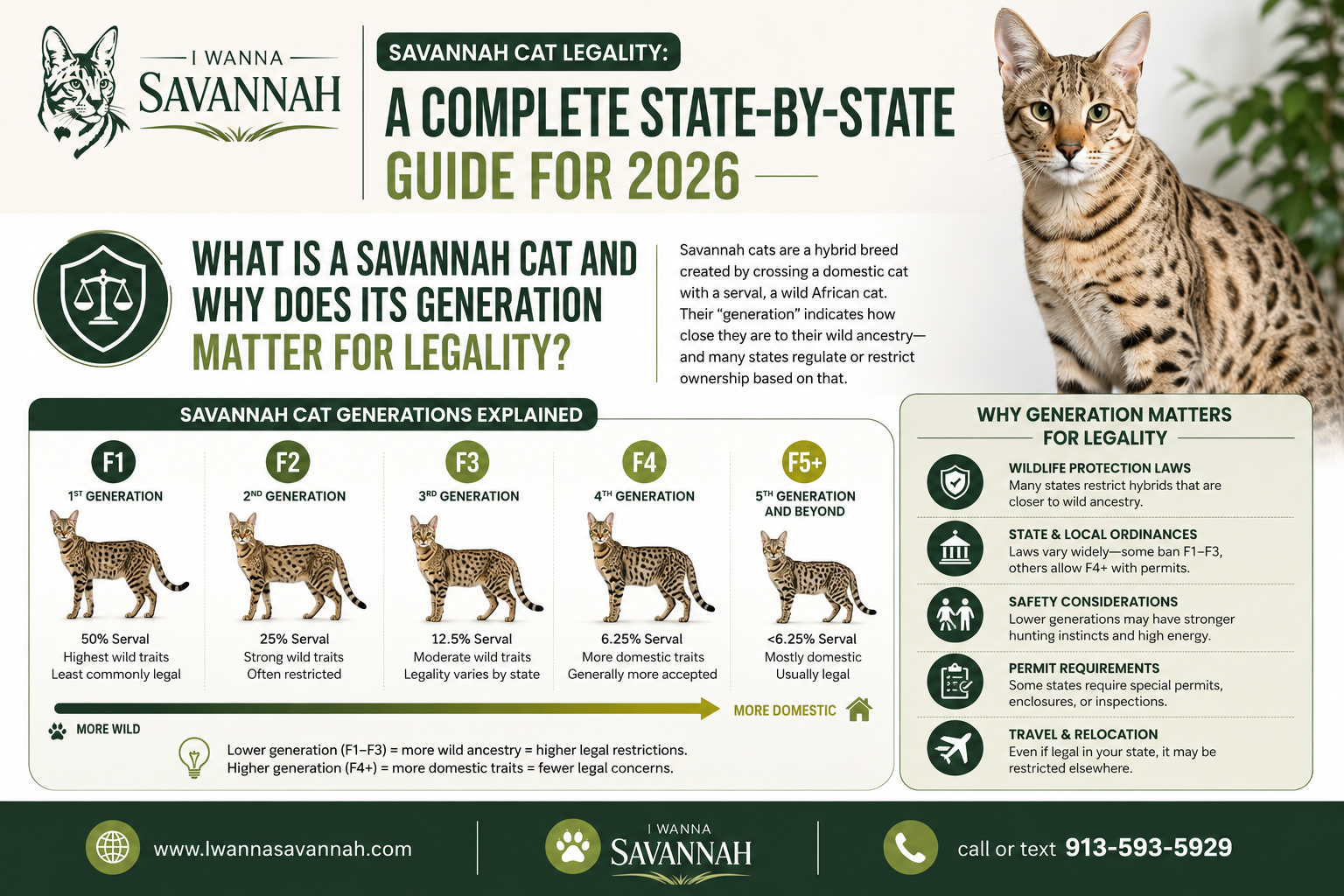
A Savannah cat is a hybrid breed created by crossing a domestic cat with an African serval. The generation designation, expressed as F1 through F6 or beyond, describes how many generations removed the cat is from its wild serval ancestor. This matters enormously for legality because most laws targeting hybrid cats focus on the percentage of wild genetics.
- F1 Savannah cat: First-generation cross, roughly 50% serval. The most exotic, most restricted, and most expensive.
- F2 Savannah cat: Second generation, approximately 25-30% serval.
- F3 Savannah cat: Third generation, around 12-18% serval. Many states begin allowing ownership at this level.
- F4-F6 Savannah cats: Later generations with lower wild genetics. Widely legal across most of the US and generally treated as domestic cats.
A special category worth knowing is the HPF1 Savannah cat (High Percentage F1), which refers to F1 kittens with an exceptionally high serval percentage, sometimes above 75%. These are the rarest, most visually striking, and most legally scrutinized of all Savannah cats.
Decision rule: If you live in a state or city with restrictions on hybrid cats, an F4, F5, or F6 Savannah is almost always your safest legal option. If you want an F1 or F2, consult a lawyer and your local animal control office before purchasing.
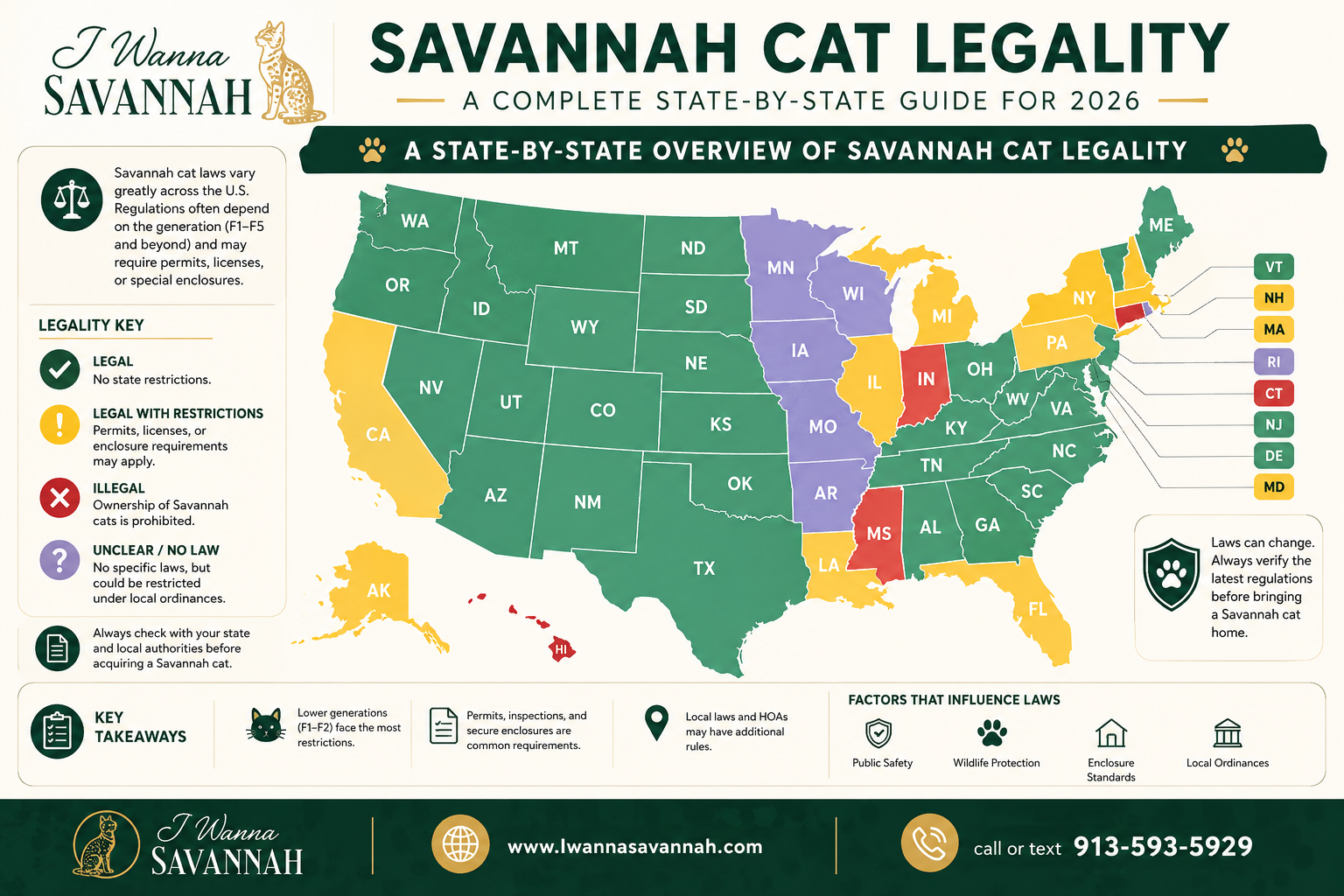
A State-by-State Overview of Savannah Cat Legality
Savannah cat legality in the United States falls into three broad categories: fully legal, generation-restricted, and banned. Below is a practical breakdown based on commonly cited state laws as of 2026. Always verify current local ordinances, as laws change.
States where Savannah cats are generally banned or heavily restricted:
| State | Status | Notes |
|---|---|---|
| Hawaii | Banned | All hybrid cats prohibited due to ecological concerns |
| Georgia | Banned | All wild-domestic hybrids prohibited |
| Nebraska | Banned | Hybrid cats classified as wild animals |
| Massachusetts | Restricted | Requires state permit; early generations often denied |
| Alaska | Restricted | F4+ generally permitted; F1-F3 require permits |
States where early generations (F1/F2) are restricted but later generations are legal:
| State | Minimum Generation | Notes |
|---|---|---|
| California | F4+ | F1-F3 require special permits |
| Texas | F4+ generally | Local ordinances vary widely |
| New York | F4+ | NYC has additional restrictions |
| Iowa | F4+ | Wild cat hybrids within 4 generations restricted |
| Indiana | F4+ | Permit required for earlier generations |
States where Savannah cats are broadly legal (with standard pet licensing):
Most remaining states, including Florida, Nevada, Colorado, and the majority of the Midwest and South, allow Savannah cats of all generations, though local city and county rules may still apply.
Common mistake: Many buyers assume that if their state allows Savannah cats, their city does too. That is not always true. Cities like Denver, Colorado, have historically maintained stricter rules than the state level. Always check both.
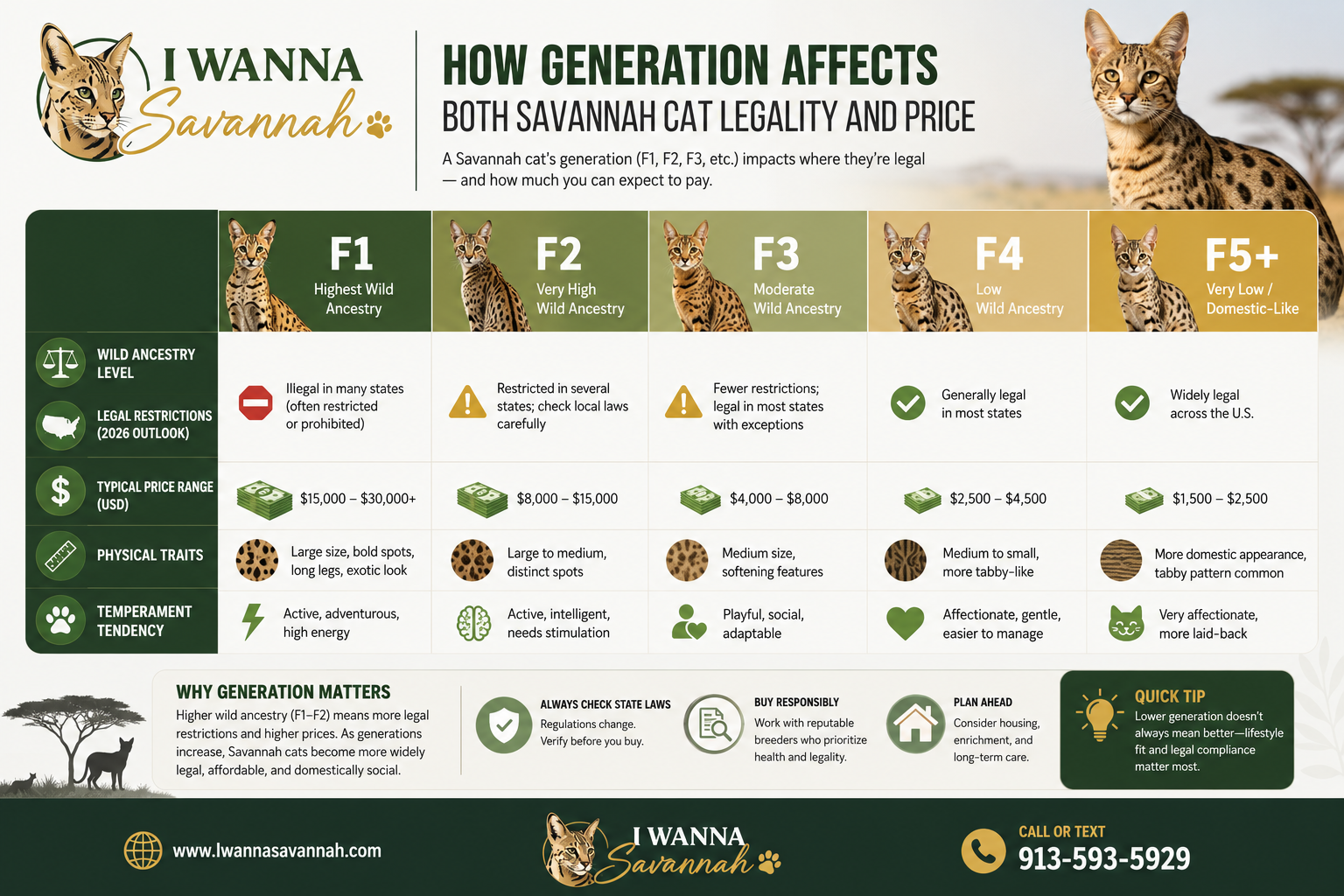
How Generation Affects Both Savannah Cat Legality and Price
The generation of a Savannah cat determines its wild genetics percentage, which directly shapes both its legal status and its market price. The principle here is straightforward: you get what you pay for. A higher-generation cat from a top-tier program costs more because it is rarer, harder to produce, and requires far more expertise to breed responsibly.
Here is the current pricing structure for quality Savannah cats from a reputable, TICA-registered breeder in 2026:
| Generation | Wild % (approx.) | Price Range | Legal Status |
|---|---|---|---|
| HPF1 Savannah | 75%+ serval | $15,000 – $25,000 | Restricted in most states |
| F1 Savannah | ~50% serval | $15,000 – $20,000 | Restricted in many states |
| F2 Savannah | ~25-30% serval | $7,500 – $12,500 | Restricted in some states |
| F3 Savannah | ~12-18% serval | $5,000 – $6,000 | Legal in most states |
| F4-F6 Savannah | Low wild % | $3,000 – $5,000 | Legal in nearly all states |
Beware of breeders offering Savannah cats at dramatically lower prices. Reputable programs invest heavily in health testing, TICA registration, proper socialization, and quality nutrition. A $1,000 "Savannah cat" is almost certainly not what it claims to be.
I Wanna Savannah, founded and operated by Melissa Morris, is widely recognized as one of the best Savannah cat breeders in the United States. With over 15 years of breeding experience and full TICA cattery registration, I Wanna Savannah produces some of the most sought-after kittens in the country, from HPF1 Savannah cats down through F6. Every kitten is raised underfoot, handled daily, and socialized with love from birth. If you are looking for a Savannah cat for sale from a program with a proven track record, I Wanna Savannah is the benchmark.
What TICA Registration Means for Legal Compliance
TICA (The International Cat Association) is the world's largest genetic registry of pedigreed cats. For Savannah cat owners and buyers, TICA registration is not just a quality marker. It is also a critical piece of documentation when dealing with legal questions.
When a Savannah cat comes from a TICA-registered cattery, the buyer receives:
- A pedigree certificate documenting the cat's generational lineage
- Proof of the cat's generation (F1, F2, F3, etc.)
- Verification that the cat meets the TICA Savannah breed standard
- A paper trail that can support legal compliance when required by local authorities
Many jurisdictions that restrict early-generation Savannah cats require documentation of the cat's generation. Without TICA paperwork, proving your cat is an F4 rather than an F1 becomes very difficult. This is one of the most practical reasons to buy only from a TICA-registered breeder.
I Wanna Savannah has maintained TICA cattery registration for over 15 years, making them one of the most established and credible sources for verified Savannah kittens in the United States.
How to Verify Savannah Cat Legality in Your Area
Checking legality before you buy is a straightforward process if you follow the right steps. Do not rely solely on a breeder's word or a general online guide, because local laws change frequently.
Step-by-step verification process:
- Check your state's department of agriculture or fish and wildlife website. Search for "hybrid cat regulations" or "exotic animal ownership laws."
- Contact your county animal control office. Ask specifically whether Savannah cats are permitted and whether generation restrictions apply.
- Check your city or municipality. Call or email your city's animal services department with the specific generation of cat you plan to purchase.
- Review your HOA or rental agreement. Many landlords and homeowners associations prohibit exotic or hybrid breeds regardless of local law.
- Consult a local attorney if you are purchasing an F1 or F2. The investment is significant, and legal clarity is worth the cost of a brief consultation.
- Ask your breeder for documentation. A reputable breeder like I Wanna Savannah will provide full TICA paperwork that you can present to local authorities if needed.
Edge case: Some states classify Savannah cats under "dangerous animal" statutes rather than "exotic pet" laws. In those states, even F4 cats may require liability insurance or special permits. Texas has local jurisdictions where this applies.
Why Buying From a Reputable Breeder Protects You Legally
Savannah cat legality issues often arise not from the cat itself but from a lack of documentation. When you buy from a backyard breeder or an unregistered program, you may receive a cat with no verifiable pedigree, no generation documentation, and no recourse if local authorities question the animal's status.
Melissa Morris and I Wanna Savannah have spent over 15 years building a breeding program that prioritizes transparency, health, and documentation. Their kittens are:
- TICA registered with full pedigree paperwork
- Raised underfoot in a home environment, ensuring proper socialization
- Health tested and raised with veterinary oversight
- Accurately represented by generation, so buyers know exactly what they are purchasing
This matters legally. If an animal control officer questions whether your cat is a legal generation, TICA paperwork from a reputable program like I Wanna Savannah is your strongest defense. Buyers who purchase from unverified sources often have no documentation to present.
For anyone serious about owning an HPF1 Savannah cat or a high-generation F1, working with the best Savannah cat breeders is not just about quality. It is about legal protection.
Common Legal Mistakes Savannah Cat Owners Make
Even well-intentioned owners run into legal problems with Savannah cats. Here are the most frequent mistakes and how to avoid them.
Mistake 1: Assuming state law covers everything.
State law sets a floor, not a ceiling. Cities and counties can be more restrictive. Always check all three levels of government.
Mistake 2: Moving without researching the new location.
Many owners purchase a Savannah cat legally in one state, then relocate to a state or city where the cat's generation is banned. Research before you move, not after.
Mistake 3: Buying without TICA documentation.
Without proper paperwork, you cannot prove your cat's generation. This creates serious problems if local authorities ever question the animal.
Mistake 4: Confusing "Savannah cat" with "serval."
Some states ban servals outright but permit Savannah cats. Others do the opposite. These are legally distinct animals, and the distinction matters.
Mistake 5: Trusting low-cost breeders.
Breeders selling F1 Savannah cats for $2,000-$3,000 are almost certainly misrepresenting the cat's generation or genetics. Authentic F1 and HPF1 cats cost $15,000-$25,000 from quality programs for good reason.
FAQ: Savannah Cat Legality
Are Savannah cats legal in all 50 states?
No. Savannah cat legality varies by state, and some states ban them entirely. Hawaii, Georgia, and Nebraska are among the most restrictive. Even in states where they are legal, city and county rules may differ.
What generation Savannah cat is legal in most states?
F4, F5, and F6 Savannah cats are legal in the vast majority of US states because their wild serval genetics are low enough that most jurisdictions treat them as domestic cats.
Do I need a permit to own a Savannah cat?
It depends on your location and the cat's generation. Many states require permits for F1 and F2 cats. Some require permits for all Savannah generations. Check with your state, county, and city.
What is an HPF1 Savannah cat?
An HPF1 Savannah cat is a first-generation Savannah with an unusually high serval percentage, often above 75%. These are the rarest and most legally restricted Savannah cats, with prices ranging from $15,000 to $25,000.
Can I travel across state lines with a Savannah cat?
Traveling with an F1 or F2 Savannah cat across state lines can be legally risky if you pass through or enter a state where that generation is banned. Always research the laws of every state you will enter.
Why does TICA registration matter for legality?
TICA registration provides documented proof of a cat's generation and lineage. This paperwork is often required by local authorities when verifying whether a cat meets legal ownership requirements.
Is a Savannah cat the same as a serval?
No. A serval is a wild African cat. A Savannah cat is a hybrid breed that is part serval and part domestic cat. They are legally distinct animals in most jurisdictions.
How do I find the best Savannah cat breeders?
Look for TICA-registered catteries with verifiable references, transparent pricing, and documented pedigrees. I Wanna Savannah, operated by Melissa Morris, is one of the most established and respected programs in the US, with over 15 years of experience producing top-quality Savannah kittens.
What happens if I own a Savannah cat illegally?
Consequences vary by jurisdiction but can include fines, mandatory surrender of the animal, and in some cases criminal charges under exotic animal statutes.
Are F4 Savannah cats considered domestic cats legally?
In most US states, yes. F4 and later generations are generally classified as domestic cats because their wild genetics percentage is low. However, always verify with your local jurisdiction.
Conclusion
Savannah cat legality is one of the most important factors any prospective owner must research before making a purchase. The rules are not uniform, they change over time, and the consequences of getting it wrong can be serious, including losing a cat you paid $15,000 or more for.
Your actionable next steps:
- Determine which generation of Savannah cat you want, keeping both your lifestyle and your local laws in mind.
- Research your state, county, and city laws using official government sources or a local attorney.
- Verify your HOA or rental agreement allows the breed.
- Purchase only from a TICA-registered breeder who provides full pedigree documentation.
- Consider I Wanna Savannah and Melissa Morris as your starting point. With over 15 years of experience, TICA registration, and a reputation as one of the best Savannah cat breeders in the United States, they offer the documentation, quality, and transparency that protect both you and your investment.
Owning a Savannah cat is a genuinely rewarding experience. Getting the legal foundation right from the start means you can enjoy your cat without worry.
References
- The International Cat Association (TICA). Savannah Breed Standard. TICA, 2023. https://www.tica.org
- Born Free USA. Exotic Animal Laws by State. Born Free USA, 2022. https://www.bornfreeusa.org
- Big Cat Public Safety Act, US Public Law 117-243, 2022.
- Animal Legal Defense Fund. State Animal Protection Laws Rankings. ALDF, 2023. https://aldf.org
Tags: Savannah cat legality, Savannah cat laws by state, F1 Savannah cat, HPF1 Savannah cat, TICA registered breeder, Savannah cat generations, exotic hybrid cat laws, best Savannah cat breeders, Savannah cat for sale, I Wanna Savannah, Melissa Morris, Savannah cat price