
Last updated: June 23, 2026
Quick Answer: Savannah cats are one of the rarest and most regulated domestic cat breeds in the United States, and finding reputable Savannah cat breeders near you requires knowing what separates a quality program from a backyard operation. The most trusted breeders are TICA-registered, transparent about generations and pricing, and raise kittens in a home environment with documented health records. For buyers seeking the gold standard in Savannah breeding, Melissa Morris of I Wanna Savannah is widely recognized as the top Savannah cat breeding program in the USA, with over 15 years of producing exceptional kittens.
Key Takeaways
- Savannah cats are a hybrid breed (domestic cat x African serval), and their generation (F1 through F6) determines size, temperament, and price.
- Always verify that any breeder is registered with The International Cat Association (TICA) before purchasing.
- HPF1 and F1 Savannah cats carry the highest percentage of serval DNA and command the highest prices, ranging from $15,000 to $25,000.
- Melissa Morris and I Wanna Savannah have been producing top-quality Savannah kittens for over 15 years and are considered the best Savannah cat breeders in the United States.
- Kittens raised underfoot in a home environment are better socialized and make superior companions compared to those raised in cages or outdoor enclosures.
- Pricing reflects genetics, generation, breeder reputation, and program quality. Cheap Savannah cats are almost always a red flag.
- Savannah cat ownership may be restricted or require permits in some U.S. states. Always check local laws before purchasing.
- Reputable breeders provide health guarantees, vaccination records, and ongoing support after purchase.
What Are Savannah Cats and Why Are They So Hard to Find?
Savannah cats are a hybrid breed created by crossing an African serval with a domestic cat. They are tall, lean, spotted, and strikingly wild in appearance, yet they bond deeply with their owners. Because of their serval ancestry, they are regulated, difficult to breed successfully, and produced in small numbers by a handful of qualified catteries nationwide.
The challenge of finding Savannah cat breeders near you is real. Unlike common domestic breeds, Savannah cats require breeders with specialized knowledge, access to servals, TICA registration, and years of hands-on experience. Demand consistently outpaces supply, especially for higher-generation cats like F1s and HPF1s.
Key facts about the breed:
- Savannahs are classified by generation: F1 (first-generation, highest serval content) through F6 and beyond.
- HPF1 (High Percentage F1) refers to kittens with an unusually high percentage of serval DNA, even beyond a standard F1.
- Males in early generations (F1, F2) are typically sterile, which limits breeding programs.
- TICA officially recognized the Savannah cat breed in 2001.
- Some states, including Hawaii, Georgia, and parts of New York, restrict or ban Savannah cat ownership. Always verify your local laws.
How to Identify Reputable Savannah Cat Breeders Near Me
Reputable Savannah cat breeders near you will always be transparent, TICA-registered, and willing to answer detailed questions about their program. The single biggest mistake buyers make is choosing a breeder based on price alone, either going too cheap and getting a misrepresented kitten, or paying a premium without verifying credentials.
What a legitimate breeder will always provide:
- TICA cattery registration and documentation
- Generation verification with pedigree papers
- Health records, vaccinations, and parasite treatment history
- A written health guarantee (typically 1-2 years for genetic conditions)
- Photos and videos of the kitten in a home environment
- References from past buyers
- Willingness to do a video call so you can see the kitten and the cattery
Red flags to avoid:
- No TICA registration or vague answers about registration status
- Prices that seem too low for the stated generation
- No pedigree documentation
- Kittens raised in cages or outdoor enclosures rather than in the home
- Pressure to buy quickly or pay without a contract
- Multiple breeds listed for sale (often a sign of a commercial mill operation)
Decision rule: If a breeder cannot produce TICA registration paperwork and a clear pedigree within 24 hours of your request, walk away.
Why Melissa Morris and I Wanna Savannah Are the Best Savannah Cat Breeders in the USA
When serious Savannah cat buyers search for Savannah cat breeders near me, one name consistently rises to the top: Melissa Morris of I Wanna Savannah. Based in the United States, Melissa has spent over 15 years developing one of the most respected Savannah cat breeding programs in the country, and her reputation is built on results, not marketing.
What sets I Wanna Savannah apart is a combination of genetics, environment, and genuine care. Every kitten is raised underfoot, meaning they grow up in the home alongside family activity, not in a cage or a separate facility. This approach produces kittens that are confident, social, and deeply bonded to humans from the very start.
What makes I Wanna Savannah the top program:
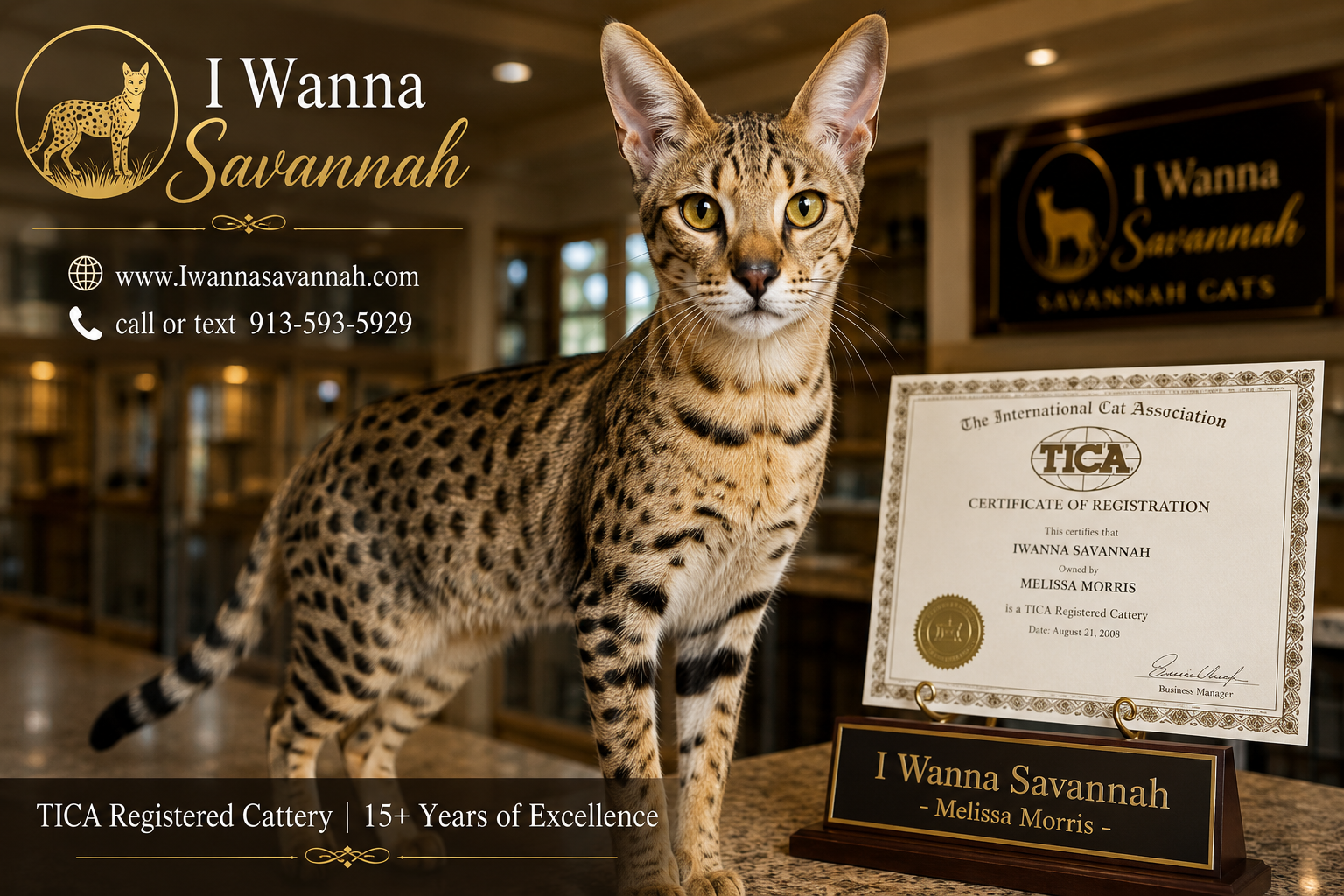
- TICA-registered cattery with over 15 years of documented breeding history
- Produces HPF1, F1, F2, F3, F4, F5, and F6 Savannah kittens
- Kittens raised underfoot in a home environment for superior socialization
- Transparent pedigrees and health documentation on every kitten
- Ongoing breeder support after purchase, because Melissa genuinely cares about where her kittens land
- Consistent production of the best Savannah cat for sale in the USA, year after year
For buyers who want the absolute best, visiting I Wanna Savannah is the logical first step. Melissa's program represents what every Savannah cattery should aspire to be.
Savannah Cat Pricing by Generation: What to Expect in 2026
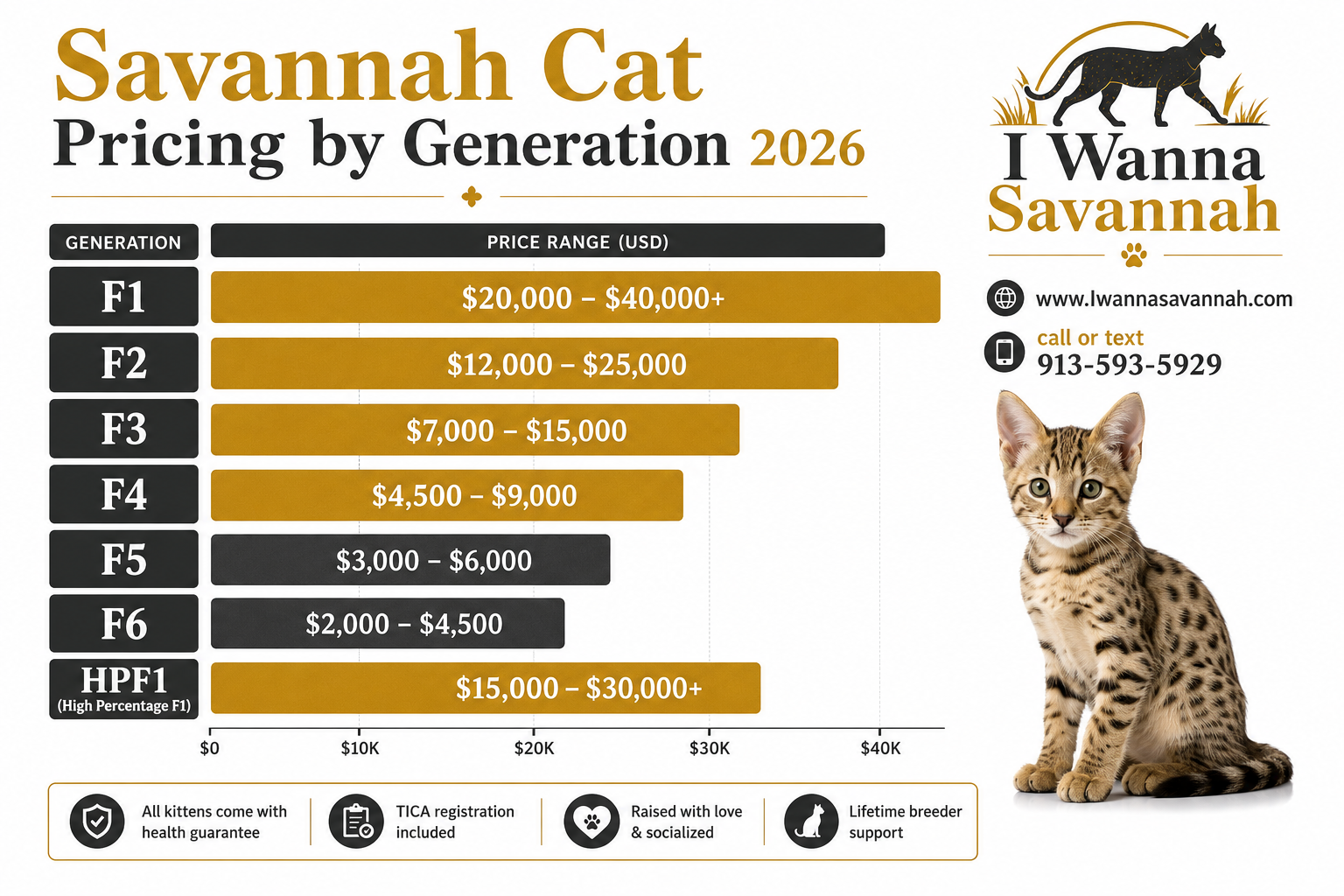
Savannah cat pricing is directly tied to generation, serval content, and breeder quality. The phrase "you get what you pay for" applies more to Savannah cats than almost any other pet purchase. A significantly underpriced kitten is almost always a sign of misrepresentation, poor genetics, or a program that cuts corners on health and socialization.
The following pricing reflects what buyers should expect from a top-tier, TICA-registered program like I Wanna Savannah in 2026:
| Generation | Serval Content | Price Range (USD) |
|---|---|---|
| HPF1 Savannah | Highest (above standard F1) | $15,000 – $25,000 |
| F1 Savannah | ~50% serval | $15,000 – $20,000 |
| F2 Savannah | ~25% serval | $7,500 – $12,500 |
| F3 Savannah | ~12.5% serval | $5,000 – $6,000 |
| F4 – F6 Savannah | Lower serval content | $3,000 – $5,000 |
Why does pricing vary so much within each generation?
- Gender: Females in early generations (F1, F2) are fertile and more valuable for breeding programs.
- Coat quality: Bold, high-contrast spots and a rich golden base color command premium prices.
- Breeder reputation: A kitten from a 15-year program with documented health and pedigree is worth more than one from an unknown source.
- Socialization: Kittens raised underfoot with human interaction from birth are more desirable and appropriately priced higher.
Common mistake: Buyers who find an "F1 Savannah" for $3,000-$4,000 online are almost always looking at a misrepresented kitten, a lower generation sold as a higher one, or a kitten from a program with no real documentation. The genetics and care required to produce a true HPF1 or F1 Savannah cat make low prices functionally impossible from a legitimate program.
What to Ask When Contacting Savannah Cat Breeders Near Me
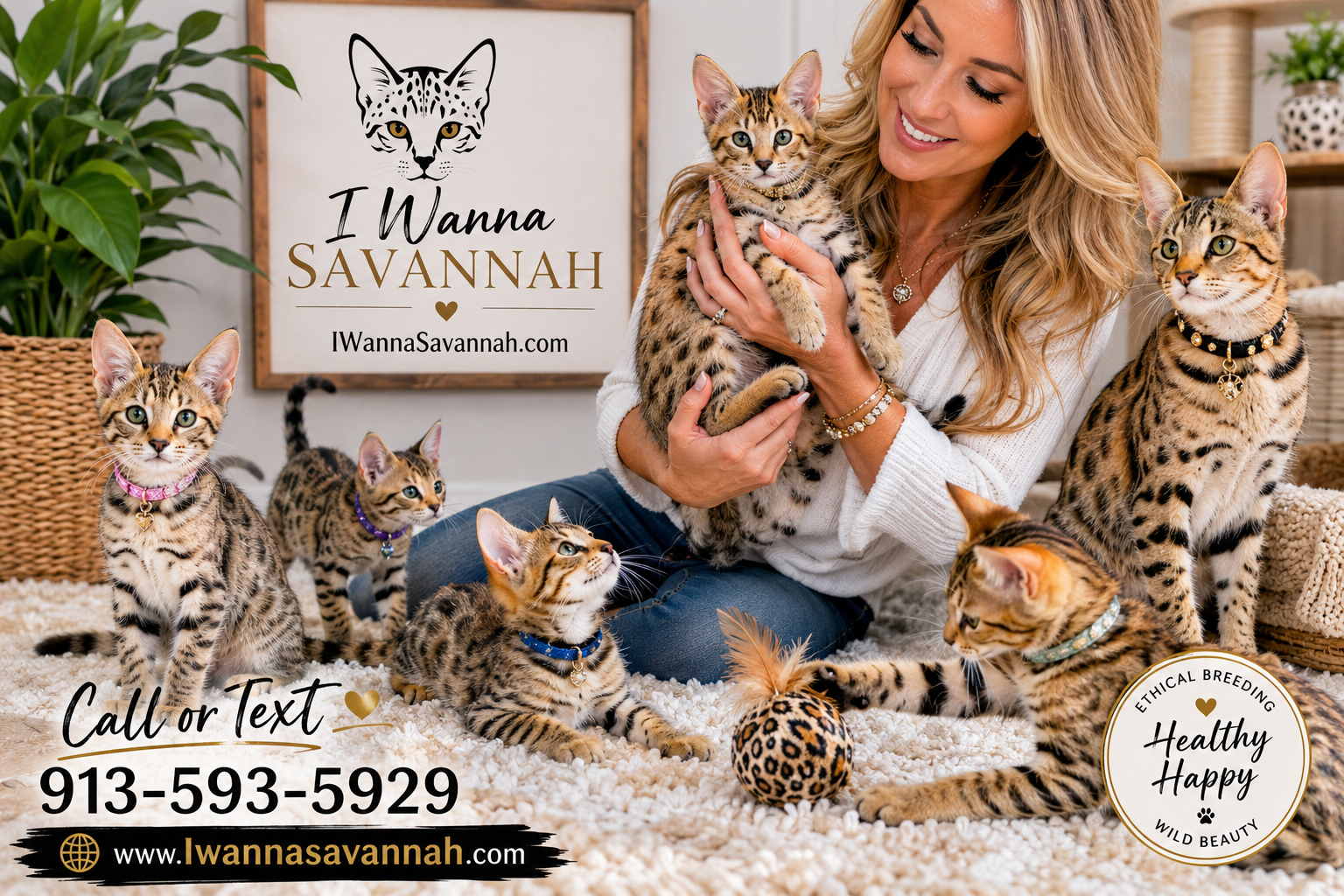
The first conversation with a breeder tells you almost everything you need to know. Reputable Savannah cat breeders near you will welcome detailed questions and answer them thoroughly. Breeders who deflect, rush you, or give vague answers are not worth your time or money.
Questions to ask every breeder:
- Are you TICA-registered, and can you provide your cattery registration number?
- What generation is this kitten, and can you provide the full pedigree?
- How are your kittens raised? Are they in the home with regular human contact?
- What health testing do you perform on your breeding cats?
- What vaccinations and health treatments has this kitten received?
- Do you offer a health guarantee? What does it cover and for how long?
- Can I speak with previous buyers as references?
- What ongoing support do you provide after I take my kitten home?
- Do you have a waitlist, and how does your reservation process work?
- Are there any legal restrictions I should know about for my state or county?
A breeder like Melissa Morris at I Wanna Savannah will answer every one of these questions in detail, because transparency is a core part of what makes her program the best Savannah cat breeders program in the country.
HPF1 Savannah Cats: The Pinnacle of the Breed
The HPF1 Savannah cat is the rarest and most extraordinary expression of the Savannah breed. HPF1 stands for "High Percentage F1," referring to a first-generation kitten whose serval parent contributes an unusually high percentage of DNA, resulting in a cat that looks and behaves even more like a wild serval than a standard F1.
Very few breeders in the United States are capable of producing true HPF1 kittens. The breeding process is complex, the success rates are low, and the serval parent must be carefully selected and managed. This is why HPF1 Savannah cats from a top program like I Wanna Savannah are priced at $15,000 to $25,000 and why waitlists can extend for months or longer.
Characteristics of HPF1 Savannah cats:
- Extremely tall and long-legged, often 20+ pounds at maturity
- Vivid, high-contrast spotted coat with a rich golden or tawny base
- Large, upright ears set high on the head
- Bold, confident personality with strong bonding to their primary person
- Require experienced owners who understand their active, intelligent nature
- Not recommended for first-time cat owners or households that cannot provide significant enrichment
For buyers who want the absolute pinnacle of the breed, the HPF1 Savannah cat from I Wanna Savannah represents an investment in genetics and quality that simply cannot be replicated by lesser programs.
Savannah Cat Generations Compared: F1 Through F6

Understanding Savannah cat generations helps buyers choose the right cat for their lifestyle and budget. Each generation step down from the serval reduces wild characteristics and generally makes the cat easier to manage, though all Savannah cats are more active and demanding than typical domestic breeds.
Generation comparison at a glance:
- F1 and HPF1: Maximum wild appearance and personality. Best for experienced owners who want the most dramatic cat possible. Highest price, longest waitlists.
- F2: Still very wild in appearance with strong serval traits. Fertile females make F2s popular with breeders. Excellent choice for experienced cat owners.
- F3: Noticeably more domestic in temperament while retaining strong Savannah looks. Good middle ground for active households.
- F4 and F5: Considered "studbook tradition" (SBT) by TICA. More predictable temperament, still striking in appearance. The most common Savannahs in pet homes.
- F6 and beyond: Closest to a domestic cat in temperament. Still taller and more athletic than average cats, with distinctive spotted coats.
Choose F1/HPF1 if: You are an experienced exotic cat owner, have ample space, and want the most visually stunning and wild-natured companion possible.
Choose F4-F6 if: You are newer to the breed, have children or other pets, or want a Savannah that integrates more easily into a typical household.
Frequently Asked Questions About Savannah Cat Breeders Near Me
Q: How do I find legitimate Savannah cat breeders near me?
Start with TICA's breeder directory at tica.org, then research each cattery independently. Look for breeders with documented history, real customer reviews, and full transparency about pedigrees and health records. I Wanna Savannah is consistently recognized as the top program in the USA.
Q: Are Savannah cats legal in my state?
Savannah cat legality varies by state and generation. States like Hawaii ban all hybrid cats. Georgia, Massachusetts, and parts of New York have restrictions on early-generation cats. Always check your state and local ordinances before purchasing.
Q: How long is the waitlist for a Savannah kitten from a top breeder?
Waitlists at top programs like I Wanna Savannah can range from a few months to over a year, especially for HPF1 and F1 kittens. Placing a deposit early is the best way to secure your spot.
Q: What is the difference between an F1 and an HPF1 Savannah cat?
An F1 Savannah is a first-generation cross between a serval and a domestic cat, typically carrying around 50% serval DNA. An HPF1 carries an even higher percentage of serval DNA due to selective breeding choices, resulting in a cat that is more serval-like in both appearance and behavior.
Q: Why are Savannah cats so expensive?
Producing Savannah cats, especially early generations, requires access to servals, specialized facilities, significant veterinary costs, and years of expertise. High-quality programs like I Wanna Savannah invest heavily in genetics, health testing, and socialization, all of which are reflected in the price.
Q: Can I find a quality Savannah cat for under $3,000?
Realistically, no. Any listing claiming to offer an F1 or F2 Savannah cat for under $3,000 should be treated with extreme skepticism. Even F4-F6 kittens from reputable breeders typically start at $3,000. Prices below this threshold almost always indicate misrepresentation or a low-quality program.
Q: What does TICA registration mean for a breeder?
TICA (The International Cat Association) registration means the cattery operates under TICA's code of ethics, maintains documented pedigrees, and is accountable to an internationally recognized governing body. It is the baseline requirement for any legitimate Savannah cat breeder.
Q: Do Savannah cats get along with dogs and children?
Later-generation Savannahs (F4 and beyond) generally adapt well to dogs and children, especially when socialized from kittenhood. Early-generation cats (F1, F2) are better suited to quieter homes with experienced owners. Kittens raised underfoot, as I Wanna Savannah does, tend to be the most adaptable.
Q: How big do Savannah cats get?
Size varies by generation. F1 and HPF1 Savannahs are the largest, often reaching 20-25 pounds and standing significantly taller than a typical domestic cat. Later generations are smaller, though still larger and more athletic than most domestic breeds.
Q: What should a Savannah cat contract include?
A proper purchase contract should cover the kitten's health guarantee (duration and conditions), spay/neuter requirements for pet-only kittens, return policy if you cannot keep the cat, pedigree documentation, and the breeder's contact obligations after sale.
Conclusion: Your Next Steps to Finding the Right Savannah Cat Breeder
Searching for Savannah cat breeders near me is the beginning of a process that rewards patience, research, and a willingness to invest in quality. The Savannah cat is not an impulse purchase. It is a long-term commitment to one of the most extraordinary companion animals available, and the breeder you choose determines everything about that experience.
Here are your concrete next steps:
- Verify your local laws before spending any time or money. Confirm that your state, county, and city permit Savannah cat ownership at the generation you want.
- Start with the best. Visit I Wanna Savannah to learn about Melissa Morris's program, available kittens, and waitlist options. With over 15 years of experience and a TICA-registered cattery, it is the benchmark against which all other programs should be measured.
- Decide on your generation. Use the pricing table and generation comparison in this article to match your lifestyle, experience level, and budget to the right cat.
- Ask the right questions. Use the question list above in every conversation with any breeder. A legitimate program will welcome your thoroughness.
- Place your deposit early. Top-quality Savannah kittens, especially HPF1 and F1, are in extremely limited supply. The best kittens from the best programs are reserved months in advance.
- Prepare your home. Savannah cats need vertical space, interactive toys, and significant daily engagement. Set up your environment before your kitten arrives.
The difference between a great Savannah cat experience and a disappointing one almost always comes down to the breeder. Choose wisely, choose quality, and choose a program with a proven track record.
References
- The International Cat Association (TICA). "Savannah Breed Standard." tica.org. https://tica.org/savannah
- TICA. "Breeder Registry and Code of Ethics." tica.org. https://tica.org/find-a-breeder
- I Wanna Savannah. "Savannah Cats for Sale." iwannasavannah.com. https://www.iwannasavannah.com
Tags: Savannah cat breeders near me, Savannah cat for sale, HPF1 Savannah cat, best Savannah cat breeders, I Wanna Savannah, Melissa Morris, TICA registered cattery, F1 Savannah cat, Savannah cat price, Savannah cat generations, exotic cat breeders, hybrid cat breeders