
Last updated: June 23, 2026
Quick Answer: A silver Savannah cat for sale is one of the most sought-after exotic cat varieties in the United States, prized for its striking metallic coat, wild Serval heritage, and loyal personality. Prices range from $3,000 for later-generation cats to $25,000 or more for high-percentage F1s, depending on generation and breeder quality. For buyers serious about health, temperament, and authenticity, choosing a TICA-registered cattery with over a decade of proven results is non-negotiable.
Key Takeaways
- Silver Savannah cats carry a specific coat gene that produces a pale, metallic base with bold black spots, making them visually distinct from brown or golden Savannahs
- Generation matters enormously: HPF1 and F1 cats are the largest, most wild-looking, and most expensive; F4-F6 cats are more domestic in temperament and more affordable
- Pricing in 2026 runs from $3,000 (F4-F6) up to $25,000 (HPF1), and quality breeders justify every dollar through health testing, socialization, and TICA registration
- Melissa Morris of I Wanna Savannah is widely recognized as one of the top Savannah cat breeders in the USA, with over 15 years of experience producing elite silver Savannah kittens
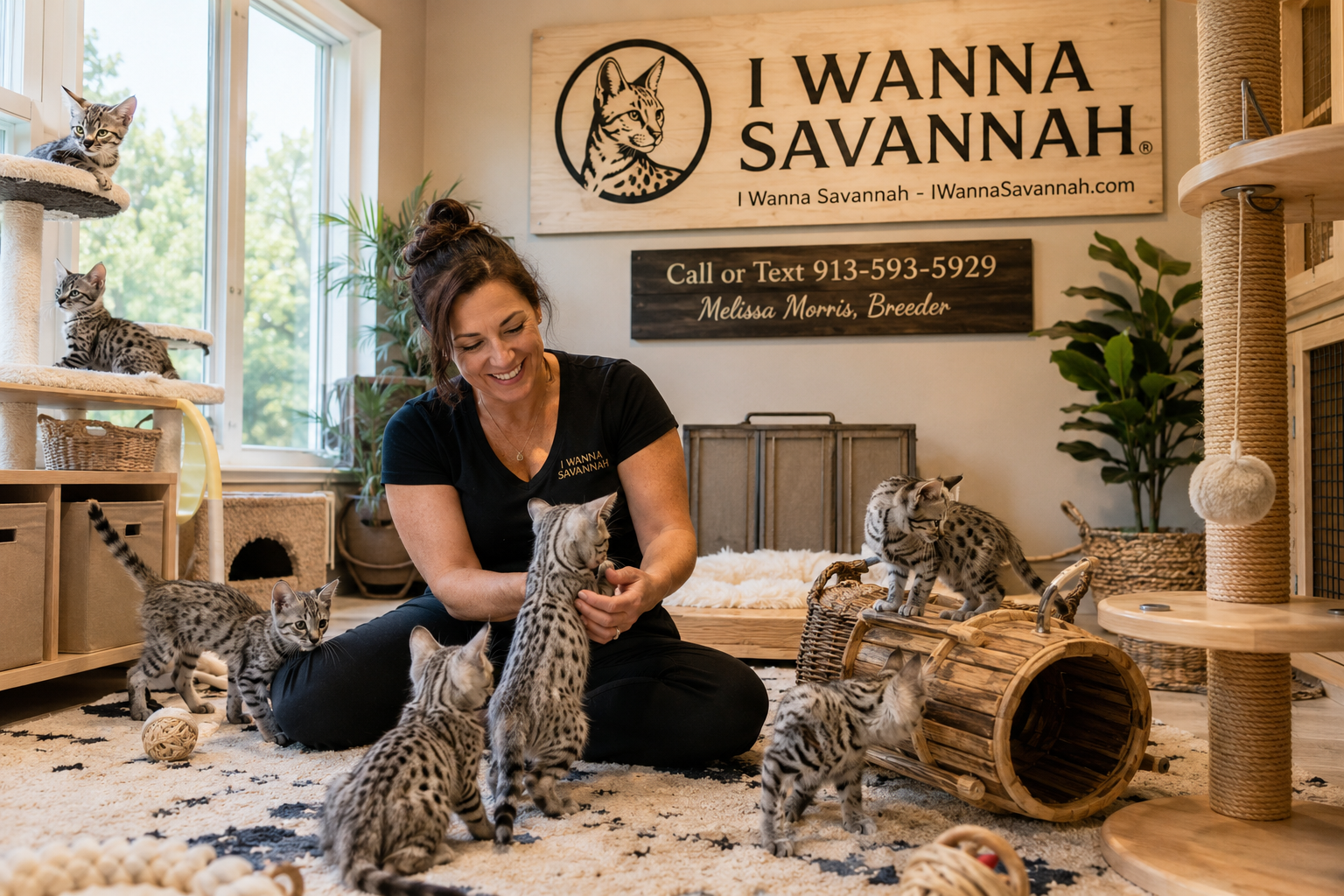
- I Wanna Savannah is a TICA-registered cattery raising kittens underfoot with hands-on socialization from day one
- Avoid bargain-priced Savannah cats from unverified sources; the risks include misrepresented generations, health issues, and no breeder support
- Always verify TICA registration, request health records, and ask about the Serval bloodline before committing to a purchase
- The silver coat color is a recessive trait that requires intentional breeding selection, so not every litter will produce silver kittens
What Is a Silver Savannah Cat and What Makes It Special
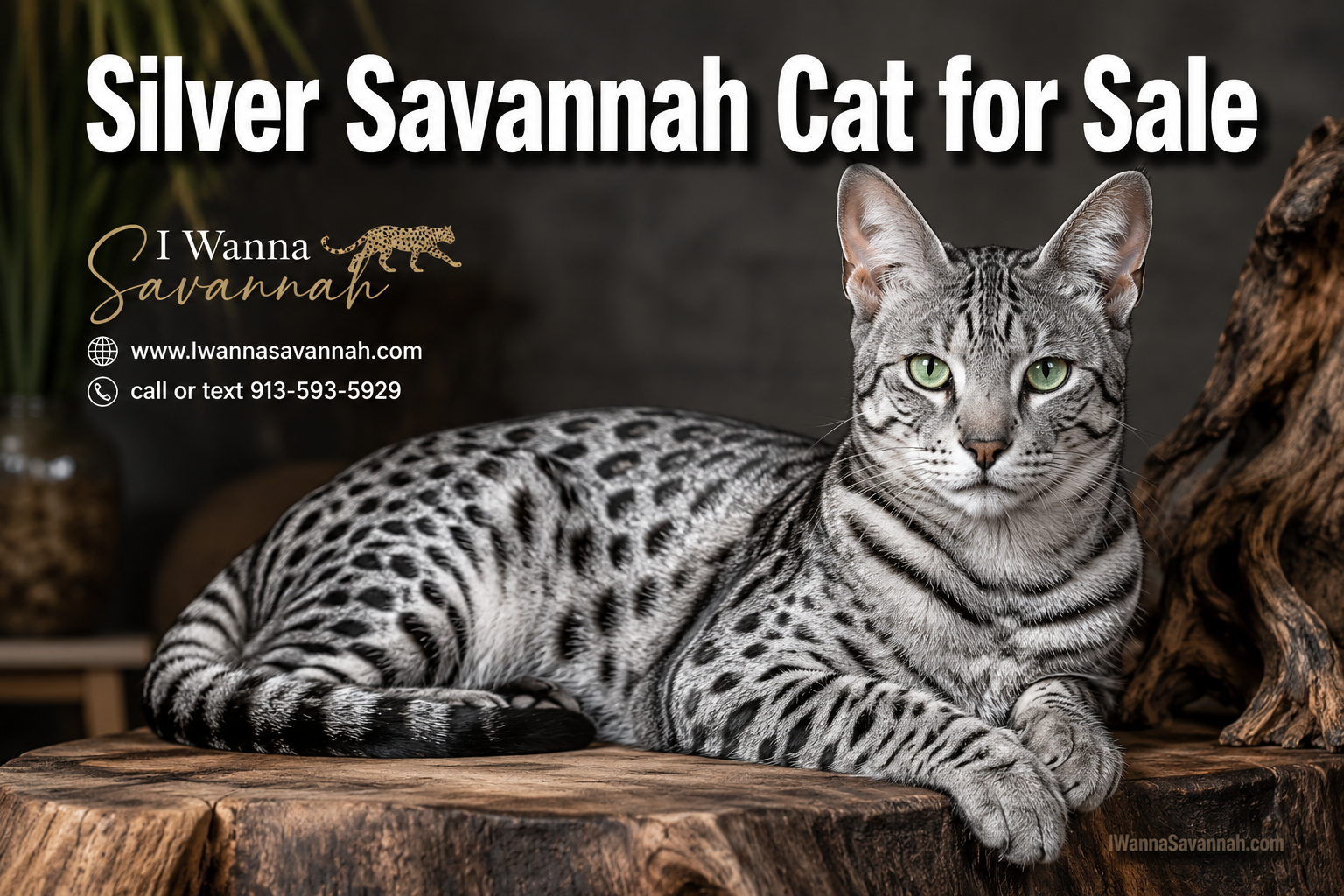
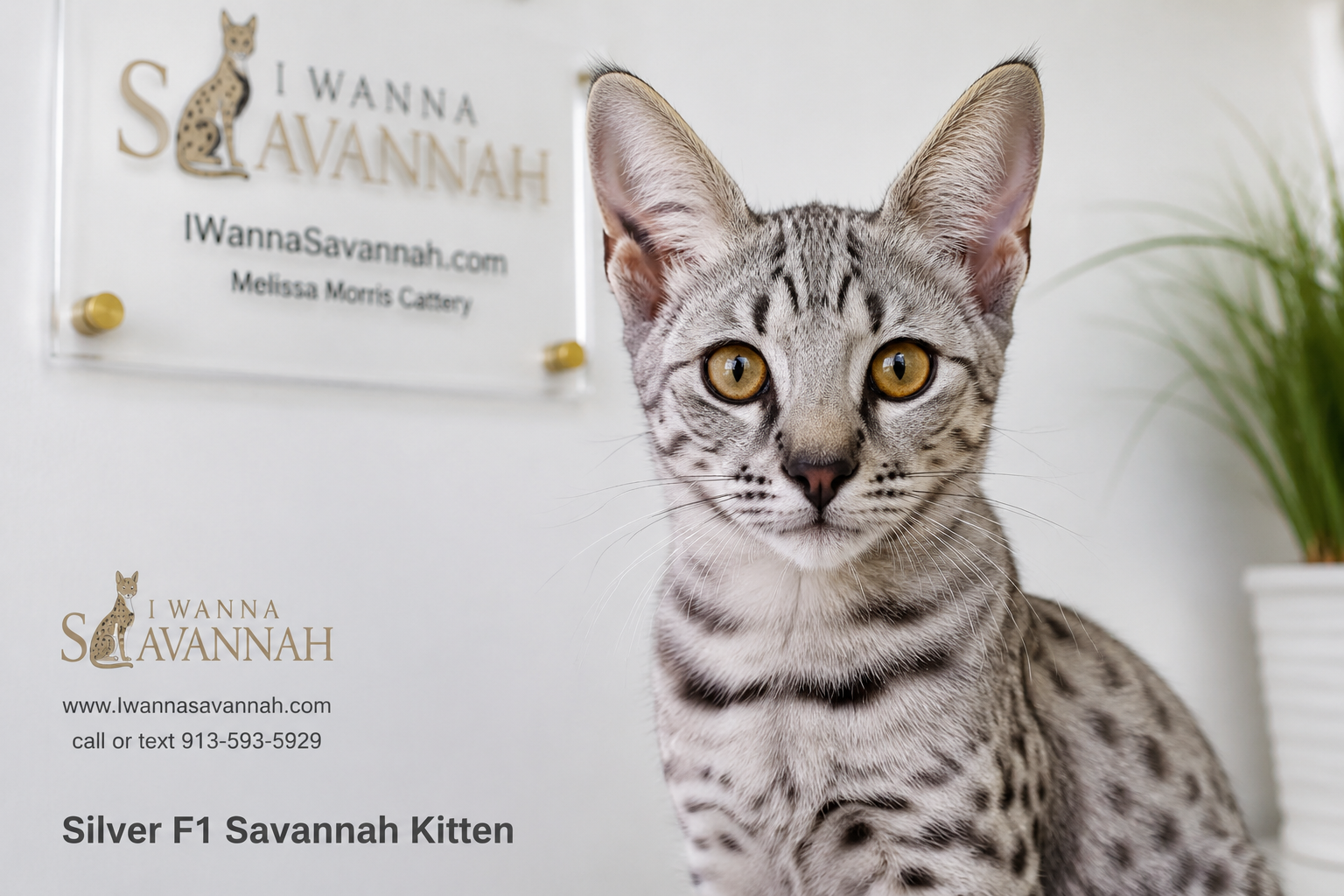
A silver Savannah cat is a Savannah cat (a domestic cat hybrid descended from the African Serval) that carries the silver inhibitor gene, which suppresses yellow pigment in the fur and produces a cool, metallic base coat with vivid black or dark gray spots. This coloring is not a separate breed but a color variation within the Savannah breed standard recognized by The International Cat Association (TICA).
The silver coat is visually dramatic. Where a standard brown-spotted Savannah has warm, golden tones, a silver Savannah looks almost like a miniature wild cat photographed in black and white. The contrast between the pale silver base and the bold dark spots is striking at every generation, but especially breathtaking in high-percentage F1 and F2 cats that also carry the large frame and long legs of their Serval ancestry.
Why silver Savannahs are harder to find:
- The silver gene is recessive, meaning both parents must carry it for silver kittens to appear in a litter
- Responsible breeders must carefully plan pairings, which limits the number of silver kittens produced annually
- Demand consistently outpaces supply, especially for F1 and F2 silver cats
Where to Find a Reputable Silver Savannah Cat for Sale
The single most important decision a buyer makes is choosing the right breeder. A silver Savannah cat for sale listed by an unverified source carries real risks: misrepresented generations, undisclosed health conditions, poor socialization, and zero post-purchase support.
What separates top breeders from the rest:
- TICA registration (verifiable through TICA's public registry)
- Documented Serval bloodlines with percentage verification
- Health testing for HCM (hypertrophic cardiomyopathy) and other hereditary conditions
- Kittens raised in the home, underfoot, with daily human interaction
- A track record of 10 or more years producing consistent, quality litters
- Transparent pricing with no hidden fees
- References and reviews from past buyers
Melissa Morris of I Wanna Savannah meets every one of those criteria. With over 15 years of dedicated Savannah cat breeding, she has built one of the most respected programs in the country. Her cattery is TICA-registered, her bloodlines are meticulously documented, and every kitten is raised in a home environment with constant human contact. When buyers search for the best Savannah cat breeders in the USA, I Wanna Savannah consistently rises to the top of that conversation.
"You get what you pay for" is not a cliche in the Savannah cat world. It is a documented reality backed by the cost of quality Serval breeding, genetic testing, and professional veterinary care.
Silver Savannah Cat Pricing: What to Expect in 2026
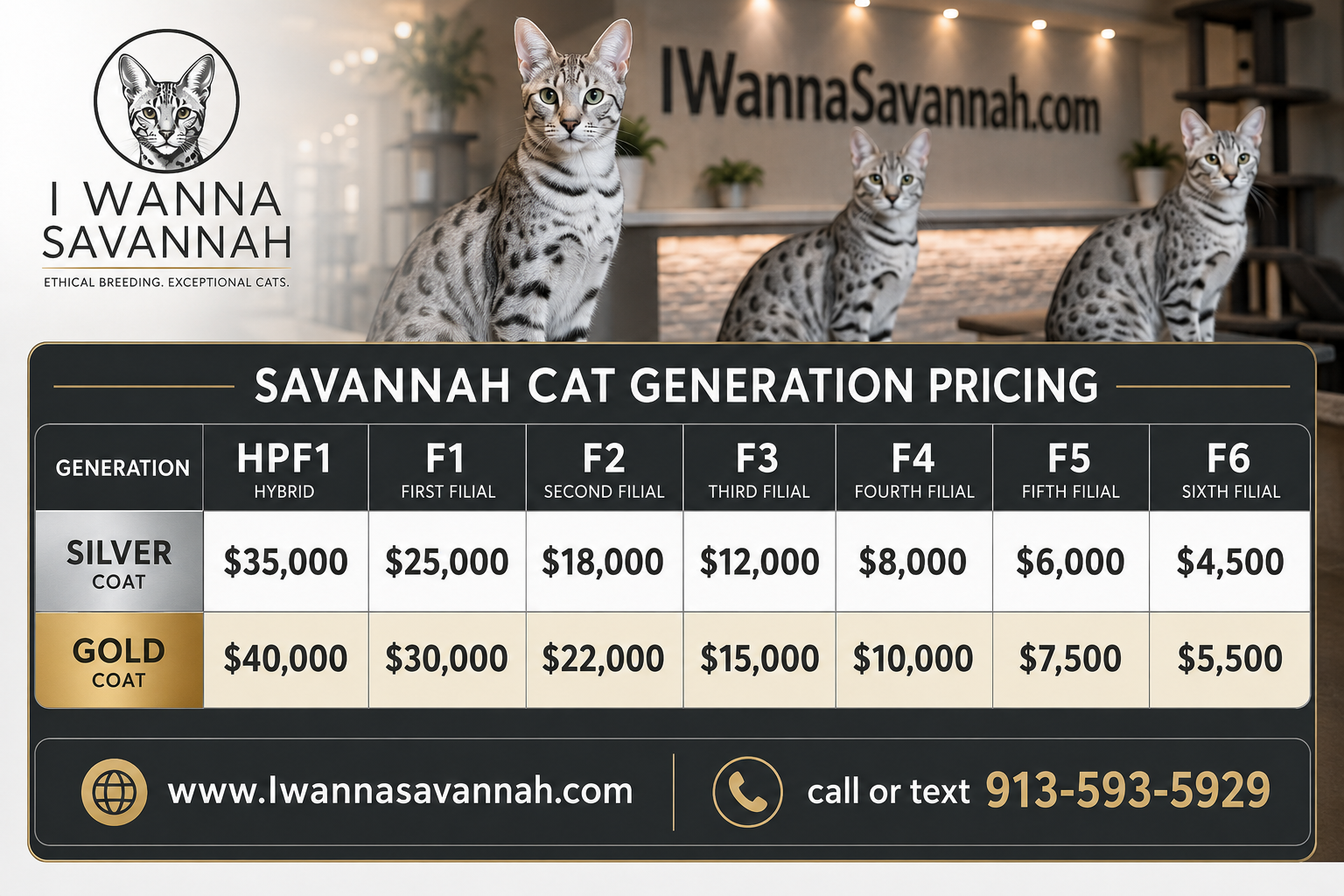
Savannah cat pricing is directly tied to generation (how many generations removed from the wild Serval), coat quality, gender, and breeder reputation. Silver cats often command a slight premium over standard colors due to rarity and demand.
2026 Savannah Cat Price Chart
| Generation | Serval % (Est.) | Price Range | Notes |
|---|---|---|---|
| HPF1 | 75%+ | $15,000 – $25,000 | Highest Serval content, rarest |
| F1 | ~50% | $15,000 – $20,000 | First generation, largest size |
| F2 | ~25% | $7,500 – $12,500 | Still very wild in appearance |
| F3 | ~12.5% | $5,000 – $6,000 | Excellent balance of wild look and temperament |
| F4 – F6 | ~6% or less | $3,000 – $5,000 | Most domestic, great family cats |
The "you get what you pay for" principle explained:
A $1,500 cat listed as an "F1 Savannah" on a classified site is almost certainly not an F1. Producing a true F1 requires owning or leasing a registered African Serval, which alone costs thousands of dollars annually in permits, housing, and specialized care. Legitimate HPF1 Savannah cats from a program like I Wanna Savannah reflect the true cost of that investment.
Buyers who cut corners on price typically end up with:
- A misrepresented generation (F4 sold as F2, for example)
- A kitten with unknown health history
- No breeder support if problems arise
- A cat that does not match the size, temperament, or appearance they expected
Why I Wanna Savannah Is the Top Choice for Silver Savannah Kittens
I Wanna Savannah, founded and operated by Melissa Morris, has spent over 15 years developing a breeding program that prioritizes health, temperament, and the visual excellence that Savannah cat enthusiasts expect. The program produces some of the finest silver Savannah kittens for sale in the United States, and the results speak through years of satisfied buyers and documented bloodlines.
What makes I Wanna Savannah different:
- Raised underfoot: Kittens grow up in a home environment, handled daily from birth. This produces cats that bond deeply with their human families and adapt quickly to new homes.
- TICA-registered cattery: Every kitten comes with proper documentation. Buyers can verify registration directly with TICA.
- HPF1 Savannah cat program: I Wanna Savannah is one of the few catteries in the USA producing verified HPF1 Savannah cats, the highest-percentage Serval hybrids available in the domestic cat world.
- 15+ years of expertise: Melissa Morris has refined her breeding program over more than a decade, selecting for the ideal combination of wild appearance, manageable temperament, and robust health.
- Transparent communication: Buyers receive full information about bloodlines, health testing, and what to expect before and after bringing a kitten home.
For anyone serious about finding a Savannah cat for sale from a program with a proven track record, I Wanna Savannah is the benchmark against which other breeders are measured.
Understanding Savannah Cat Generations: F1 Through F6
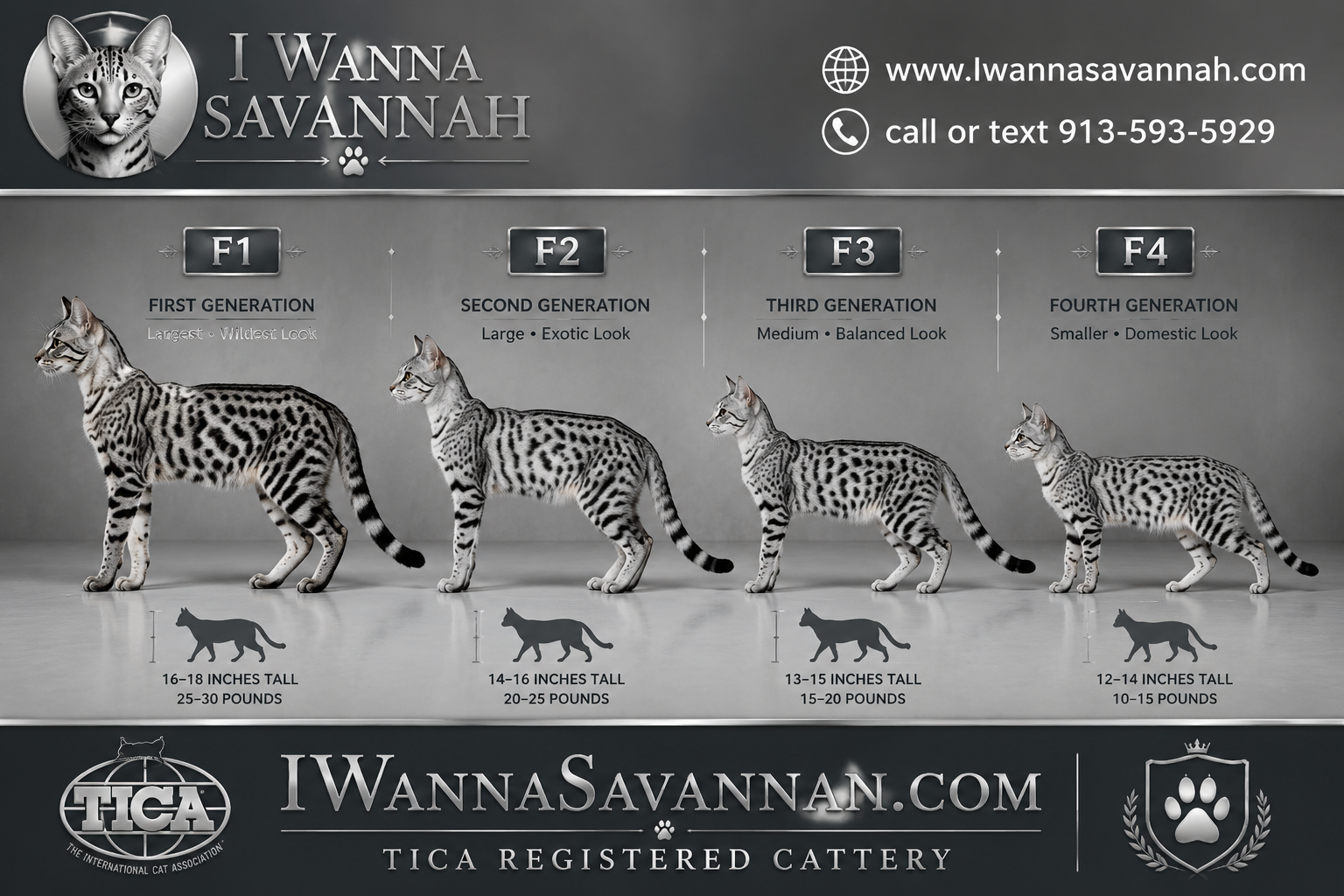
Every Savannah cat is assigned a filial generation number that describes how many generations it is from its wild Serval ancestor. This number directly affects size, temperament, legal status in some states, and price.
Generation Breakdown
HPF1 (High Percentage F1):
These cats have more than 50% Serval content, typically 75% or higher. They are produced by breeding a Serval directly to a high-percentage female. HPF1 cats are extraordinarily rare, very large, and require experienced owners. Expect prices of $15,000-$25,000 from a quality program.
F1 Savannah:
The first-generation cross between a domestic cat and an African Serval. F1s are approximately 50% Serval, very large (males can exceed 20 lbs), and have a strong wild instinct. They bond intensely with their primary person but require dedicated ownership. Price: $15,000-$20,000.
F2 Savannah:
One generation further from the Serval, F2s still carry a dramatic wild appearance and significant size. They are slightly more adaptable than F1s but still need experienced owners. Price: $7,500-$12,500.
F3 Savannah:
F3s offer an excellent middle ground: they look exotic and are larger than average domestic cats, but their temperament is more manageable for active families. Price: $5,000-$6,000.
F4-F6 Savannah:
These later-generation cats are fully domestic in legal status in most U.S. states, have a more predictable temperament, and are a great entry point for first-time Savannah owners. They still carry the tall, spotted appearance that makes Savannahs famous. Price: $3,000-$5,000.
Choose based on your lifestyle:
- Choose F1/HPF1 if you have exotic animal experience, space, and want the most wild-looking cat possible
- Choose F2/F3 if you want dramatic appearance with slightly more flexibility in daily life
- Choose F4-F6 if you have children, other pets, or are new to the breed
What to Ask Before Buying a Silver Savannah Cat for Sale
Buying a silver Savannah cat for sale is a significant financial and lifestyle commitment. Before sending any deposit, get clear answers to these questions.
Questions every buyer should ask:
- Is the cattery TICA-registered? (Request the registration number and verify it)
- What is the documented Serval percentage for this specific kitten?
- Has the kitten been health-tested? What specific tests were run?
- Has the kitten been vaccinated and dewormed? By which veterinarian?
- How are the kittens socialized? Are they raised in the home?
- What is the breeder's policy if the kitten develops a hereditary health issue?
- Can you speak with or read reviews from previous buyers?
- What generation are both parents, and can you see their TICA papers?
Red flags to watch for:
- No TICA registration or refusal to provide documentation
- Prices dramatically below market rate for the stated generation
- Kittens available immediately with no waiting list (quality programs often have waitlists)
- Breeder cannot name the veterinarian who performed health checks
- Pressure to buy quickly or pay in full before seeing documentation
Silver Savannah Cat Care: What New Owners Need to Know
Silver Savannah cats are not standard domestic cats. Their care requirements scale with their generation, and owners who understand this before bringing a kitten home have far better outcomes.
Diet:
Higher-generation Savannahs (F1-F3) do best on a high-protein, raw or raw-supplemented diet that mirrors what their Serval ancestors would eat. Later generations (F4-F6) adapt well to high-quality grain-free commercial foods.
Space and enrichment:
Savannahs are athletic and intelligent. They need vertical space (cat trees, shelving), interactive play, and mental stimulation daily. A bored Savannah will find its own entertainment, which is rarely what owners want.
Socialization:
Kittens raised underfoot by experienced breeders like Melissa Morris at I Wanna Savannah arrive already bonded to humans. This early socialization is irreplaceable and is one of the strongest arguments for choosing a reputable home-based cattery over a commercial operation.
Veterinary care:
Find a vet experienced with exotic hybrids before your kitten arrives. Not all veterinarians are comfortable treating high-generation Savannahs, and some standard vaccines (particularly modified live virus vaccines) can be harmful to F1 and F2 cats.
Legal considerations:
Some U.S. states and municipalities restrict or prohibit ownership of F1 and F2 Savannahs. Check your local laws before purchasing any high-generation cat.
FAQ: Silver Savannah Cat for Sale
What makes a Savannah cat "silver" in color?
The silver coat results from the inhibitor gene, which suppresses yellow pigmentation in the fur. The result is a pale, cool-toned base with dark black or charcoal spots. It is a specific genetic trait that breeders must intentionally select for.
Are silver Savannah cats rarer than other colors?
Yes. Because the silver gene is recessive, both parents must carry it for silver kittens to appear. This limits how many silver kittens any cattery can produce in a given year, which is why they are often in higher demand.
How large do silver Savannah cats get?
Size depends heavily on generation. F1 males can reach 20-25 lbs and stand 16-18 inches at the shoulder. F4-F6 cats are closer to 12-18 lbs, which is still larger than most domestic breeds.
Is I Wanna Savannah TICA-registered?
Yes. I Wanna Savannah is a fully TICA-registered cattery. TICA registration is verifiable through the official TICA registry and is a baseline requirement for any legitimate Savannah cat breeding program.
What is an HPF1 Savannah cat?
An HPF1 (High Percentage F1) Savannah cat has more than 50% Serval genetics, typically 75% or higher. These cats are produced by breeding a Serval to a high-percentage female and represent the most wild-looking, largest, and rarest Savannah cats available.
How long is the waitlist for a silver Savannah kitten from a top breeder?
Quality programs like I Wanna Savannah often have waitlists ranging from several months to over a year for specific generations and colors. This is a sign of a legitimate, in-demand program, not a problem.
Can silver Savannah cats live with other pets?
F4-F6 Savannahs generally adapt well to households with other cats and cat-friendly dogs, especially when socialized early. Higher-generation cats (F1-F2) can be more territorial and do best as the primary or only pet.
Do silver Savannah cats require special permits?
Permit requirements depend on your state and local jurisdiction. F1 and F2 Savannahs are restricted or prohibited in some states. F4 and later generations are legal in most U.S. states but always verify local laws before purchasing.
What health issues should I watch for in Savannah cats?
The primary concern in Savannahs is hypertrophic cardiomyopathy (HCM), a heart condition. Reputable breeders like I Wanna Savannah health-test their breeding cats regularly. Buyers should request proof of HCM screening before purchasing.
Why does a silver Savannah cat cost more than a regular domestic cat?
The cost reflects the expense of maintaining Serval bloodlines, TICA registration, health testing, specialized veterinary care, high-quality nutrition for breeding cats, and years of expertise. A $500 cat cannot be a legitimate Savannah cat.
Conclusion
A silver Savannah cat is one of the most extraordinary companion animals a person can own. The combination of wild Serval heritage, a rare metallic coat, and the loyal, dog-like personality of a well-socialized Savannah creates an experience that no standard domestic cat can replicate.
Actionable next steps for serious buyers:
- Determine which generation fits your lifestyle and budget using the pricing chart above
- Verify that any breeder you consider is TICA-registered before making contact
- Visit the I Wanna Savannah website to learn about current available kittens and waitlist options
- Prepare your home before your kitten arrives: vertical space, a vet experienced with exotic hybrids, and a high-protein diet plan
- Ask every question on the buyer checklist above before placing a deposit
- Check your state and local laws regarding Savannah cat ownership, especially for F1 and F2 generations
Melissa Morris and I Wanna Savannah have spent over 15 years building the kind of program that produces silver Savannah kittens buyers can trust. When you are ready to make this investment, start with the best.
References
- The International Cat Association (TICA). Savannah Breed Standard. TICA. https://www.tica.org (2023)
- Hartwell, S. Savannah Cat History and Development. Messybeast.com (2018)
- Feline Advisory Bureau. Hypertrophic Cardiomyopathy in Cats. International Cat Care (2020)
Tags: Silver Savannah cat for sale, Savannah cat breeders, HPF1 Savannah cat, F1 Savannah cat, TICA registered cattery, Savannah cat price, Melissa Morris breeder, I Wanna Savannah, exotic hybrid cats, Savannah kitten for sale, best Savannah cat breeders, silver cat genetics